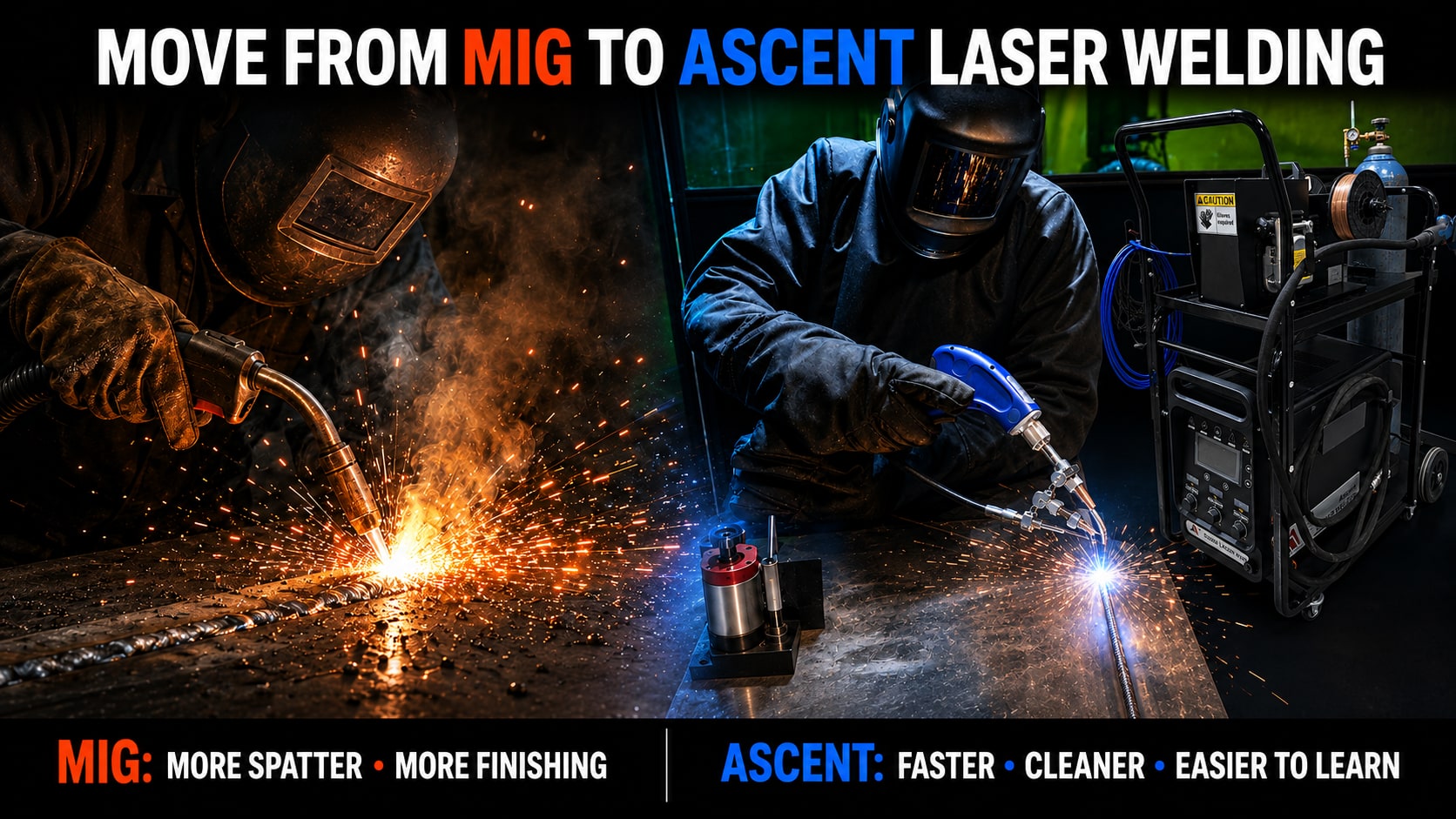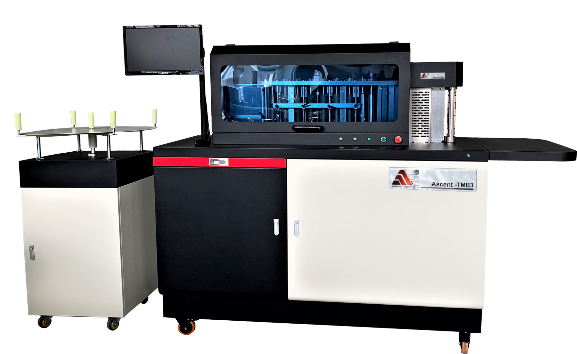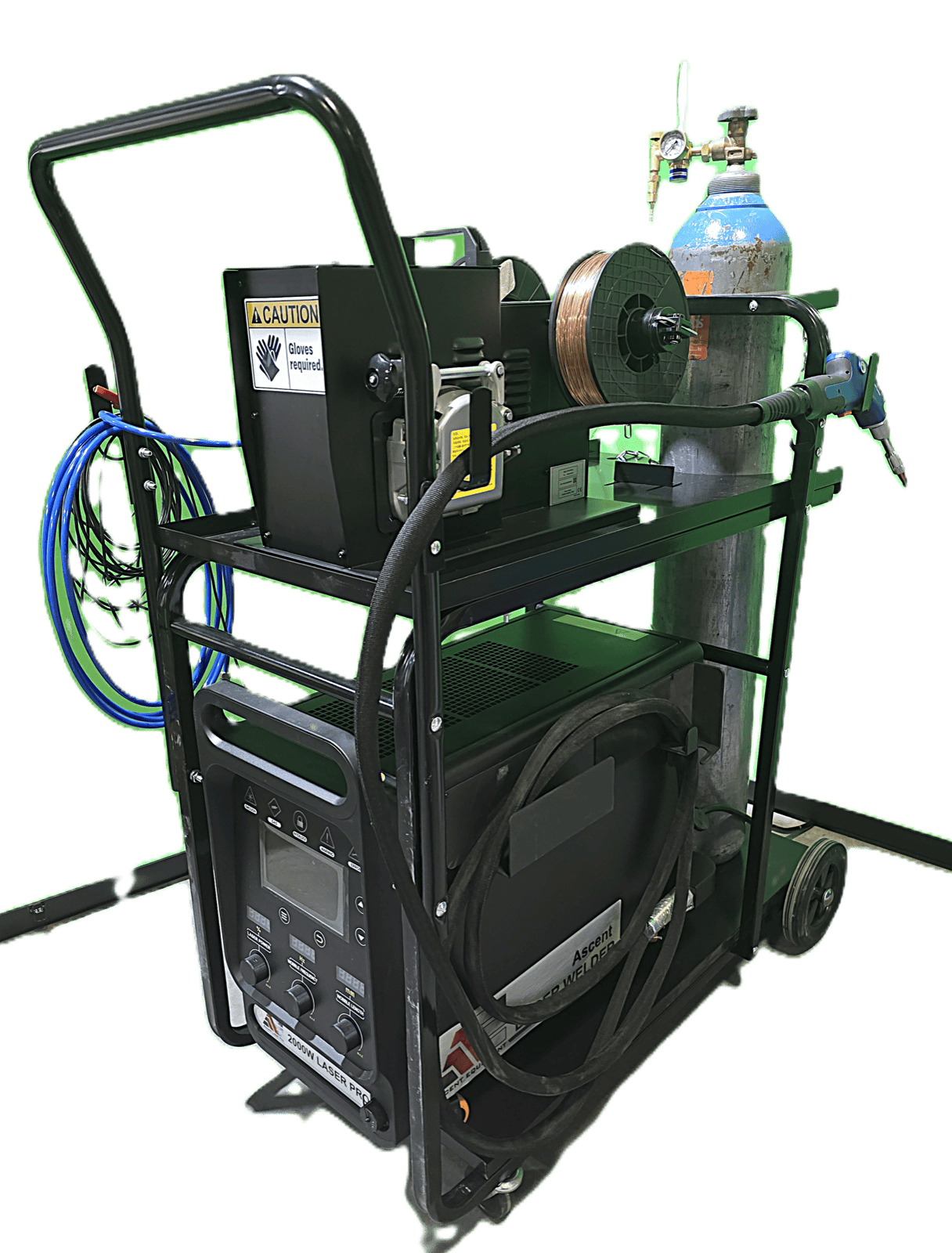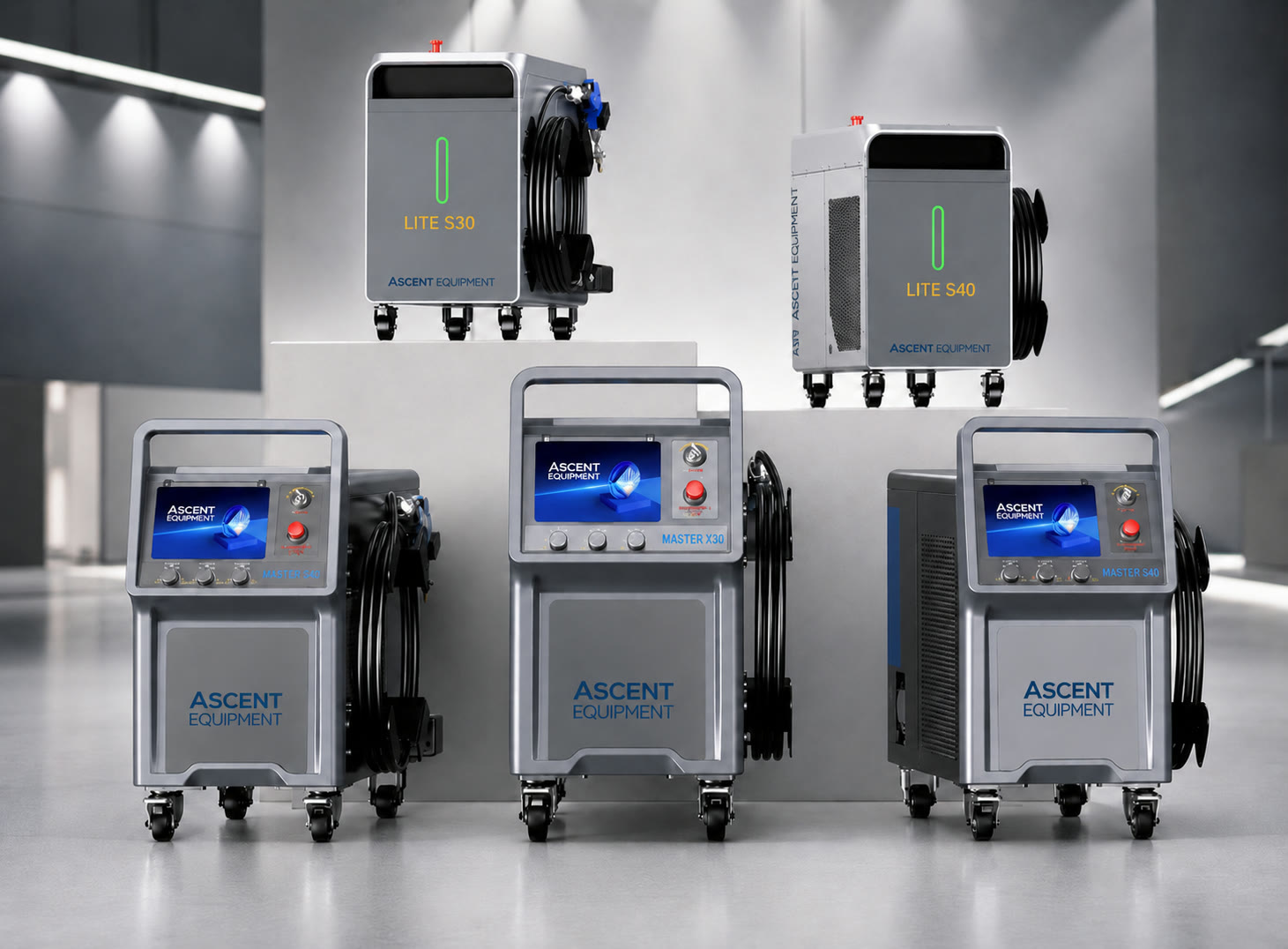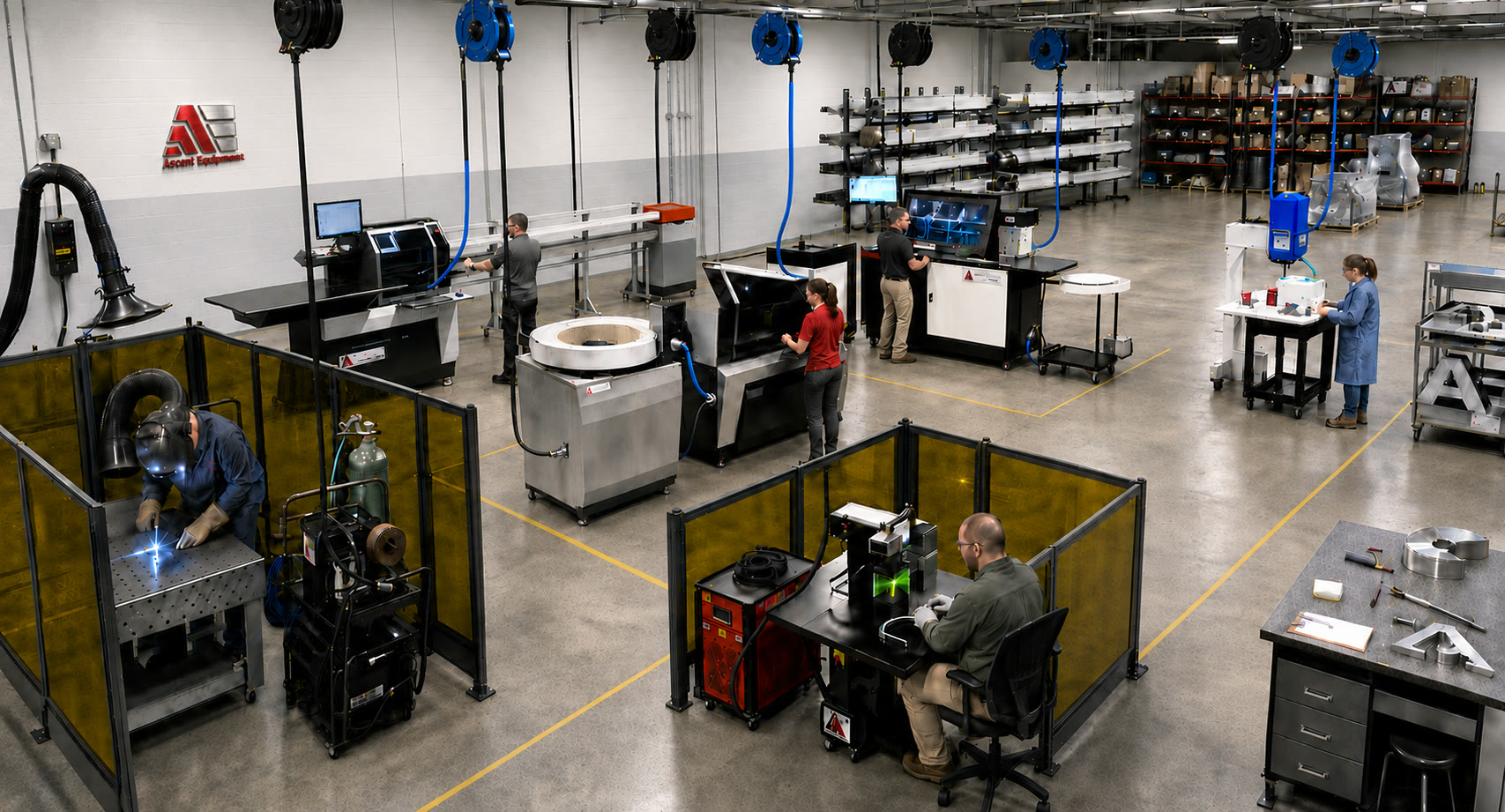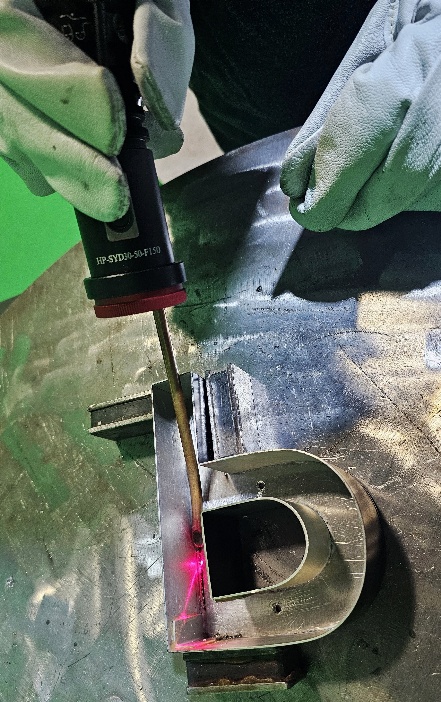

The Ascent QCW Laser Welder is available in both tabletop and handheld configurations. Safety requirements for this system are similar to those for any open-beam Class 4 fiber laser — but the Quasi-Continuous Wave (QCW) operating mode introduces additional considerations. QCW lasers deliver very high peak-power pulses that, even at lower average power than a continuous-wave (CW) system, can cause permanent eye injury, skin burns, and fire.
ANSI Z136.1, ANSI Z136.9, OSHA, and AWS all classify these systems as Class 4 laser equipment and require comprehensive safety controls.
1. Laser Classification
- Class 4 Fiber Laser
- Infrared wavelength — typically 1064–1080 nm
- Invisible beam — there is no visible light to warn the operator
- Direct and reflected beams can cause permanent eye damage
- Diffuse reflections from metal surfaces can also pose hazards at close range
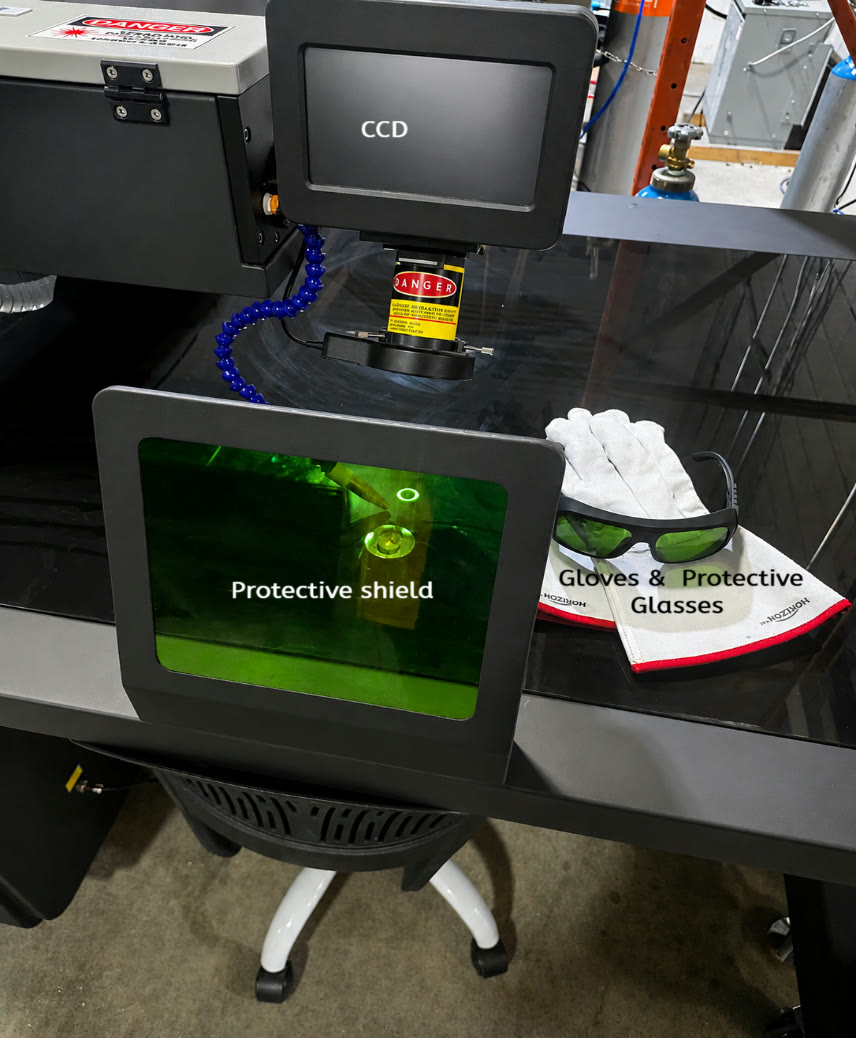
The Ascent QCW includes a CCD camera system so the operator views the weld on a monitor rather than looking directly at the beam. The machine also ships with a protective shield, leather gloves, and laser protective glasses.
2. Eye Protection — Highest Priority
Everyone within the controlled laser area must wear appropriate eye protection. The QCW beam is invisible, which eliminates the natural blink reflex that provides some protection against visible light sources.
Required eyewear:
- Laser safety glasses designed for the welder's specific wavelength (~1064–1080 nm)
- Appropriate Optical Density rating — OD 6, 7, or 8 as specified by the laser manufacturer
- Certified to ANSI/ISEA Z136 or equivalent standard
Never rely on standard welding glasses. Welding shades are designed for arc welding brightness, not for fiber laser wavelengths.
3. Protective Clothing
Operators should wear:
- Flame-resistant clothing (optional — available from Ascent)
- Leather welding gloves (supplied with the machine)
- Long sleeves
Avoid:
- Reflective jewelry
- Watches
- Chrome or polished metal tools and accessories
Any reflective surface near the weld zone can redirect the beam unpredictably.
4. Controlled Laser Area
The welding area must be properly controlled:
- Prominent laser warning signs posted at entry points
- Access restricted to authorized personnel only
- Beam path maintained below eye level wherever practical
- Controlled entry enforced during laser operation
Where practical, use:
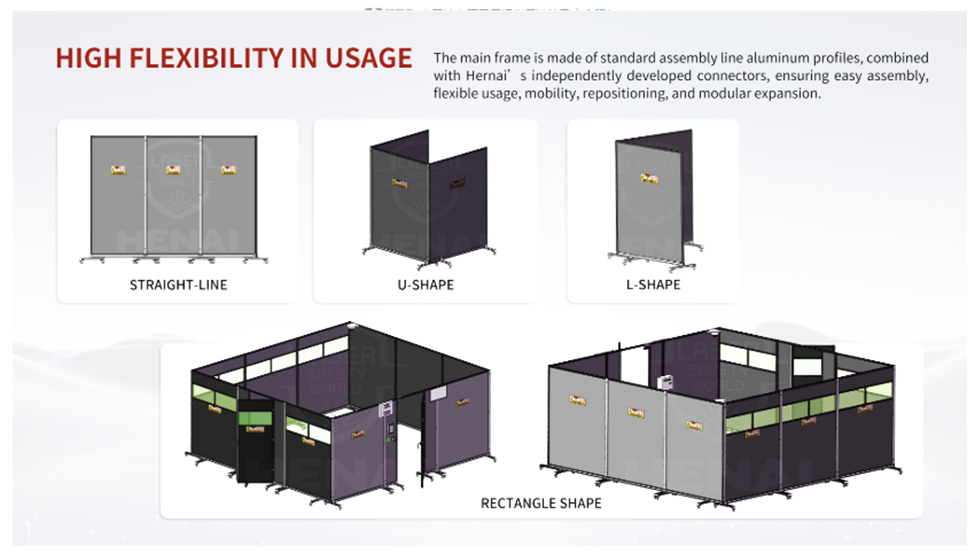
- Laser safety curtains
- A dedicated laser welding booth
- An enclosure or laser partition — available from Ascent, or built from any solid, non-reflective material
5. Reflection Hazards
The QCW welder is designed to process materials including stainless steel, aluminum, mild steel, and brass. All of these can produce hazardous reflections. Minimize uncontrolled beam angles by keeping the welding head properly positioned and avoiding awkward work angles that could redirect the beam toward people or combustibles.
6. Fire Prevention
Keep the following away from the welding area at all times:
- Paper and cardboard
- Plastic
- Solvents and aerosols
- Flammable liquids of any kind
Always have an ABC fire extinguisher accessible — CO₂ type is recommended. It should be within reach of the operator without requiring them to pass through the beam path.
7. Fume Extraction
Laser welding generates metal fumes, fine particulate, and metal oxides that must be captured at the source.
- Use local exhaust ventilation — not general room ventilation
- Position the fume extractor as close to the weld as practical
- Fume extraction systems are available from Ascent or from third-party suppliers
Do not rely on opening windows or doors to handle welding fumes.
8. Electrical Safety
Only trained, authorized personnel should:
- Service the laser
- Open electrical cabinets
- Replace components
Always:
- Disconnect power before any servicing
- Follow lockout/tagout (LOTO) procedures
- Verify proper grounding before operation
9. Cooling System
Daily checks should include:
- Coolant level (water-cooled systems)
- Water temperature
- Flow alarm function
- Hose condition and any signs of leaks
Maintain proper ventilation around the chiller unit.
10. Gas Safety
For shielding gas cylinders:
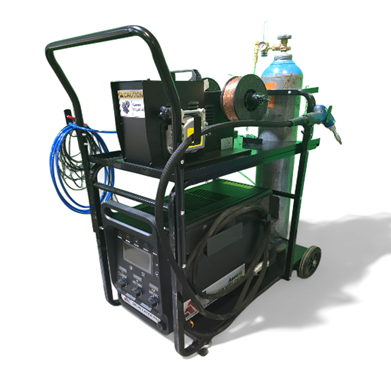
- Secure cylinders upright and chained to prevent tipping
- Inspect regulators and hoses before each use
- Check for leaks with approved leak-detection solution
- Ensure adequate room ventilation when shielding gas is in use
11. Daily Inspection Checklist
Before each operating session, verify:
- Laser safety glasses present and undamaged
- Emergency stop functional
- Beam delivery cable in good condition — no kinks, cuts, or abrasion
- Shielding gas supply adequate
- Welding head clean and properly seated
- Cooling system operating at correct temperature
- Warning lights functioning
- Fume extractor operating
12. Emergency Procedures
Immediately stop operation if:
- Laser safety eyewear is damaged or lost
- A cooling alarm activates
- Unexpected beam reflections occur
- Smoke or fire develops
- The beam delivery cable is damaged
- The protective enclosure or shield is compromised
Know the location of the emergency stop before beginning any session.
13. Operator Training
Every operator must complete training that covers:
- Class 4 laser hazards
- Eye and skin protection requirements
- Beam reflection risks
- Fire hazards specific to laser welding
- Machine startup and shutdown procedures
- Emergency stop procedures
- Basic maintenance and inspection
- Safe work practices
Training must be documented and repeated periodically.
14. Laser Safety Officer (LSO)
Facilities operating Class 4 laser systems should designate a trained Laser Safety Officer responsible for:
- Conducting hazard assessments
- Developing and maintaining safety procedures
- Operator training and authorization
- PPE selection and inspection
- Periodic safety audits
- Ensuring ongoing regulatory compliance
ANSI Z136.1 and AWS guidance strongly recommend appointing an LSO for any Class 4 laser operation. Ascent Equipment recommends that the LSO receive certified training from an accredited facility.
Recommended Safety Equipment
| Item | Source |
|---|---|
| Certified laser safety glasses (1064–1080 nm, OD 6+) | Ascent or third-party supplier |
| Flame-resistant jacket | Available from Ascent |
| Leather welding gloves | Supplied with machine |
| Laser safety curtains or enclosed booth | Available from Ascent |
| Fume extraction system | Available from Ascent |
| Emergency stop button | Installed on machine |
| Fire extinguisher (ABC / CO₂) | Local supply |
| Laser warning signs | Already on machine |
Applicable Standards
For installations in the United States and Canada:
- ANSI Z136.1 — Safe Use of Lasers
- ANSI Z136.9 — Safe Use of Lasers in Manufacturing Environments
- OSHA Technical Manual — Laser Hazards
- AWS Fact Sheet No. 46 — Handheld Laser Welding Safety
- IEC 60825-1 — Safety of Laser Products
- ISO 11553-1 — Laser Processing Machine Safety
Ascent Equipment Safety Documentation Package
Every Ascent QCW Laser Welder comes with a complete safety documentation package:
- Operator Safety Manual
- Laser Safety Manual
- Daily Inspection Checklist
- Standard Operating Procedure (SOP)
- Laser Safety Officer Guide
- Emergency Response Procedure
- Training Sign-Off Form
- Maintenance Log
- PPE Selection Guide
This package is designed to help customers implement a structured safety program from day one.
The information provided is for educational purposes. It is the customer's responsibility to verify requirements with local authorities and regulatory bodies. Ascent Equipment highly recommends that the Laser Safety Officer receive professional training from an accredited facility.
Questions about the Ascent QCW Laser Welder or safety accessories? Contact us or visit the QCW Fiber Laser Welder product page.