
Call us: 1-800-927-5107 647-494-7800 ext. 1008

Ascent True Trimless vs. Adhesive-Bonded Systems

Both approaches eliminate the conventional plastic trim cap, but they get there through fundamentally different construction methods.

FeatureAscent True TrimlessThe competition's adhesive-bonded system
Face attachmentAcrylic or polycarbonate face is mechanically captured inside a built-in aluminum extrusion grooveFace and related components are joined primarily through an adhesive-bonding process
Structural principleIntegrated mechanical constructionBonded construction
Production setupCNC-bent extrusion, pneumatic fastening and mechanically seated faceRequires controlled adhesive application, positioning and curing
Assembly equipmentPneumatic gun and standard production tableAdhesive products and a positioning/magnetic table may be required
Operator variablesPrimarily machining accuracy and face-cutting toleranceAlso affected by surface preparation, adhesive quantity, alignment, temperature, and curing conditions
Face appearanceClean, flush front-lit face with no trim cap or exposed adhesive jointTrimless appearance produced through bonded components
IlluminationDesigned as a traditional front-lit letter without trim capConstruction may produce front, edge, or side illumination depending on the competition's specific profile
Material sourcingAscent states its UL/RU-recognized profiles are non-proprietary and may be sourced directly in volumeThe competition markets its proprietary material under the trade name LetterForm
Listed size capabilityAscent states cULus certification for indoor and outdoor letters up to 66 inches, subject to the certified constructionConfirm the applicable listing, construction, and size restrictions for each project

The essential difference

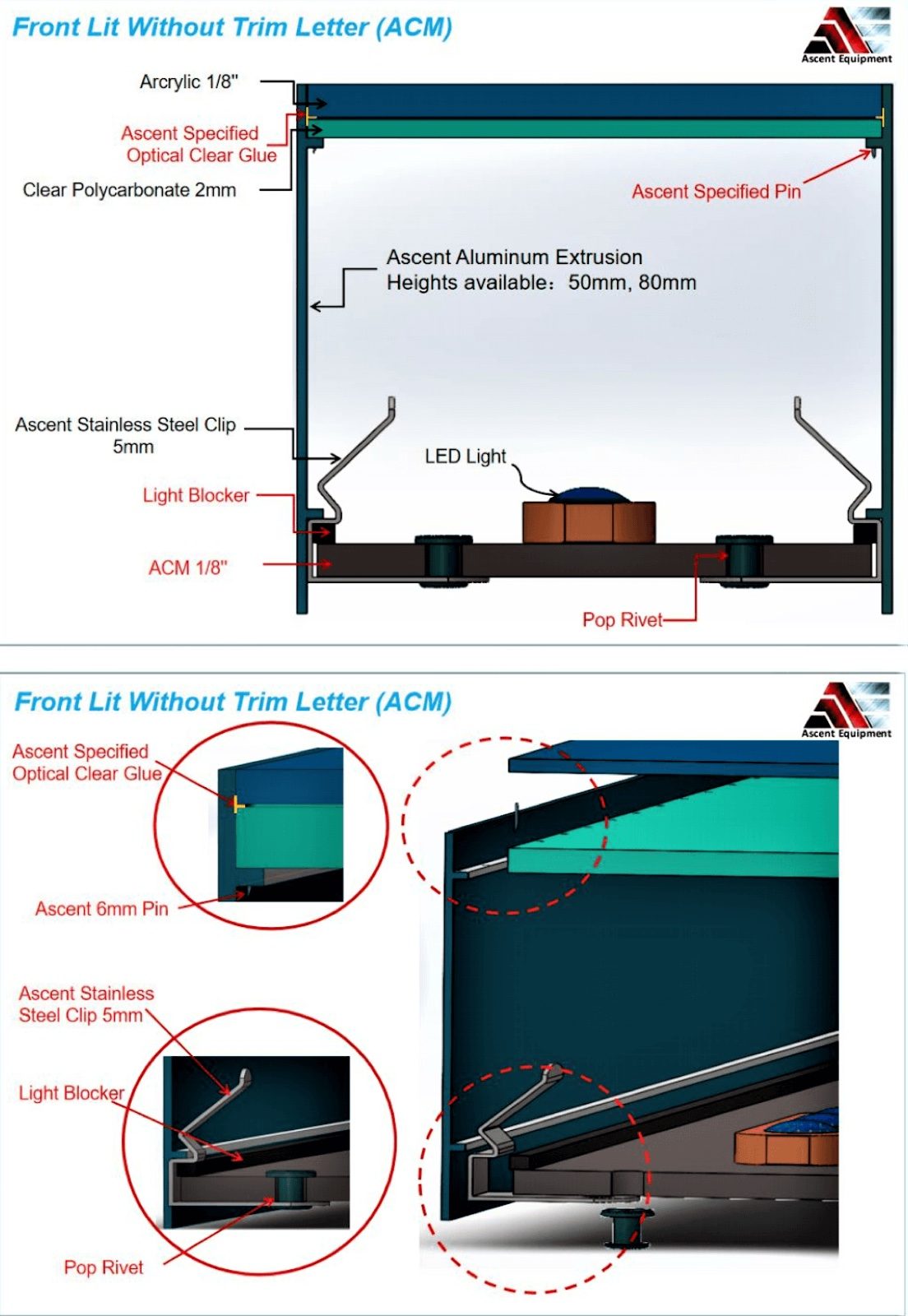
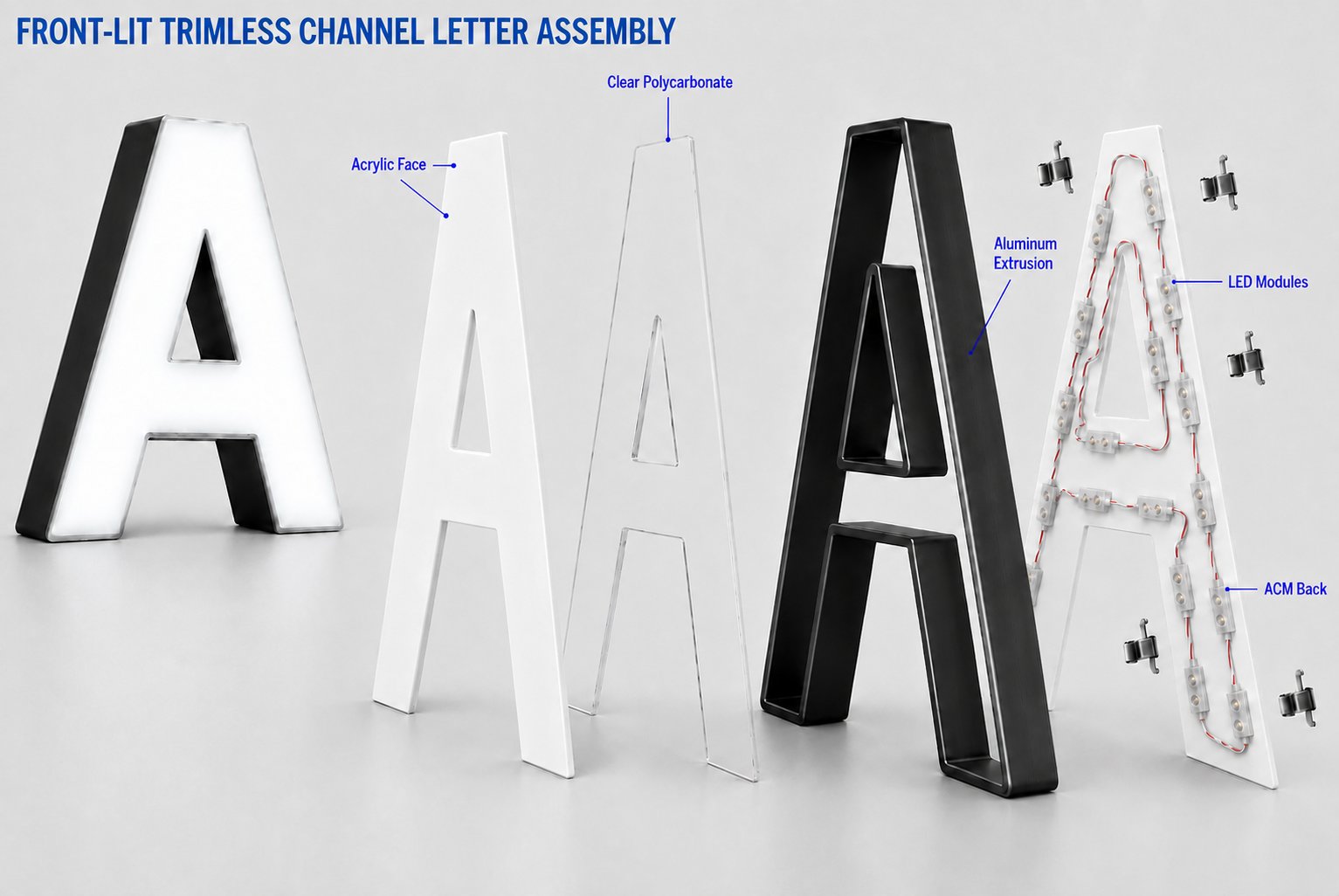
Ascent True Trimless is mechanically engineered, not created by simply gluing a face to the return. The Ascent aluminum extrusion incorporates a precision groove that captures the acrylic or polycarbonate face. The face becomes part of the letter's mechanical construction, producing a clean, flush, front-lit appearance without plastic trim cap or face-bonding adhesive.

The competition can also produce a trimless-looking letter, but their assembly relies more heavily on adhesive bonding and proprietary materials. That introduces additional process controls: surface preparation, adhesive application, positioning, and curing, all of which have to go right for a consistent, durable result.

Not every trimless letter is built the same way. Ascent's construction needs no trim cap and no adhesive to secure the face. An adhesive-bonded system's durability and consistency depend more heavily on getting that surface preparation, application, alignment, and curing right, every time, on every letter.

Both eliminate the trim cap. The real difference is that Ascent mechanically captures the face, while the competition relies on an adhesive-bonded construction to achieve the same look.

Ascent True Trimless construction is standard on the Ascent 5AS. Contact us if you want to walk through the difference on your own current jobs.

← All articles
More from Ascent

Related articles

Case Study: Trimless Signage for a National Supermarket Rollout
How Wholesale Sign Pro used the Ascent 4AS and Ascent extrusions to deliver trimless signage on schedule across a multi-location supermarket expansion.
How Laser Welding Lowers Aluminum Welding Labor Costs
Skilled aluminum TIG welders are expensive and hard to hire. Here's the wage data behind training a production employee on an Ascent laser welder instead.
How to Improve Productivity and Quality in Sign Manufacturing
A practical guide to standardizing engineering, materials, equipment, and production in sign manufacturing, without losing the flexibility custom work requires.
Channel Letter Sign Business Startup Costs and ROI Guide
A practical guide to starting a channel-letter sign business — core equipment costs, real production capacity, and how to estimate your payback period.
Ascent 2000W Handheld Fiber Laser Welder: Complete Overview
A complete look at the Ascent 2000W Handheld Fiber Laser Welder — refrigeration cooling, wobble-head welding, torch weight, and everything included.
Best Handheld Laser Welder for Sign Shops: A Buyer’s Guide
What to look for in a handheld laser welder for sign shops and channel letters: power, cooling, wire feeder, torch weight, and warranty compared.
Two Ascent Machines vs. One Premium Bending Machine
Why two specialized Ascent bending machines often cost less than one premium competitor machine, and cover more construction methods combined.
True Trimless Channel Letters: Ascent vs. the Competition
How Ascent's true front-lit trimless channel letters differ from adhesive-bonded, edge-lit systems that other manufacturers also market as trimless.
QCW vs. CW Tabletop Fiber Laser Welders: Which Is Safer?
QCW pulsed lasers reduce heat, distortion, and burn-through on thin aluminum and stainless letters versus CW — but both remain Class 4 laser hazards.
Ascent TMB-3 Aluminum Trim vs. Ascent 5AS F-Trim
Ascent TMB-3 forms economical flat aluminum coil with PVC backing into trim-cap-style trim. Ascent 5AS processes a premium F-trim profile requiring polycarbonate.
How to Set Up a Laser Welding Workstation
A setup guide for handheld laser welding stations — table height, fixturing, fume extraction, safety zone layout, and cable management.
How to Train a Channel Letter Fabricator
Labor is the #1 cost in channel letter production. A guide to hiring the right person and realistic timelines for each machine in the workflow.
Laser Welder Fit-Up and Gap Control
A gap between welded parts isn't just a defect — it's a beam transmission hazard. How to achieve proper fit-up and fixture parts correctly.
Materials That Block a 1070nm Fiber Laser Beam
Not every material stops a fiber laser beam. Which flexible and rigid materials absorb or reflect 1070nm energy, and how to use them safely.
Laser Welder vs. MIG and TIG: Convincing Your Welder
An experienced welder's skepticism about switching to laser is rational. How to address it honestly — performance, safety, and the close.
How to Make a Channel Letter — The Ascent Way with Ascent TMB-3
A step-by-step walkthrough of building a channel letter with the Ascent CNC Router, Ascent TMB-3, and Stapler — including how Ascent TMB-3 saves 20–50% on material.
How to Make a Channel Letter — The Ascent Way with Ascent EDGE-3
A step-by-step walkthrough of building a channel letter with the Ascent CNC Router, Ascent EDGE-3, and Stapler — faster and more accurate than hand methods.

Let Ascent Experts Assemble All the Pieces of The Equipment Puzzle for your Company

Contact us