Laser Cleaning
Option one: Continuous Wave (CW) fiber laser cleaning — rust, paint, oxide & oil removal
Option two: Pulse laser cleaner for delicate parts that need less heat
Continuous Wave laser cleaning — no chemicals, no abrasives
Fiber laser cleaning removes rust, paint, oxides, and oil with amplified light. Non-contact and non-abrasive — with the right settings, the base metal is left largely unchanged.
- Eco-friendly — no chemicals, solvents, or blasting media
- Gentle on the part — with settings tested on your material, the base metal is left largely unchanged
- Low operating cost — no blasting media or chemicals to buy
- Precise — clean intricate geometries and targeted zones
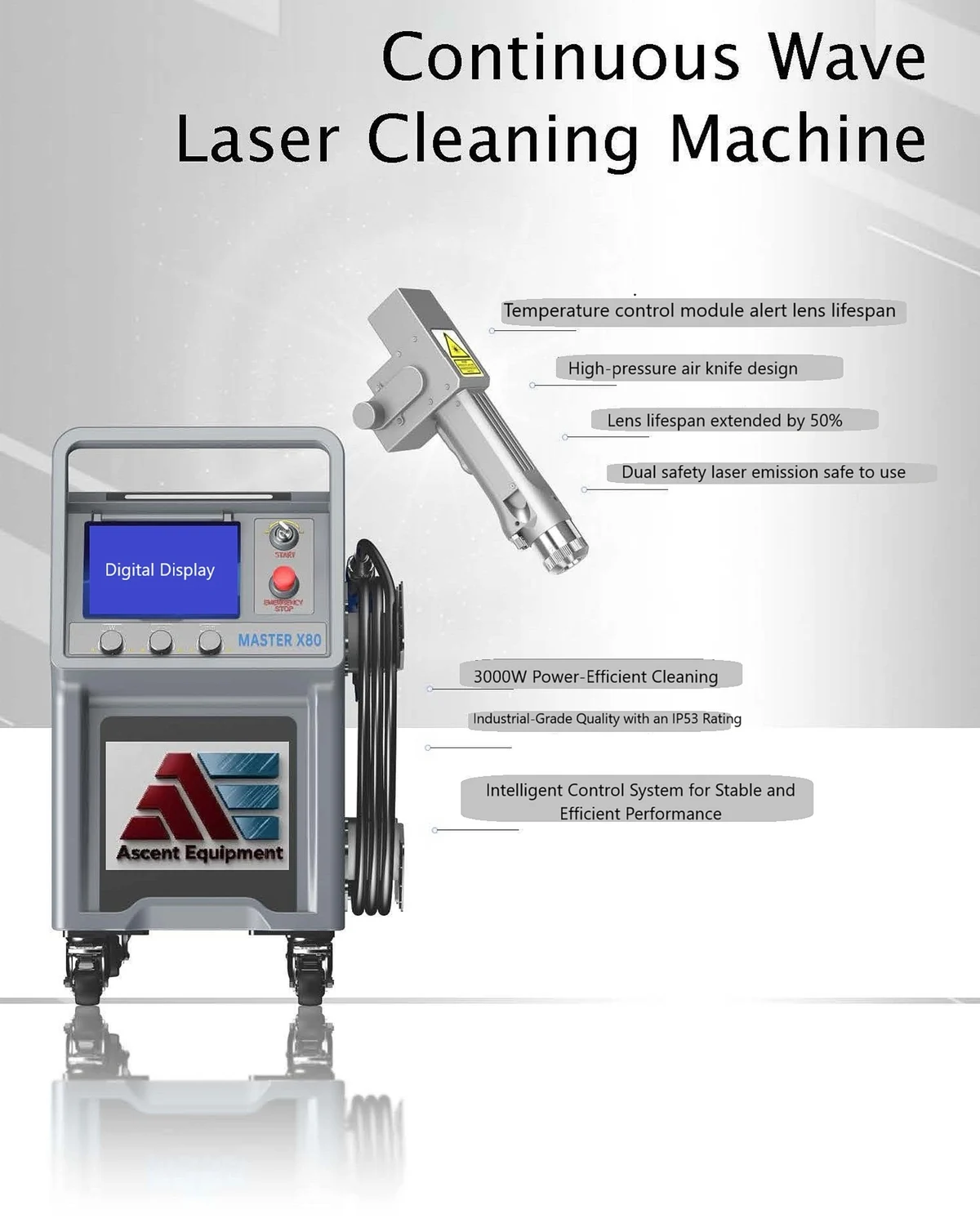
- Models from 1500W to 3000W (MASTER X50 / X60 / X80)
- Industrial-grade IP53 with intelligent control system
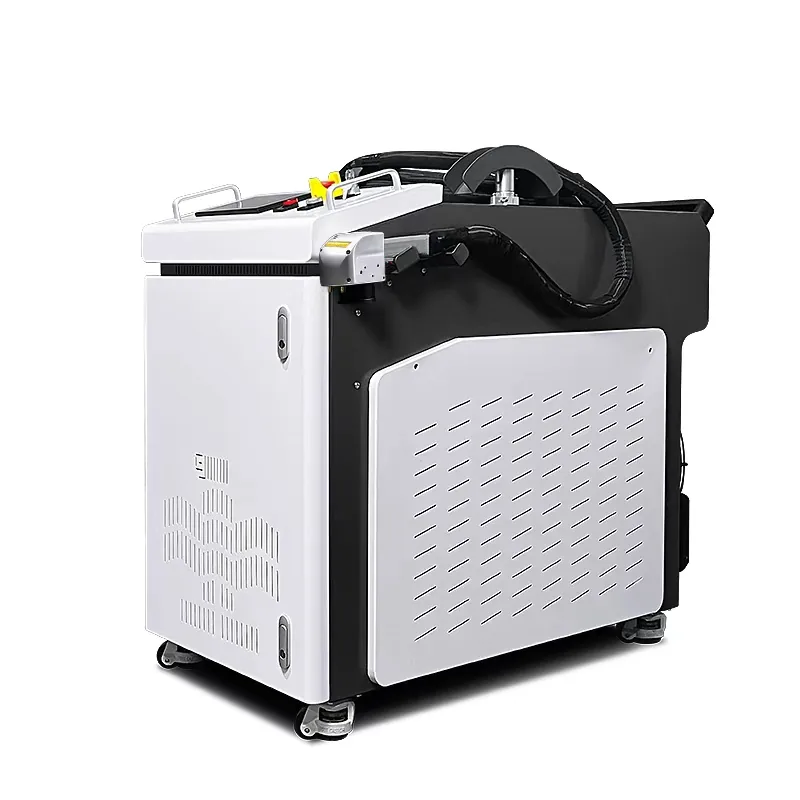
Water Cooling 500W and 1000W Fiber Laser Cleaner
500W and 1000W Handheld Pulsed Fiber Laser Cleaning Systems Water-cooled pulsed laser cleaning for industrial maintenance and precision surface preparation.
- High cleaning efficiency
- Minimal substrate damage
- Manual or extended automatic cleaning
Industrial Cleaning Without Abrasive Media
A non-contact process for rust, paint, oil, oxide, and residue removal.
Key capabilities
- 360-degree cleaning access for complex surfaces
- Stable pulsed output for controlled material removal
- Nine scanning patterns for different cleaning tasks
- Ergonomic handheld operation for large workpieces
- Water cooling for continuous industrial operation
Typical Industries
Transportation and rail, mold manufacturing, aerospace, electronics, automotive manufacturing, nuclear and military, new energy and lithium battery, new materials, tire manufacturing, and petrochemical.
Technical Specifications
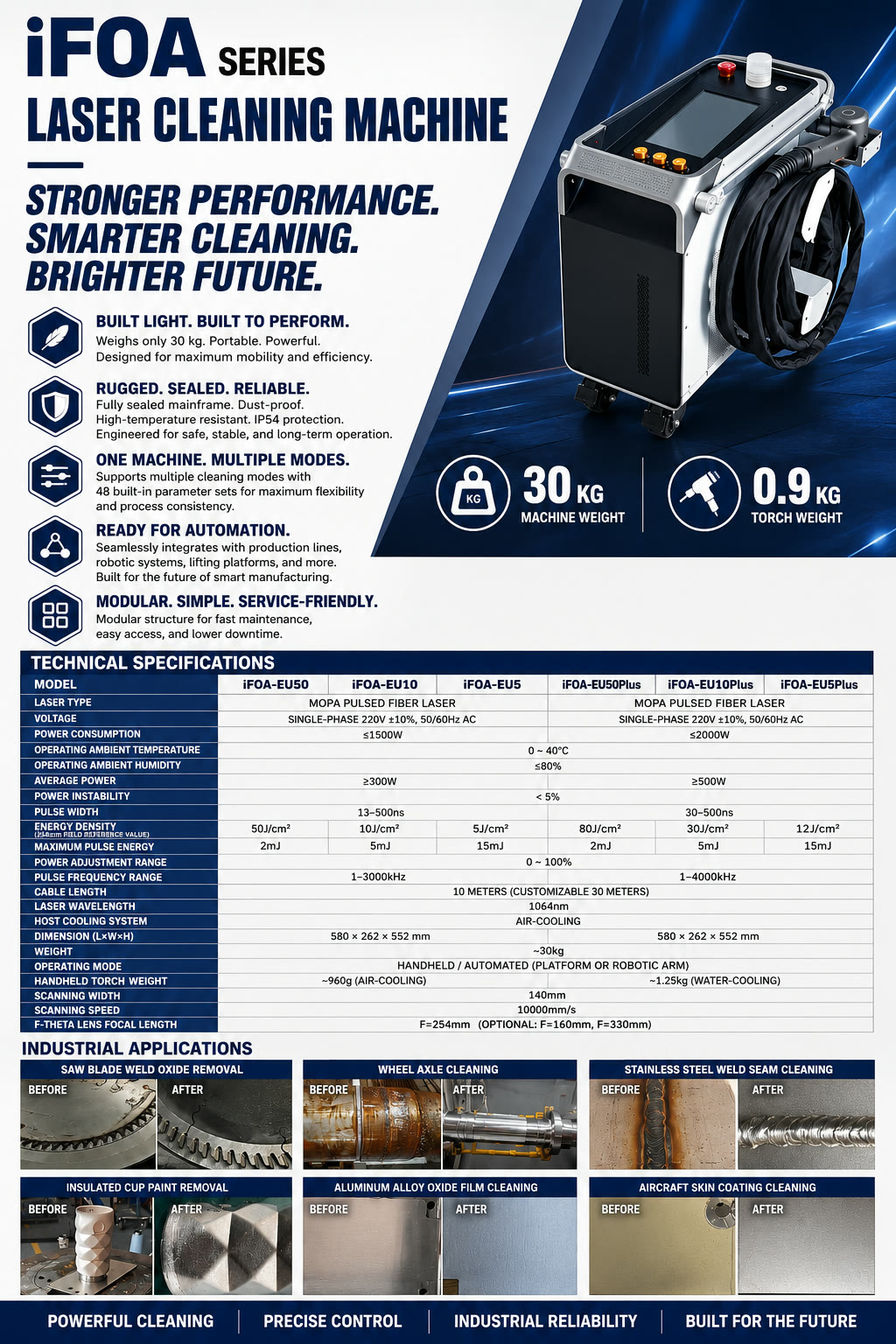
Metric values are followed by US customary conversions in parentheses.
| Specification | 500W system | 1000W system |
|---|---|---|
| Laser power | 500W | 1000W |
| Laser operating mode | Pulsed | |
| Pulse duration | 30 – 500 ns | |
| Pulse energy | 15 mJ or 50 mJ depending on application | |
| Pulse frequency | 1 – 4000 kHz | |
| Fiber cable length | 10 m (32.8 ft) | |
| Cooling method | Water cooling | |
| Scanning width | 0 – 145 mm (0 – 5.71") | 0 – 250 mm (0 – 9.84") |
| Scanning modes | 9 modes | |
| Scanning frequency | ≥ 300 Hz | |
| Standard focal distance | 254 mm (10.00") | 300 mm (11.81") |
| Optional focal distances | 160 / 210 / 330 / 420 mm (6.30" / 8.27" / 12.99" / 16.54") | 160 / 210 / 254 / 500 / 600 mm (6.30" / 8.27" / 10.00" / 19.69" / 23.62") |
| Cleaning gun weight | 1.5 kg (3.31 lb) | |
| System languages | English | |
| Process data | Available | |
| Machine weight | 150 kg (330.7 lb) | 168 kg (370.4 lb) |
| Machine dimensions | 135 × 70 × 122 cm (53.15" × 27.56" × 48.03") | |
| Power supply | AC 220V, 60Hz | |
| Power consumption | ≤ 4000W | ≤ 6000W |
| Work environment | 0°C to 40°C (32°F to 104°F), humidity ≤ 80% | |
Ergonomic Handheld Cleaning Gun
Designed for flexible operation and continuous industrial use.
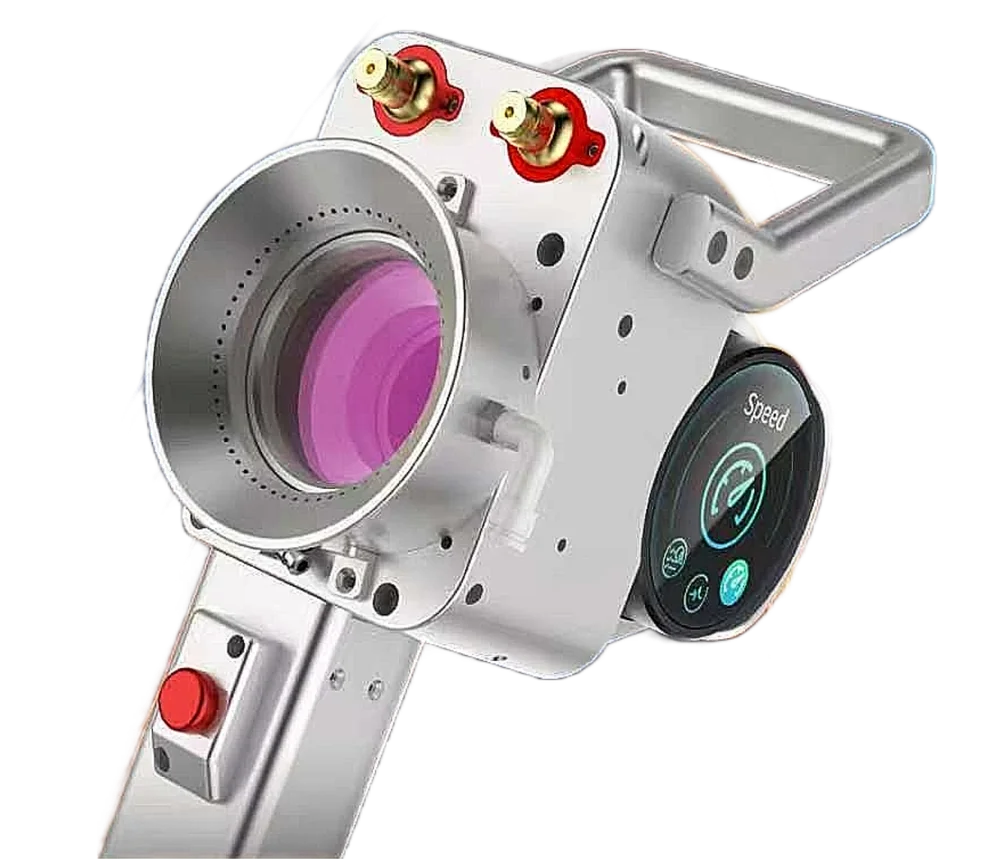
Features Distance indicator, strap hook, handle bar, focusing lens, operation display, and switch button.
The red-light aiming function helps the operator locate the focus position. The optical and cooling design supports extended operation when the equipment is used and maintained according to Ascent Equipment procedures.
New Upgrade Gun
Newly upgraded knob screen control for the 1000W pulsed laser cleaning system.
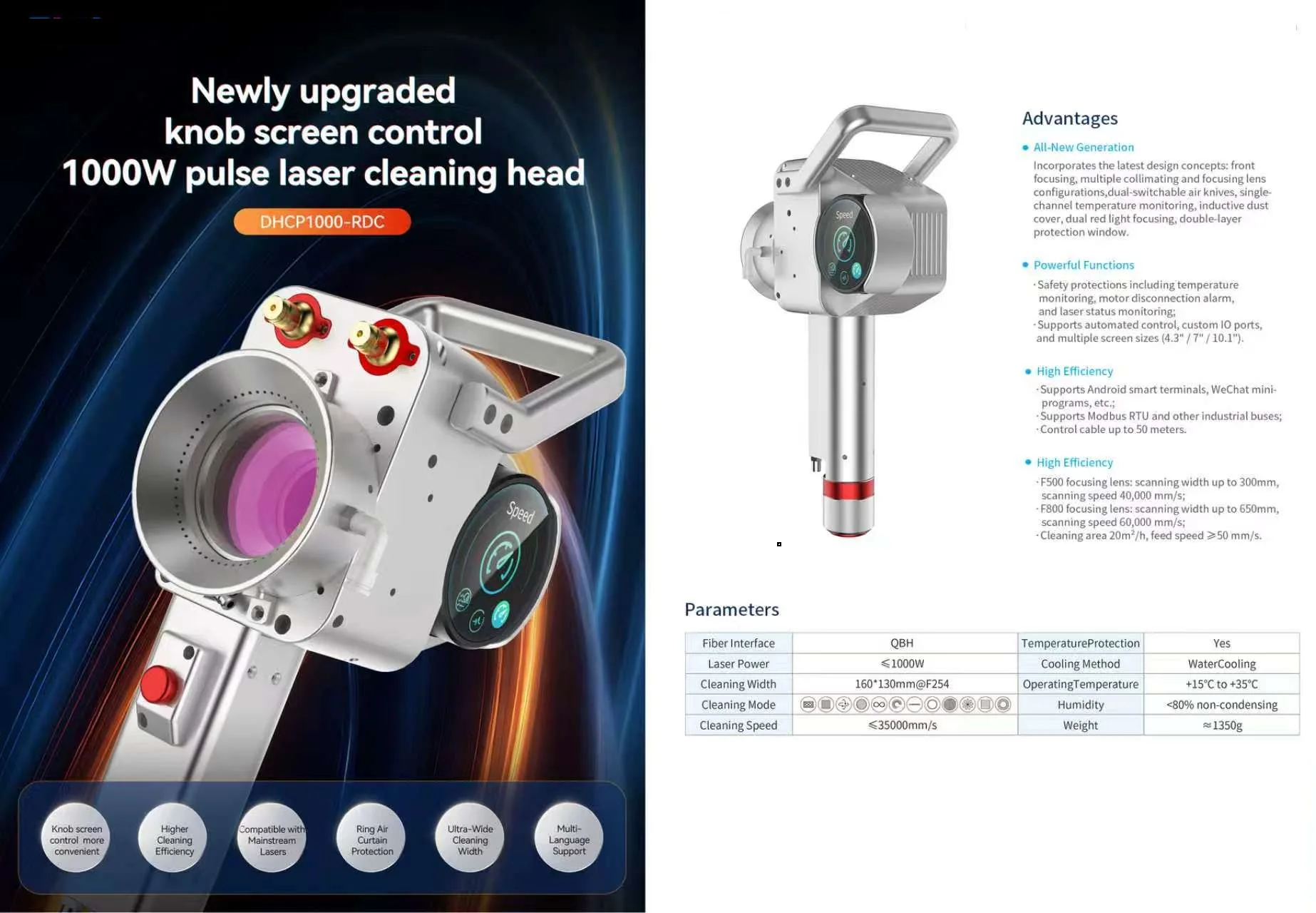
US conversions of the metric values shown in the product image
| Value shown in the image | US conversion |
|---|---|
| Control cable up to 50 m | 164 ft |
| F500 lens: scanning width up to 300 mm | 11.81" |
| F500 lens: scanning speed 40,000 mm/s | 1,574.80 in/s |
| F800 lens: scanning width up to 650 mm | 25.59" |
| F800 lens: scanning speed 60,000 mm/s | 2,362.20 in/s |
| Cleaning area 20 m²/h | 215 sq ft/h |
| Feed speed ≥ 50 mm/s | ≥ 1.97 in/s |
| Cleaning width 160 × 130 mm at F254 | 6.30" × 5.12" |
| Cleaning speed ≤ 35,000 mm/s | ≤ 1,377.95 in/s |
| Operating temperature 15 – 35°C | 59 – 95°F |
| Weight about 1,350 g | about 2.98 lb |
| Focal lengths F254 / F500 / F800 (254 / 500 / 800 mm) | 10.00" / 19.69" / 31.50" |
Cleaning Applications
Suitable for controlled cleaning and surface preparation across varied industrial tasks.
Rust removal
Carbon steel, internal walls, machinery, and fabricated components
Paint and coating removal
Metal surfaces, localized stripping, and maintenance preparation
Oil and grease removal
Gears, solidified oil, machinery, and production components
Oxide removal
Welds, aluminum alloy, galvanized sheet, and heat-affected surfaces
Mold cleaning
Tire molds, rubber molds, and precision production tooling
Specialized cleaning
Combustion chambers and difficult-to-access industrial parts
Example Production Use
The system can support both maintenance cleaning and process preparation.
- Cleaning tire interiors and mold surfaces in automotive production
- Cleaning aluminum and titanium alloys in rail vehicle manufacturing
- Removing paint and layered coatings during high-speed rail maintenance
- Preparing metal surfaces before welding, coating, bonding, or inspection
Controls, Cooling, and Reliability
Smart control interface
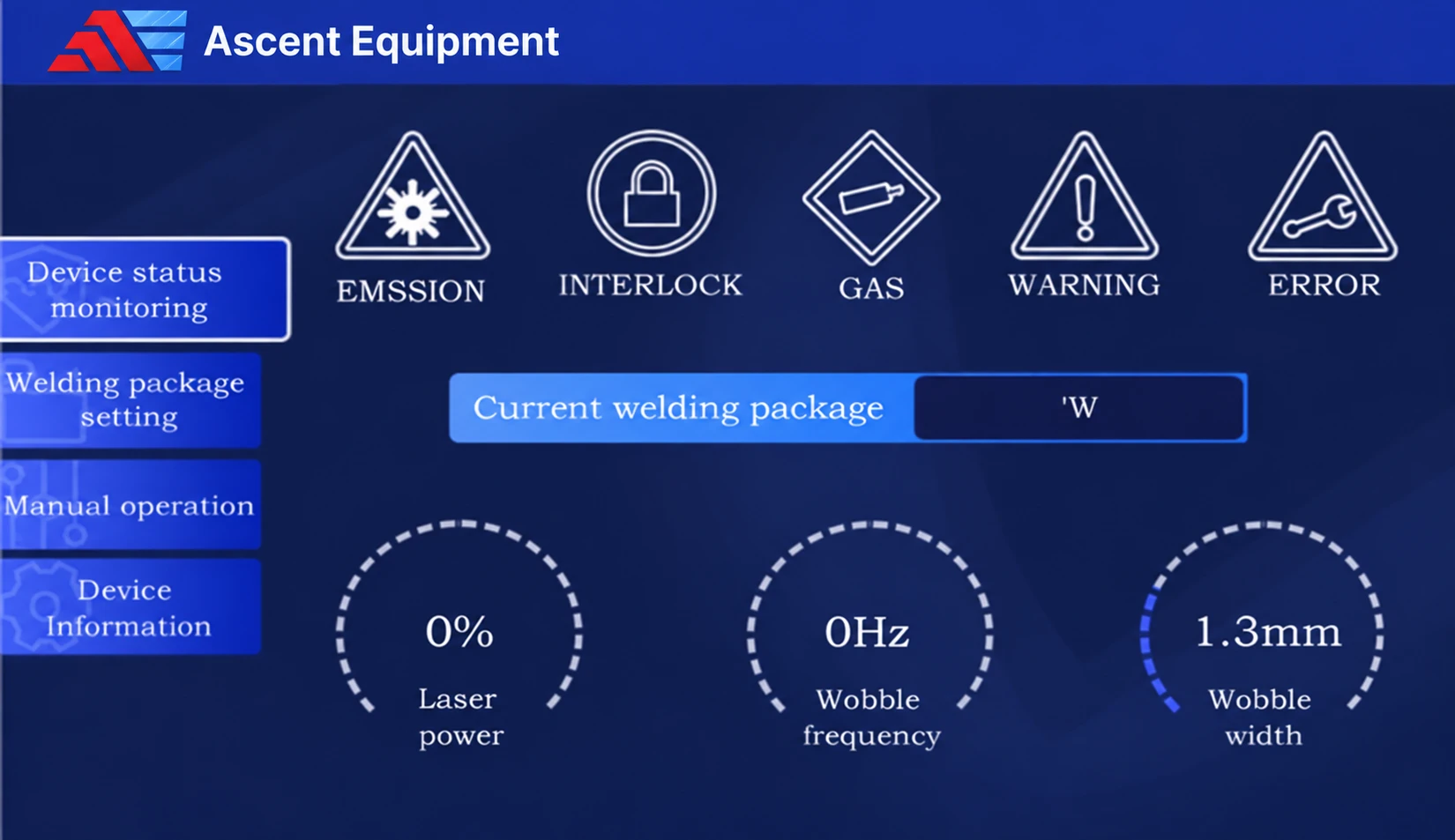
A full touchscreen interface displays operating status and allows cleaning parameters to be set and adjusted for different applications.
Integrated control circuit
A highly integrated control system uses dedicated wiring and an IP64-rated enclosure design for reliable industrial operation.
Ascent Equipment laser system
Configured for stable pulsed output, high efficiency, energy-conscious operation, and practical maintenance.
Ascent Equipment water chiller
Intelligent temperature regulation and an enhanced heat-dissipation design support stable cooling during operation.
Quality Verification
Quality verification includes high-pollution, anti-interference, high-temperature, vibration, continuous-operation, fatigue, dust-resistance, and low-temperature tests.
Ascent MASTER X Series — Technical Specifications
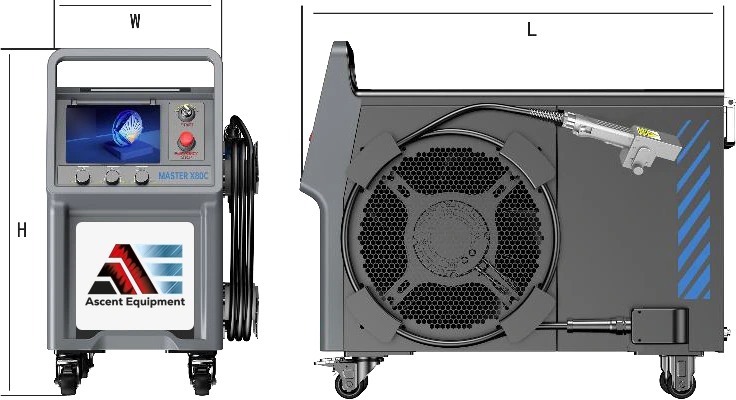
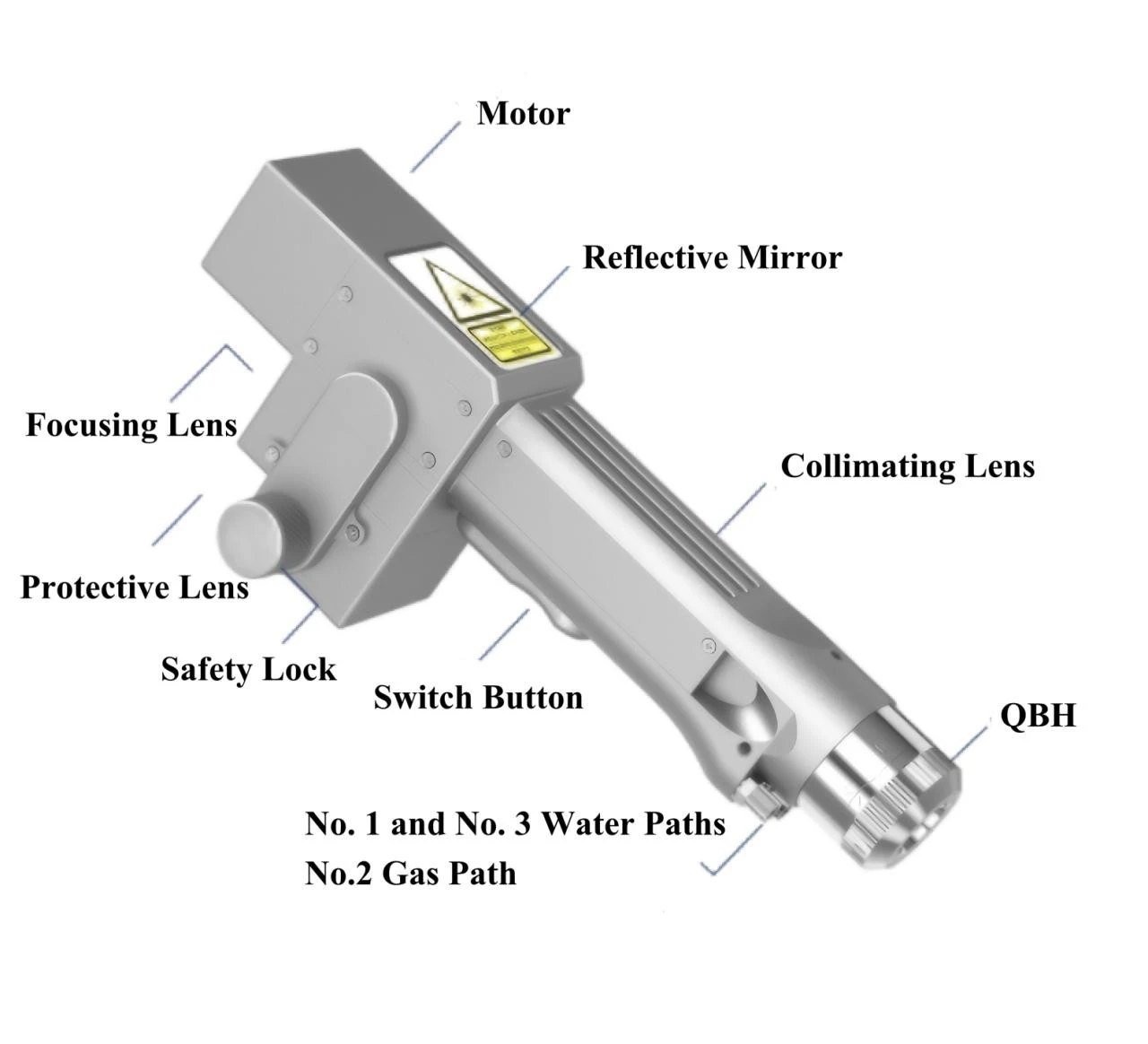
The Ascent MASTER X Series combines a high-stability laser source, refrigerant-based cooling, a cleaning head, and a control module in one system, for surface cleaning and rust removal on stainless steel, iron, galvanized sheet, and aluminum alloy. It's used across automotive manufacturing, aerospace, construction, and pipeline work.
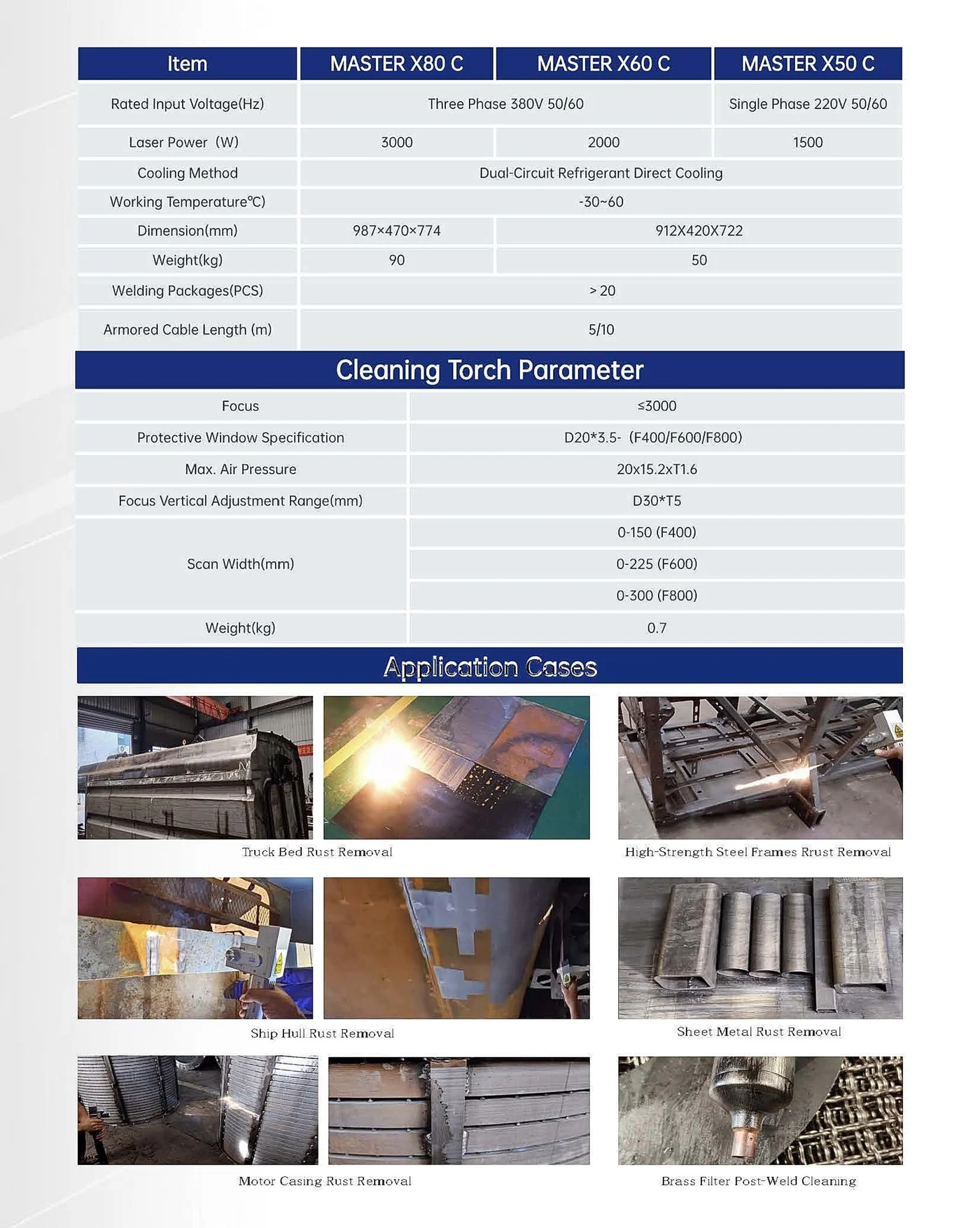
| Specification | MASTER X50C 1500W |
MASTER X60C 2000W |
MASTER X80C 3000W |
|---|---|---|---|
| Laser center wavelength | 1080 ± 1 nm | ||
| Working mode | Continuous / pulse modulation | ||
| Cleaning width range | 0 – 300 mm (0 – 11.81") | ||
| Power supply | Single phase (1 live + 1 neutral + 1 ground) | 3-phase, 5-wire (3 live + 1 neutral + 1 ground) | |
| Power supply voltage | 200 – 240V / 47 – 63Hz | 350 – 440V / 47 – 63Hz | |
| Power supply cable length | 5 m (16.4 ft) | ||
| Gas input port | 8 mm (0.31") quick connector | ||
| Input gas pressure range | 0 – 0.7 MPa | ||
| Gas flow rate | ≥ 15 L/min | ||
| Dimensions (L × W × H) | 912 × 420 × 722 mm (35.91" × 16.54" × 28.43") | 987 × 470 × 774 mm (38.86" × 18.5" × 30.47") | |
| Weight | 50 kg | 90 kg | |
| Operating temperature | -30°C to 60°C (-22°F to 140°F) | ||
| Storage temperature | -40°C to 85°C (-40°F to 185°F) | ||
| Operating humidity | 0% – 95% @RH | ||
| IP rating | IP43 | ||
| Cleaning head weight | ≤ 700 g | ||
| Connector type | QBH | ||
| Armored cable length | 10 m (32.81 ft) | ||
| Wobble frequency | 0 – 100 Hz | ||
| Wobble amplitude | 0 – 300 mm (0 – 11.81") | ||
| Focus vertical adjustment | ± 10 mm (± 0.39") | ||
| Collimation focal length | 60 mm (2.36") | ||
| Cleaning focal length | 800 mm (31.5") | ||
| Cleaning head cooling method | Air cooling | Water cooling | |
| Cooling system capacity | 5 kW | 7.5 kW | |
| Power source cooling medium | R410A refrigerant | ||
| Power source temperature control accuracy | ± 0.5°C (± 0.9°F) | ||
| Power source control temperature | Constant 30°C (86°F) | ||
Pulse Laser Cleaner
See it in action
How Fiber Laser Cleaning Works
Fiber laser cleaning is a highly efficient, eco-friendly surface preparation method that uses amplified light to remove rust, paint, oxides, oil, and other contaminants from materials, primarily metals.
Unlike traditional methods that rely on chemicals or abrasive blasting, laser cleaning is non-contact and non-abrasive.
Here is the science behind it:
- Laser Generation: A fiber laser source generates a high-intensity, concentrated beam of light.
- Pulsed Energy: The laser delivers short, rapid pulses of energy to the surface.
- Selective Absorption: The contaminant layer (rust, paint, oil) quickly absorbs the laser energy, while the underlying substrate (like steel or aluminum) reflects much of it.
- Ablation: The absorbed energy rapidly heats the contaminant, causing it to vaporize, sublimate, or plasma-expand, literally detaching it from the surface.
Key Benefits of Fiber Laser Cleaning
- Eco-Friendly: No chemicals, solvents, or blasting media are used, so the only waste is what comes off the part, captured as dust by a vacuum fume extractor. Residue from a hazardous coating, such as lead paint, is still hazardous waste.
- Gentle on Substrates: Metals reflect much of the laser's energy at these wavelengths, so with the right settings the base metal is left largely unchanged. No laser cleaner guarantees damage-free results, so the settings are tested on your parts.
- Low Operating Costs: No sand, grit, or chemicals are required. The main running costs are electricity, protective lenses, and fume extractor filters, and maintenance is minimal, resulting in a low cost per hour.
- Precision: Operators can dial in exact settings to clean highly intricate geometries, select specific spot sizes, or clean only a highly targeted zone without taping off surrounding areas.
Common Industrial Applications
| Industry | Primary use case |
|---|---|
| Manufacturing & Welding | Pre-weld cleaning (removing oxides) and post-weld cleanup (removing soot / discoloration). |
| Automotive & Aerospace | Selective paint stripping, oil / grease removal from engine parts, and tool coating removal. |
| Restoration | Heavy rust removal from structural steel, historical monuments, and vintage machinery. |
| Mold & Tooling | Cleaning residue, rubber, or plastics off injection molds, with settings chosen to protect the mold surface. |
⚠️ Safety Note: Fiber laser cleaners are typically Class 4 laser systems. Because the beam can reflect off metallic surfaces, operators and anyone in the vicinity must wear wavelength-specific laser safety goggles and work within a designated, enclosed safety zone. One pair of OD 8 goggles ships with every Ascent laser cleaner, and additional pairs can be ordered from Ascent Equipment.
Specifications & application cases
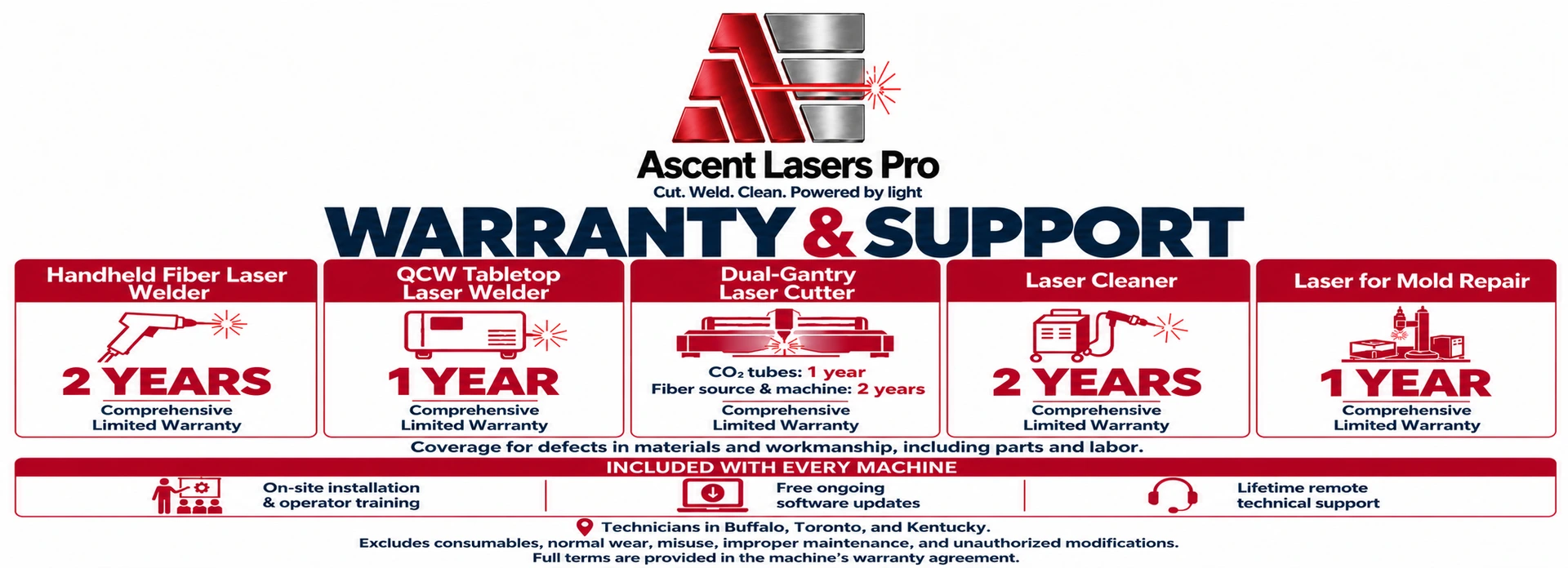
Warranty and support