Cobot Automation
Fiber laser welding integrated with a collaborative robot
A turnkey fiber-laser cobot — handheld speed, full automation
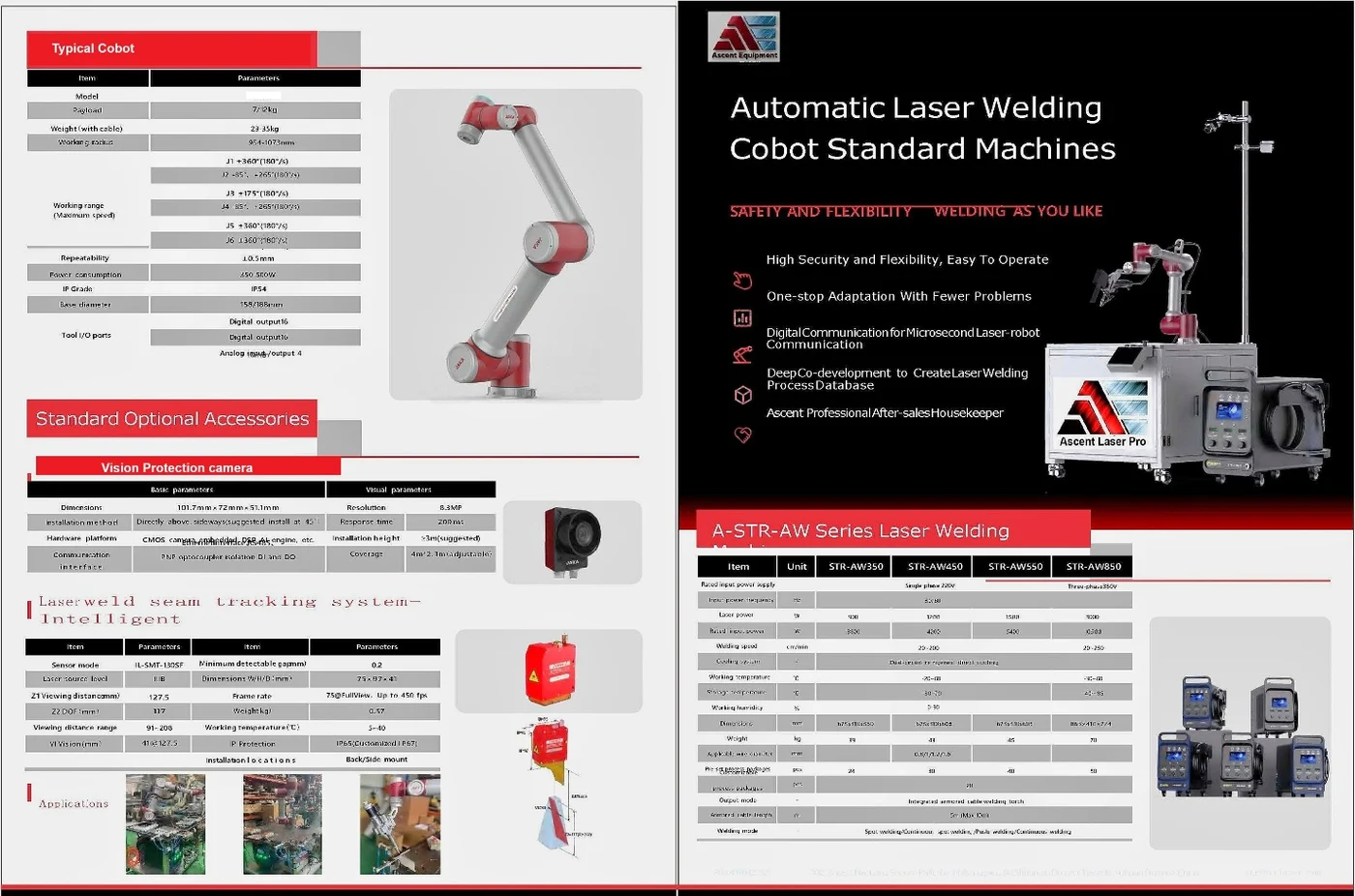
Ascent integrates a high-power fiber laser welder with a collaborative robot arm and a light-tight Class 1 safety enclosure. Hand-guide the torch and start production on day one.
- Welds up to 4x faster than traditional TIG
- Tiny heat-affected zone — no warping on thin metals
- Clean welds with no post-weld grinding
- Joins different metals: send us your specification and we'll tell you what's possible
- No-code, drag-and-drop programming — teach by hand
- Integrated Class 1 laser enclosure on a mobile cart
See it in action
Ascent supplies the fiber laser welder, cobot arm, controls, and safety enclosure as one integrated system.
Fiber laser welding cobots represent a significant leap forward in metal fabrication, combining the extreme speed and precision of a high-power fiber laser with the flexibility and user-friendliness of a collaborative robot (cobot).
Unlike traditional, rigid industrial robotic cells, which can cost hundreds of thousands of dollars and demand complex programming, a fiber-welding cobot allows fabricators to "hand-guide" a laser torch into place and commence production on day one.
Key Advantages of Fiber Laser Cobots
- Extreme Speed: Fiber lasers weld up to 4x faster than traditional TIG welding and significantly faster than MIG, drastically increasing throughput.
- Minimal Heat & Distortion: Because the laser concentrates energy onto a highly focused point, the heat-affected zone (HAZ) is tiny. This eliminates warping and deformation common when welding thin metals such as stainless steel or aluminum.
- No Post-Weld Grinding: Laser welds are incredibly clean and aesthetically pleasing directly off the line. This saves hundreds of hours of tedious post-weld cleaning, brushing, or grinding.
- Different Metals: The system can join different metals. Send us your specification, and we'll let you know what's possible for your parts.
- Intuitive "No-Code" Programming: Most systems (like Hirebotics' Beacon or Productive Robotics' Blaze) feature drag-and-drop tablet software. An experienced manual welder can learn to program a complex weld path in minutes by simply physically moving the robot arm.
The Critical Difference: Safety Caging
While standard MIG/TIG cobots are known for operating alongside humans without safety fences (thanks to force-limiting sensors), laser-welding cobots are a major exception.
⚠️ The Class 4 Laser Hazard: Even though the robot is collaborative and won't crush a human, the fiber laser beam can instantly cause permanent blindness or severe skin burns from a fraction of a second of stray reflection.
Because of this, fiber laser cobots require a light-tight, interlocked safety enclosure or a dedicated laser-safe room (Class 1 enclosure) to shield the surrounding shop from hazardous scattered light.
Ideal Use Cases
Fiber welding cobots fill the "middle ground" of fabrication. They are perfect for job shops and manufacturers that handle high-mix, low-volume production, prototypes, or repeat batches of thin-gauge sheet metal assemblies where aesthetic appearance is critical.
From Handheld to Automation
Ascent Cobot Cart
Ascent's cobot cart pairs our fiber laser welding systems with a collaborative robot for high-mix manufacturing. It takes handheld laser welding a step further and makes it ready for automation. One teach pendant runs both the laser source and the cobot arm, where other systems use separate controls. The result is a laser welding platform that's ready to program and built for real production work. Because it sits on a mobile cart, you can bring it right to the work area, and the built-in laser enclosure gives Class 1 operation.
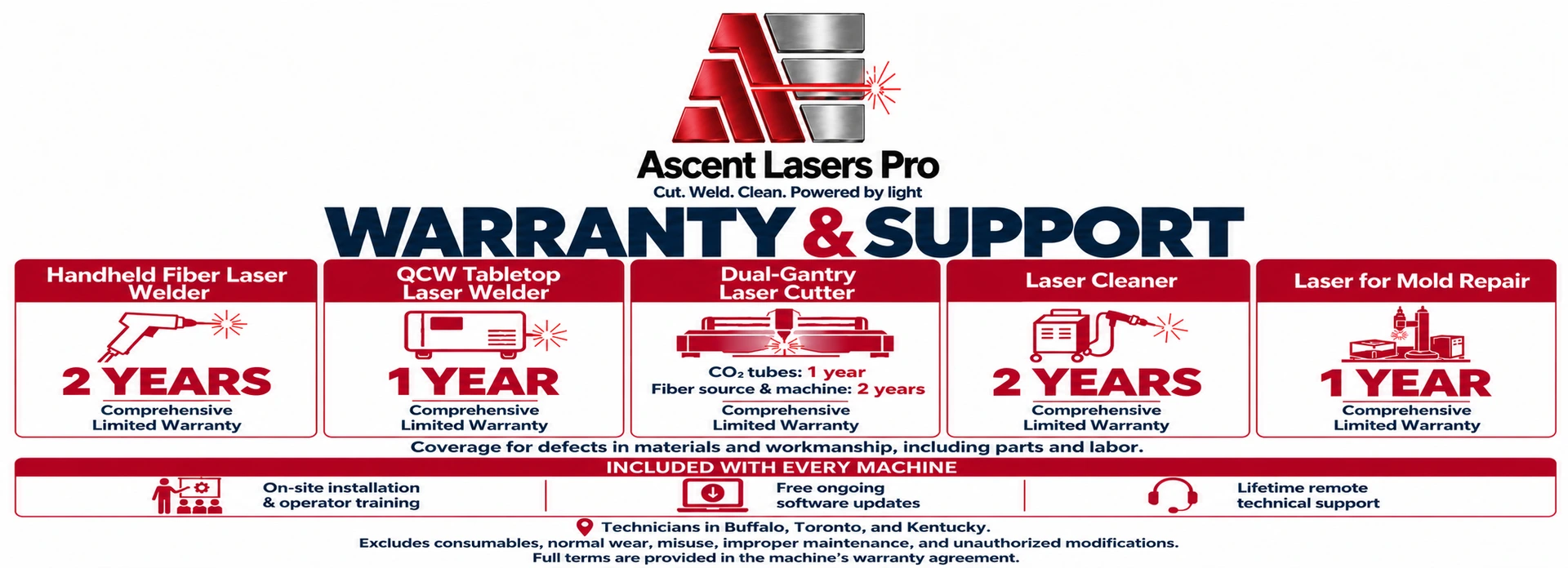
Warranty and support