
It’s totally normal for experienced welders to be skeptical about trying laser welding. Let’s face it, they’ve invested years—sometimes whole careers—perfecting MIG or TIG skills. That’s real expertise. So, when you suggest swapping their tried-and-true process for a laser, it can feel like you’re undervaluing their abilities. Before diving into technical specs, you have to tackle this head-on.
It’s not about saying “laser is better.” It’s more about purpose: lasers fit certain jobs that MIG and TIG just aren’t built for—especially in aluminum fabrication. The rest of their expertise? It’ll always have its place.
Who Are You Talking To?
MIG and TIG operators don’t think the same way, and their concerns are different.
TIG welders? They’re the artists. Precision matters most and they’re suspicious of anything that smells like a shortcut. They care about results, not marketing speak.
MIG welders focus on production—throughput, cost, speed. They worry about big upfront investments and figuring out new tech. If you want their attention, talk numbers: speed, ROI.
Most shops use both: MIG for heavier steel, TIG for finer aluminum work. Sometimes they try MIG on aluminum and get mixed results. Laser isn’t trying to take over—it really shines with thin to medium aluminum, about 0.040" to 0.125". It’s not for thick structural jobs. Being upfront about this helps.
The Real Aluminum Struggle
Aluminum is tricky for both MIG and TIG. This is where laser earns its keep.
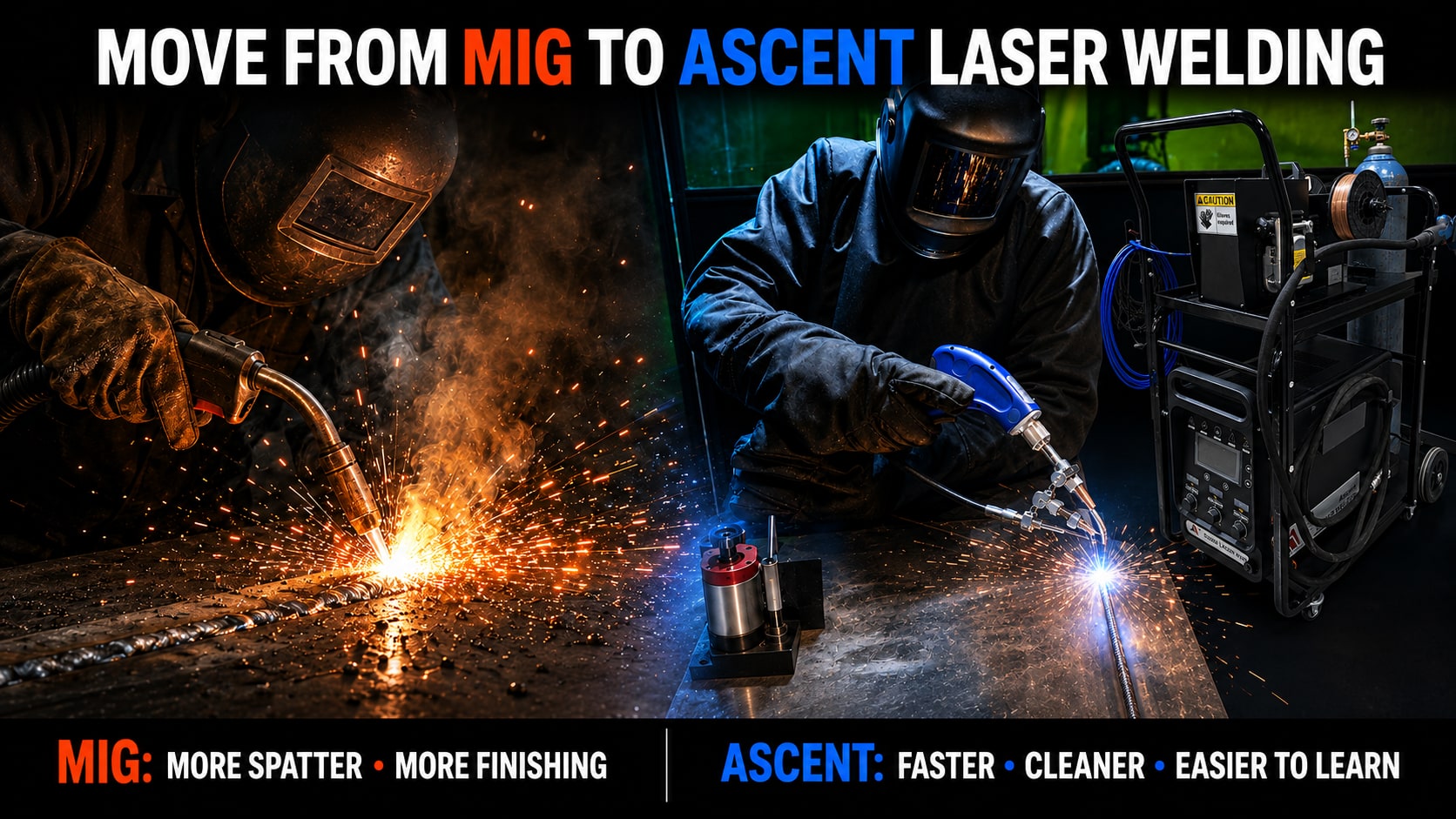
MIG on aluminum? It’s messy. You need special gear because the wire is soft. It runs hot, spits everywhere, and when you’re working thin stuff—like 0.040"—it just burns through before you even get a proper weld. Thicker gauges are easier, but still cause warping and lots of grinding. Honestly, most shops claiming “aluminum MIG” are making welds that need sanding and repainting.
TIG? It’s the precise route. Cleaner, more control—but slow and demanding. TIG needs AC current for aluminum. Managing heat to avoid porosity and burn-through is tough, especially on thin material. Even pros have a hard time with corners and curves at 0.040". At 0.125", it’s fine, but below that, you’re fighting every inch.
Laser, on the other hand, steps around these headaches entirely:
| Gauge | MIG | TIG | Laser |
|---|---|---|---|
| 0.040" | Burns through; tough | Slow, warps | Purpose-built, no burn-through |
| 0.063" | Burns through; spatter | Works, slow, grinding | Fast, clean, no filler |
| 0.080" | High heat, manageable | Good, slow | Very fast, tight bead |
| 0.125" | Needs prep | Good penetration | Strong, may need filler over 2kW |
What Actually Changes Day to Day
So, what does your shop notice when you switch from MIG or TIG to laser?
| MIG | TIG | Laser | |
|---|---|---|---|
| Spatter | A lot | None | None |
| Warping | High | Medium | Minimal |
| Filler rod | Always | Always | Usually not |
| Grinding | Usually | Light | Minimal |
| Skill needed | Moderate-High | High | Low-Moderate |
| Consistency | Varies | Varies | Repeatable |
| Corners, curves | Tough | Tough | Simple |
| Heat discoloration | Lots | Medium | Minimal |
For finished parts, those last couple rows stand out. Laser welding avoids heat discoloration, which means no cleanup on brushed stainless or anodized aluminum. And when you’re dealing with complex shapes—corners, brackets, formed sheet metal—laser is simply faster and more consistent than TIG.
Let’s Talk Labor Costs
Great TIG welders are expensive and rare. Training someone up takes months, even for those who already know their way around metal. If you lose a TIG welder, your production screeches to a halt.
Laser welders are easy to learn. The handpiece is user-friendly, settings are managed for you, and technique develops fast. New hires can make solid welds within their first week; good enough for production in a month.
If your shop churns out aluminum parts, the numbers are straightforward. If laser cuts 15 minutes per weldment on a job that used to take 20? That’s five minutes per part. Make 200 parts each month, and you save 50 hours of skilled labor. At $40/hr, you’re saving $2,000 a month — the $34,000 Ascent 3000W laser welder pays for itself in 17 months just on labor, before factoring in rework or recruitment costs.
How to Talk to Welders
For TIG welders:
Don’t insult their skill. Respect it—and admit the limits. “Thin aluminum with complex curves isn’t easy with TIG—you know that better than anyone. Laser isn’t faster because it’s easier; it’s faster because it uses less heat and tracks the seam in ways TIG can’t. Your TIG abilities remain essential—thick materials, structural jobs, repairs, exotic alloys. Laser is a tool, not a replacement.”
For MIG welders:
Start with the aluminum headache. They’ll admit it’s a pain: slow wire feed, multiple passes, lots of grinding, burn-through. They’re already working around MIG’s limits. Laser removes these obstacles: “Same output, cleaner weld, no grinding, way faster.”
For both:
Let them weld a test piece. Nothing convinces like hands-on. Give them the handpiece and some scrap aluminum—same gauge they’re used to. You’ll see them crank out presentable welds in minutes. That first surprise? It’s always on their face.
When MIG and TIG Still Belong
Laser won’t replace every job.
TIG is better when:
- Material is thick (above 3/16"), laser can’t penetrate deeply;
- Structural welding needs to meet code;
- You’re working with exotic alloys;
- You need versatility for odd repairs and custom jobs.
MIG is better when:
- It’s all about structural steel—frames and plates;
- You weld outside, where laser safety isn’t possible;
- Speed matters more than heat control.
But neither MIG nor TIG are ideal if:
- You’re welding thin aluminum (<0.125") and want consistency;
- Stainless parts keep showing heat stains;
- Your parts have tough interior corners and tight curves;
- Weld distortion keeps causing rework headaches;
- Finding skilled TIG welders is nearly impossible.
Addressing Safety Fears
The term “laser” freaks people out: invisible beams, eye injuries, fire risks. Most worries are overblown—just be honest about them.
The real risks:
- Eyes—that’s number one. The reflected beam can cause permanent blindness. Take it seriously.
- Fumes—same as any welding.
- Skin burns—possible, but minor.
What’s not a risk:
- The beam doesn’t blast through walls or bounce for miles.
- No arc flash.
- No UV—TIG and MIG actually hit you with more UV.
- No ignition hazards.
- No spatter burns on your skin or clothes.
Eye protection:
You need laser safety glasses (OD5+ rated for 1070nm). They’re clear, so you see your work. Cost is reasonable—about $50–$150. Ascent lasers include safety interlocks that cut power if the beam isn’t hitting metal.
“You wore a welding helmet because arc flash is real. Now, you wear laser glasses—they solve the hazard directly.”
Visibility:
TIG welders often worry they can’t see the puddle. The glasses don’t obstruct your vision; the melt pool is visible. Many welders think this is actually easier than TIG, where the arc shading hides the leading edge.
Bystanders:
Mark off a laser safety zone—anywhere with line-of-sight to the weld. Anyone near the weld wears glasses. It’s simpler than managing UV exposure across a shop.
Fumes:
No different from MIG or TIG. No flux, no coatings. Basic fume extraction works fine.
Compliance:
Class 4 lasers are regulated by ANSI and OSHA. A written laser safety plan, training, and PPE get you compliant. Compared to gas storage or arc flash PPE? It’s a walk in the park.
Give the Welder a Fair Trial
Don’t argue endlessly. Get them a test weld on their usual material. Let them time themselves using their current method and then with laser.
For the MIG welder, seeing a laser weld on thin aluminum—no spatter, no burn-through, no grinding—is eye-opening.
For the TIG artist, finishing a clean weld in just a minute on 0.063" aluminum (instead of four), with a tiny heat zone, is even more impressive.
Then ask: “If you could cut your aluminum welding time by two-thirds, what would that mean for your shop?”
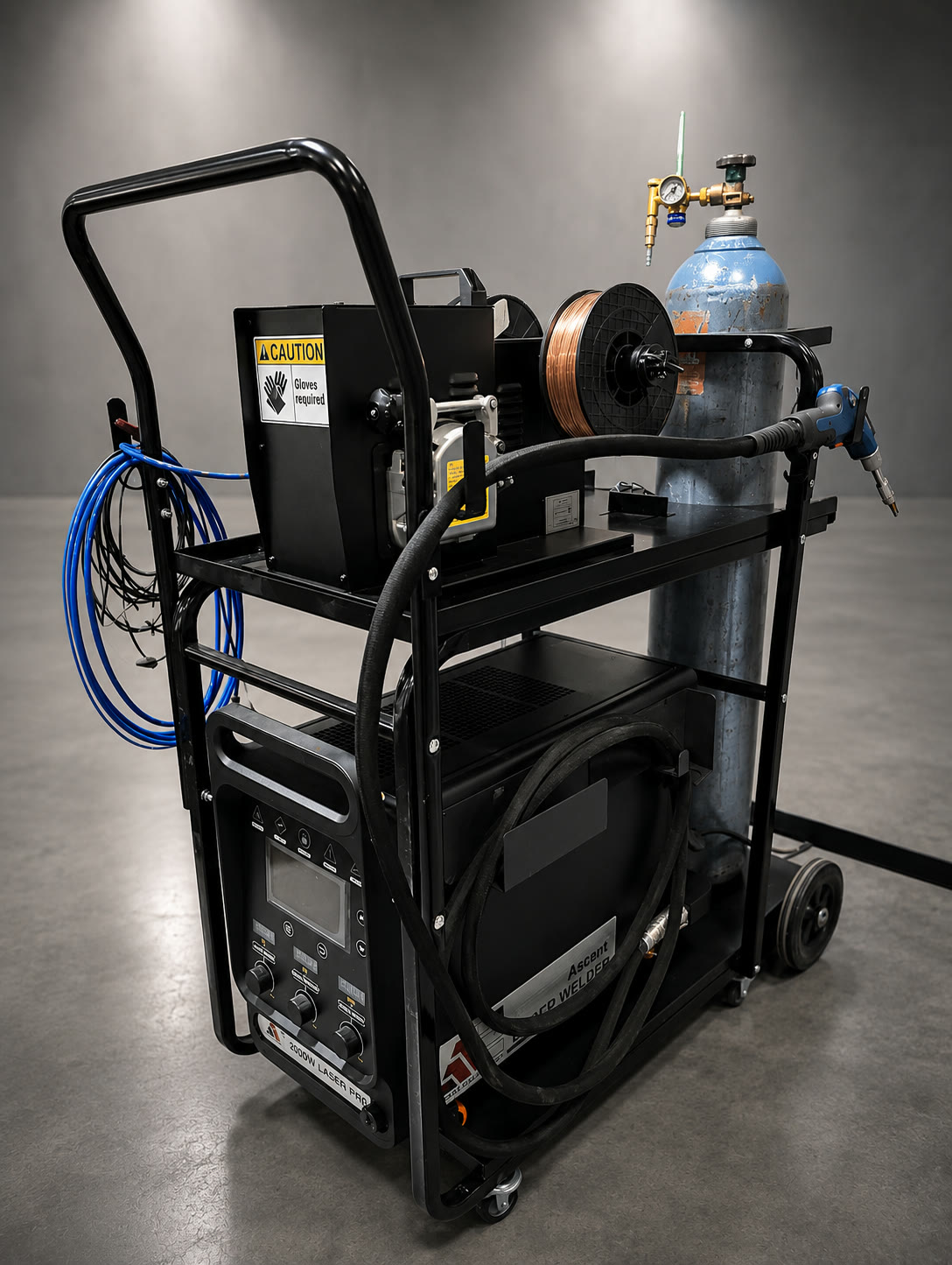
Ascent offers a handheld laser for higher volumes, or the QCW tabletop/handheld combo—actually rated for aluminum—if you’re working smaller parts at a bench. Want a payback estimate for your parts, material, and labor rate? Reach out, and we’ll put one together.
About Dov "Dave" Rom
I’m Dov Rom (also known as Dave), president and chief engineer at Ascent Equipment. For more than a decade, I’ve designed CNC machines, channel benders, laser cutters, and laser welders specifically for sign shops across North America. I write regularly about equipment selection, automation, and production economics for the sign industry. If your shop is looking to modernize, I’m here to help.