
Laser Welder vs TIG Welder for Channel Letters
If your sign shop produces channel letters that require welding — stainless steel letters, large aluminum letters, reverse halo letters where the back needs a clean seam — the question of which welding process to use is a real production decision. TIG welding has been the industry standard for decades. Laser welding has been available for years but has become significantly more practical and affordable in the past five years. Both work. They work differently, and the right choice depends on your volume, letter types, and labor situation.
This is a direct comparison — no filler, no marketing language.
What Each Process Is
TIG welding (Tungsten Inert Gas): An arc welding process that uses a non-consumable tungsten electrode to produce the weld. The operator controls the arc with one hand and feeds filler rod with the other, while a foot pedal controls amperage. It is a high-skill, manual process that produces excellent weld quality in experienced hands. It is also slow, heat-intensive, and completely dependent on the skill of the individual welder.
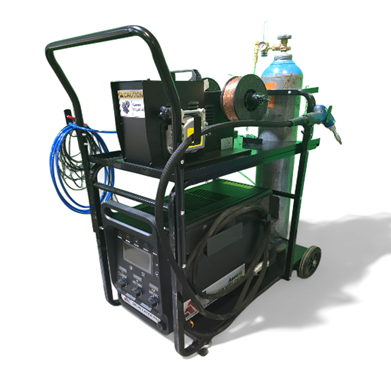
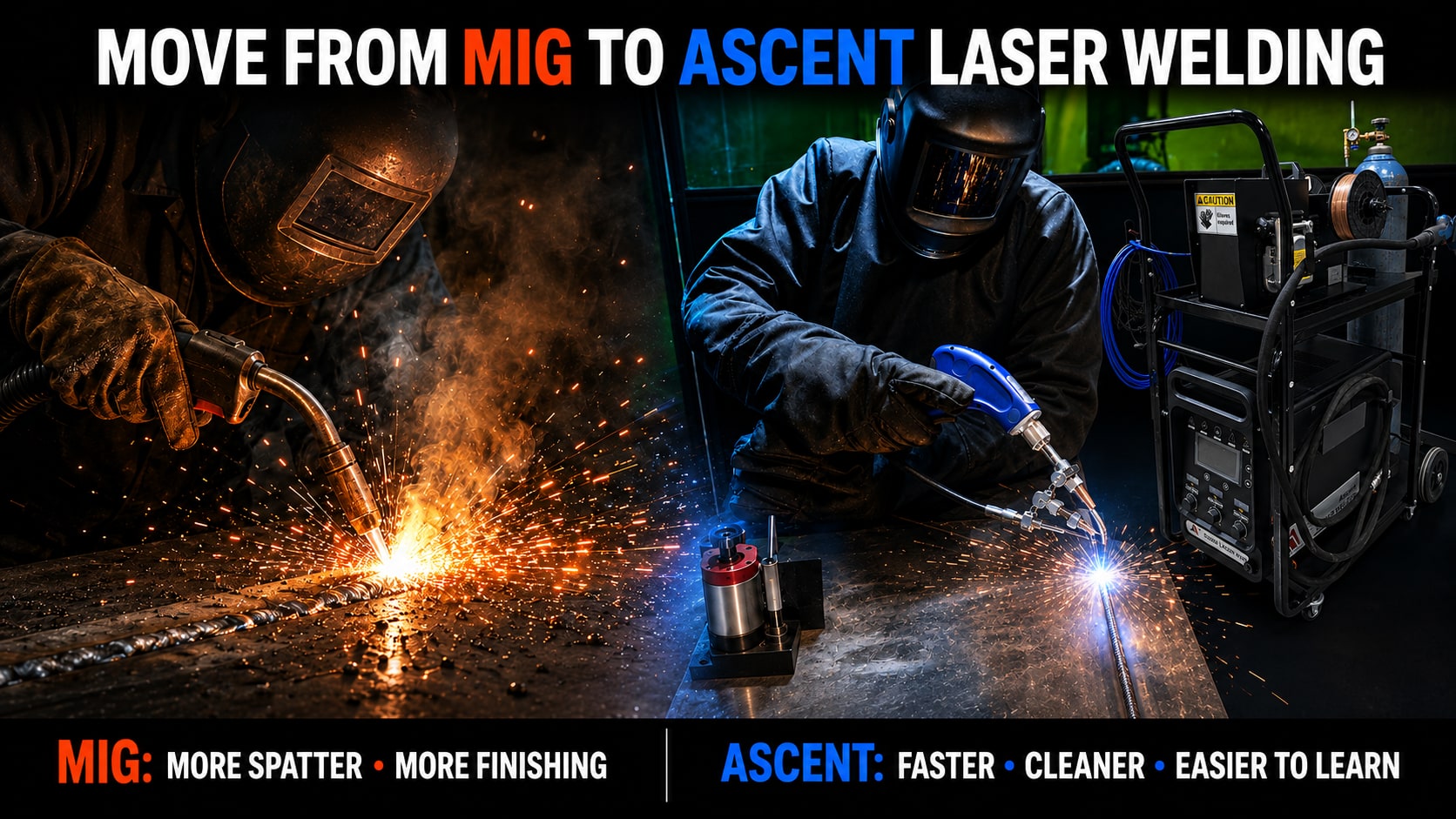
Laser welding: A focused laser beam melts and fuses metal at the weld point. Handheld laser welders — the configuration most relevant to sign shops — are held like a gun and moved along the weld seam. The process requires no filler rod for most channel letter applications, generates significantly less heat than TIG, and can be learned to a production-ready standard in days rather than months.
Speed
This is where the difference is most stark.
A skilled TIG welder closing a medium-complexity channel letter back — say, a capital letter B or S in stainless steel — takes 20 to 40 minutes including setup, tacking, full weld, and grinding. An experienced welder on a simple straight-sided letter might do it faster; a complex script letter takes longer.
A laser welder operator running the same letter takes 3 to 8 minutes. The laser travels faster, does not require tacking, and leaves a seam that typically needs little or no grinding on steel.
For a shop closing 300 letters per month that currently require welding, switching from TIG to laser welding at an average time reduction of 20 minutes per letter removes 100 hours of production time per month. At a welder's fully-loaded labor rate of $35/hr, that is $3,500/month in direct labor reduction.
Weld Quality
For channel letter work specifically, laser welding produces equal or better results than TIG in most applications.
On stainless steel: Laser welding produces a narrower, cleaner heat-affected zone than TIG. The surrounding material stays cooler, which reduces discoloration and distortion. On brushed stainless steel letters — where any heat discoloration shows clearly — laser welding is consistently cleaner.
On aluminum: Aluminum is more challenging for both processes. TIG welding aluminum requires AC current, high skill, and careful heat management to avoid porosity and burn-through. Laser welding aluminum requires precise power settings. The Ascent QCW tabletop laser welder is specifically rated for aluminum welding — the only tabletop laser welder with this capability — and produces consistent results on channel letter-gauge aluminum without the burn-through risk that plagues TIG on thin material.
On back panels and return seams: For the closing seam on a standard channel letter back, laser welding produces a tighter, more consistent seam than TIG. There is less spatter, less porosity, and less post-weld grinding required.
The one area where TIG has an edge is on very thick material — heavy-gauge stainless, structural components, or repair work where deep penetration matters. For standard channel letter fabrication in 0.040" to 0.080" aluminum and 16–18 gauge stainless, laser welding is the stronger process.
Heat and Distortion
TIG welding puts substantial heat into the workpiece. On thin aluminum (0.040"), this causes warping that has to be straightened or worked around during assembly. On painted or powder-coated surfaces near the weld zone, heat can cause discoloration that requires touchup. On letters with tight curves, heat accumulation on interior corners is a constant problem.
Laser welding is concentrated and fast. The heat-affected zone is narrow — typically 1 to 3mm on each side of the weld bead, versus 8 to 15mm for TIG on the same material. This means:
- Less warping on thin aluminum
- Less discoloration on stainless
- Less post-weld grinding and finishing
- Less rework overall
For shops where rework from weld distortion is a regular time cost, the reduction in rework alone often justifies the laser welder investment.
Skill Requirements
TIG welding is one of the most skill-intensive manual trades in metalworking. A production-ready TIG welder takes 6 to 18 months to develop — even if the person has metalworking experience. Finding one, retaining one, and paying for one is an ongoing challenge in most markets. Turnover in the welding position causes immediate production disruption.
Laser welding is learnable in days for production channel letter work. The handheld head is intuitive to control, the machine manages power settings, and consistent technique develops quickly. A new employee with no welding experience can be producing acceptable seams on channel letter backs within a week and hitting production quality within a month.
This is not a minor operational difference. A process that is dependent on one skilled person is a single point of failure. A process that any trained production employee can operate is a resilient one.
Equipment Cost
TIG welder: A production-quality TIG welder costs $3,000 to $8,000. The machine itself is not expensive. The cost is the skilled labor it requires.
Laser welder: The Ascent handheld laser welder is USD $28,000 for 2000W and USD $34,000 for 3000W, and the QCW tabletop/handheld combination is USD $28,500, all including shipping, installation, and training. The capital cost is higher; the labor cost is dramatically lower.
The payback calculation is straightforward. If a laser welder saves 100 hours per month of skilled welding labor at $35/hr, that is $3,500/month. The $28,000 Ascent 2000W laser welder pays back in 8 months. A shop with higher volume or a more expensive welding labor cost sees faster payback.
Running Both
Some shops run TIG and laser welding in parallel — laser for standard letter production, TIG for heavy structural work or specialty repairs. This is a reasonable configuration for shops that do both high-volume channel letter fabrication and occasional custom metal fabrication. The laser handles the volume; the TIG handles the outliers.
For shops that are purely channel letter fabricators, running TIG as a backup is less necessary. The laser welder covers the full range of channel letter welding work with the possible exception of very heavy-gauge stainless — a job type that is uncommon in standard channel letter production.
When TIG Still Makes Sense
TIG is the better choice when:
- You already have an experienced TIG welder on staff and low letter volume that does not justify the laser investment
- You regularly weld heavy-gauge material (3mm+ stainless, structural aluminum) where deep penetration matters
- You do repair and custom fabrication work alongside channel letter production and need the versatility of arc welding
- Budget constraints make the laser capital cost unworkable right now
TIG is not the better choice when:
- You are trying to reduce dependence on skilled labor
- You are closing more than 150 letters per month that require welding
- You are producing reverse halo letters where the back seam needs to be visually clean
- You are producing stainless steel letters where heat discoloration is a quality issue
- You cannot find or retain a qualified TIG welder
Which Process Fits a Channel Letter Shop?
For channel letter production specifically, laser welding is faster, cleaner, easier to staff, and lower in total labor cost than TIG welding in most shop configurations. The higher equipment cost is the only reason to stay with TIG — and at typical sign shop labor rates and letter volumes, the payback is faster than most shop owners expect when they first run the numbers.
Ascent offers both a handheld laser welder for shops with higher weld volume and a QCW tabletop and handheld combination for shops that weld smaller to medium letters at a bench. If you would like to see a payback calculation for your specific letter volume and labor rate, contact us and we will put one together.