
From Hand-Bending to Machine-Bending: What It Means for Your Shop
If your shop currently hand-bends channel letter returns, you already know the process intimately: unroll the coil, measure each segment, mark the bend points, work through the letter section by section on a brake or by hand, fit and adjust, weld the seams, grind the welds smooth, and clean up before you can move on to the next letter. For a skilled fabricator, a single letter takes 30 to 45 minutes — longer for complex shapes, tight curves, or large formats.
A CNC channel letter bending machine does the same letter in 3 to 4 minutes.
That gap is not a typo. And once you run the numbers on what it means for your labor cost, your production capacity, and the kind of work your shop can realistically take on, the machine stops looking like a capital expense and starts looking like a labor strategy.
This post walks through what the shift from hand-bending to machine-bending actually changes inside a shop — not just the speed number, but the workflow, the staffing, the quality, and the transition itself.
What Hand-Bending Actually Costs
Most shops that hand-bend channel letters don't track the true labor cost per letter — they track the job cost, which absorbs the time without isolating it. Here's what the math looks like when you do isolate it.
Assume a fabricator earning $25/hour. At 45 minutes per letter, your labor cost for the bending step alone is $18.75 per letter. A typical sign job with 12 letters costs $225 in bending labor before you've touched the acrylic face, the lighting, or the cabinet.
At 15 jobs per month, that's $3,375 in bending labor. At 25 jobs per month, it's over $5,600.
The machine changes the math at every level:
| Scenario | Hand-bending cost/month | Machine cost/month | Savings |
|---|---|---|---|
| 15 jobs × 12 letters | ~$3,375 | ~$450 | ~$2,925 |
| 25 jobs × 12 letters | ~$5,625 | ~$750 | ~$4,875 |
| 40 jobs × 12 letters | ~$9,000 | ~$1,200 | ~$7,800 |
The machine doesn't eliminate labor — someone still needs to load the coil, monitor the run, and assemble the finished returns. But the bending step that required a skilled fabricator now runs in the background while that person does higher-value work.
What Changes in Your Shop
1. Who can do the work
Hand-bending channel letter returns requires experience. Getting consistent bends, managing springback, keeping the return height even across a curved letter — these take time to learn, and mistakes mean scrapped material.
The Ascent 5AS runs from a Windows interface that accepts your existing DXF and AI design files. A new operator can run the machine independently after three hours of training. That doesn't mean channel letter fabrication gets deskilled entirely — assembly, quality checking, and troubleshooting still benefit from experience — but the bending step itself no longer requires a senior fabricator to produce consistent results.
This has a practical implication most shops feel within the first month: your experienced fabricators stop spending a third of their day doing repetitive bending and start doing the work that actually requires their knowledge.
2. How many jobs you can take on
Hand-bending is a bottleneck because it consumes skilled labor hours that can't be easily added. You can't solve a capacity problem by telling a fabricator to go faster — at some point you're looking at overtime or another hire.
The machine removes bending from that bottleneck. A shop that was producing 15 to 20 channel letter jobs per month by hand can often handle 35 to 40 with the same crew once bending is mechanized — not because the machine is magic, but because the labor hours it frees up can go to the steps that were previously waiting on bending to finish.
The shops most likely to see this effect immediately are those already turning away work or stretching lead times to manage capacity.
3. Consistency across every letter
Bending by hand introduces variability. Experienced fabricators minimize it, but even skilled hands produce slight differences in bend radius, return height, and corner sharpness between the first letter of the day and the last. On a small job it's imperceptible. On a large exterior sign with 30 identical letters, it shows.
The machine produces every bend to the same specification, every time. The 12th letter in a run is identical to the first. For shops doing high-volume production or working on large-format projects where visual consistency matters, this is not a minor benefit.
4. Letter types you can produce
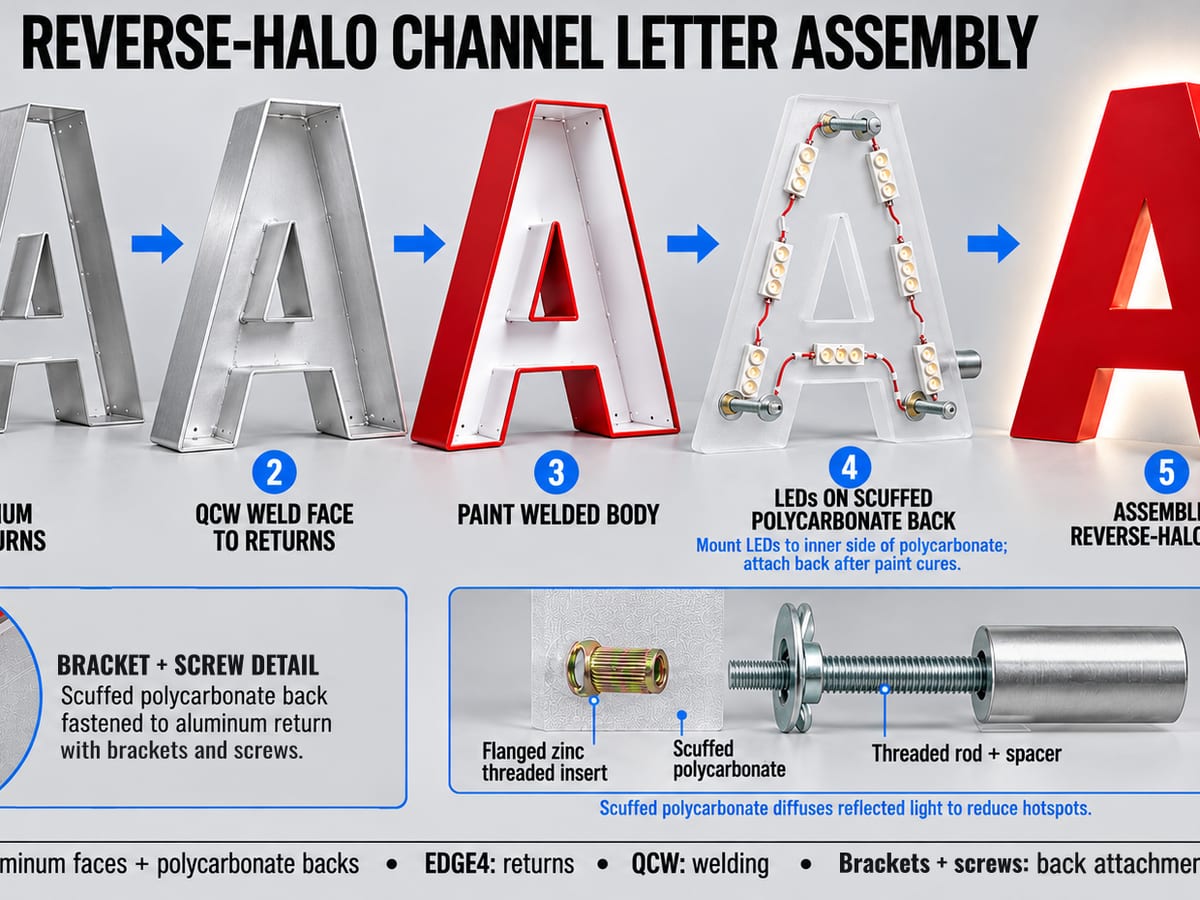
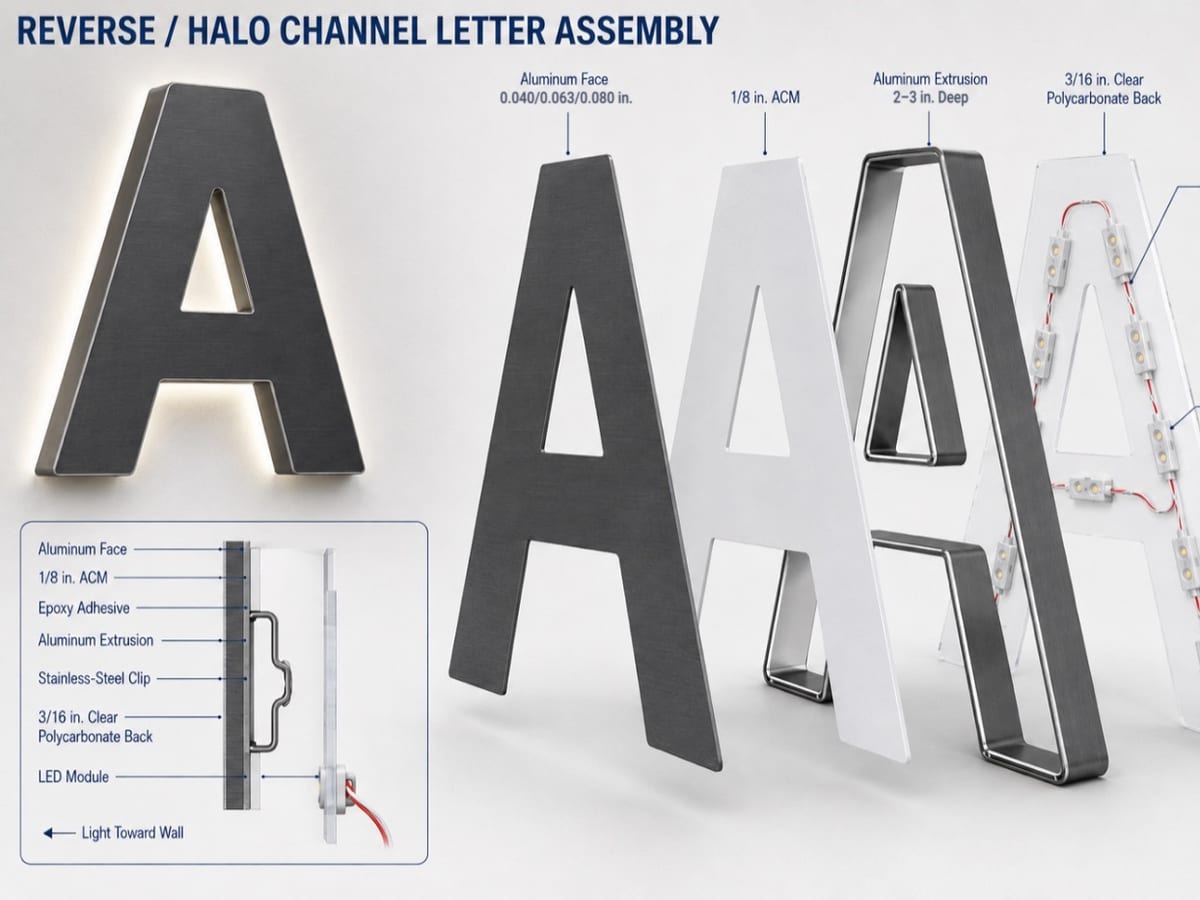
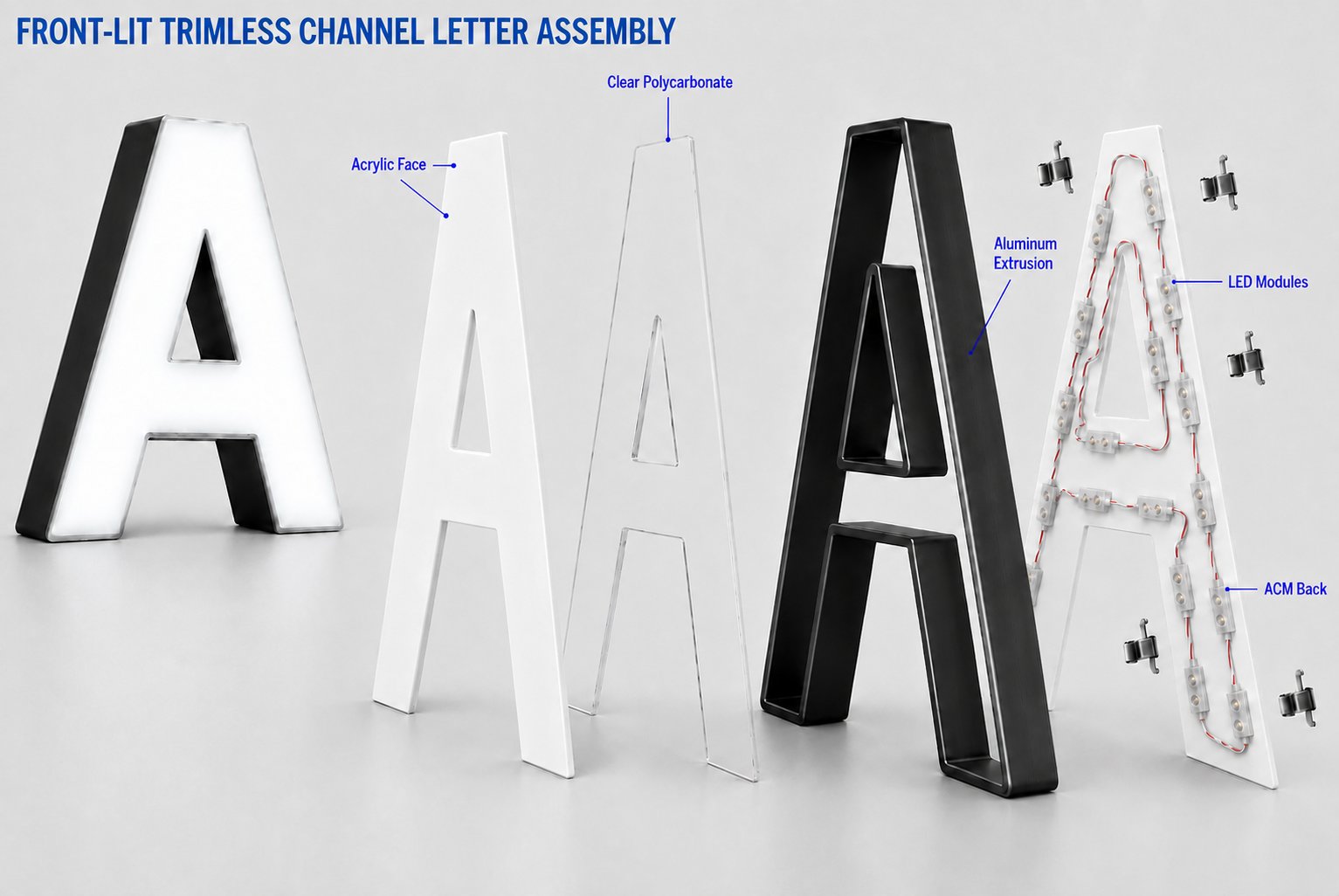
Some letter styles are genuinely difficult to hand-bend consistently: trimless letters, reverse halo returns that require no welding, side-lit letters with plastic returns. Many shops don't offer these styles because the hand-fabrication process is too slow or too inconsistent to price competitively.
The Ascent 5AS handles all of these letter types — trimless, reverse halo (without welding), combined front- and back-lit, side-lit plastic returns, complex logo shapes — from the same machine, software-driven, with no hardware changeover between styles. Adding these to your offering is a menu expansion, not a new production challenge.
What the Transition Actually Looks Like
The machine doesn't require a facility overhaul. It runs on 110 VAC / 30A power and compressed air — the same infrastructure most sign shops already have. It's fully assembled when delivered; you're not building anything.
Installation and training happen on-site at your location, and Ascent's technicians cover USA and Canada. The training typically takes three days total: machine setup and calibration, software walkthrough with your design files, and supervised production runs with your operators. By the end of the third day, your team is running the machine on real jobs.
Support after installation is available remotely via AnyDesk (pre-installed on the machine) and from service technicians in Buffalo, Toronto, and Kentucky who can be on-site on short notice when remote diagnostics aren't enough.
When Does the Machine Make Sense?
Not every shop needs one today. Here's a practical way to think about it:
The machine makes clear financial sense if you are:
- Bending more than 20 channel letter jobs per month
- Turning away work or stretching lead times because bending is a production constraint
- Paying a skilled fabricator to spend most of their shift bending letters
- Looking to add trimless or reverse halo to your menu but finding the hand-fabrication process too slow to price competitively
The machine is worth evaluating seriously if you are:
- Growing and expect to hit 20+ jobs per month within the next year
- Winning more channel letter work and watching it pile up against your fabrication capacity
- Hiring for channel letter production and wondering whether another fabricator or equipment is the right answer
The machine is likely premature if:
- Channel letter jobs are occasional and your volume isn't consistent
- The investment doesn't pencil out against your current volume within a reasonable payback period
If you're not sure which category you're in, the math in the first section of this post is a reasonable starting point. Plug in your actual fabricator rate and your average monthly letter count, and the payback timeline becomes clear quickly.
Choosing the Right Ascent Machine
Once you've decided you're ready for a bending machine, the next question is which one fits your shop's letter types and materials. Ascent makes six models — here's how they compare.
Ascent 5AS
The current 5th-generation Ascent bender. The right choice if you produce — or want to produce — trimless letters, reverse halo without welding, or F-trim channel letters.
- Trimless letters with UL/RU Recognized Component Ascent extrusions — pneumatic nail gun assembly, no adhesive table
- Reverse halo letters without welding
- F-trim profile (exclusive to 5AS in the Ascent lineup)
- Side-lit letters with plastic returns
- 0.040" and 0.063" aluminum + stainless steel, up to 8" depth
- Letter height from 3" with no upper limit
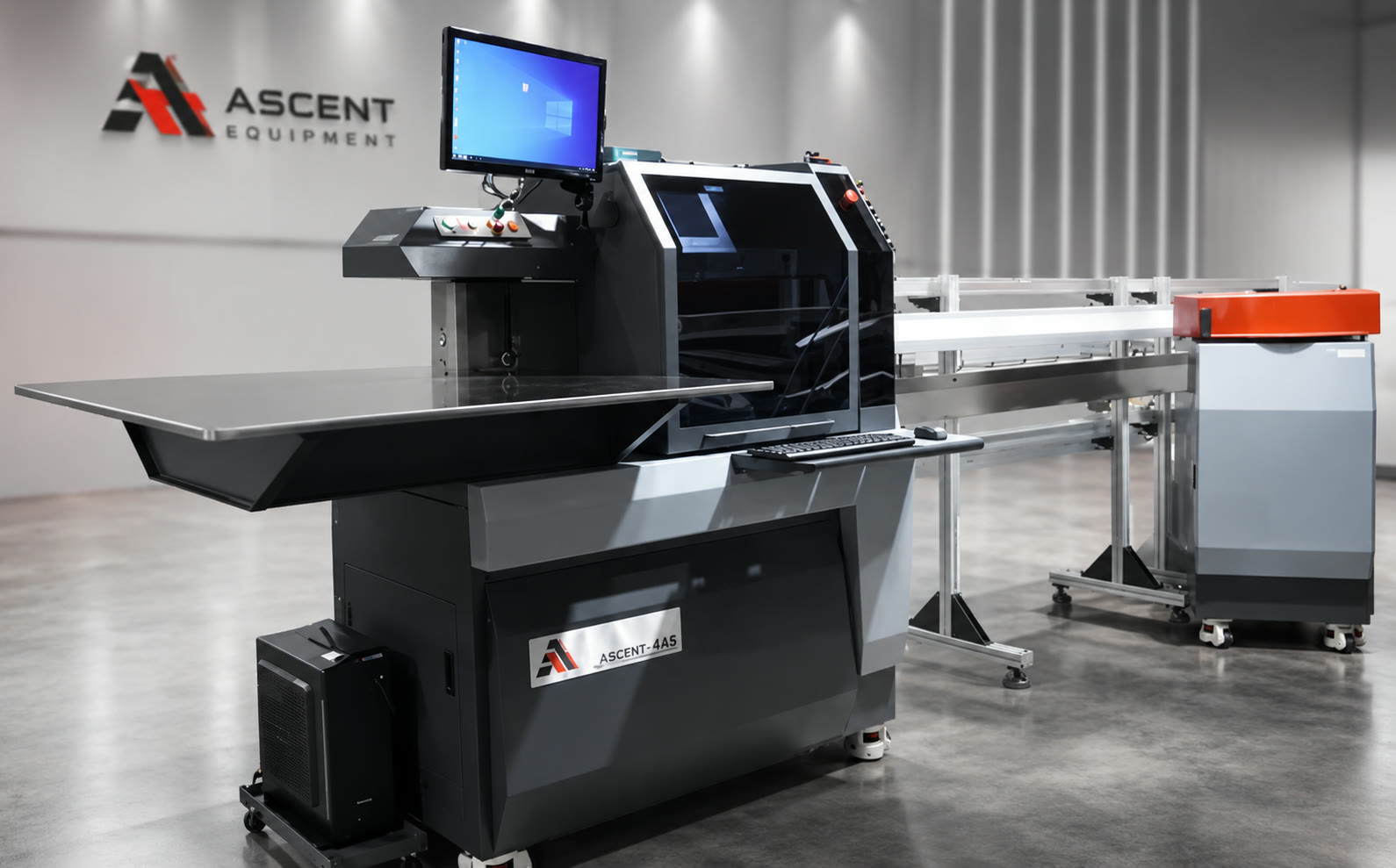
Ascent 4AS
4th-generation machine that established Ascent's trimless letter system. Same core capabilities as the 5AS — trimless letters and halo without welding — without F-trim support. Now upgraded to the 5AS.
- Trimless letters with Ascent extrusions
- Reverse halo letters without welding
- Side-lit letters with plastic returns
- 0.040" and 0.063" aluminum + stainless steel, up to 8" depth
Ascent MAX-V2
The only Ascent machine for letters over 8" in depth. Built for large outdoor cabinets, architectural signage, and thick aluminum stock that other machines in the lineup cannot handle.
- Material height from 2.3" up to 15.7" — deepest capacity in the lineup
- Aluminum up to 0.125" — the thickest any Ascent bender handles
- Stainless and galvanized steel up to 0.055"
- Traditional reverse halo with welding
- Two bending entrance / blade sets included
- ±0.1 mm accuracy
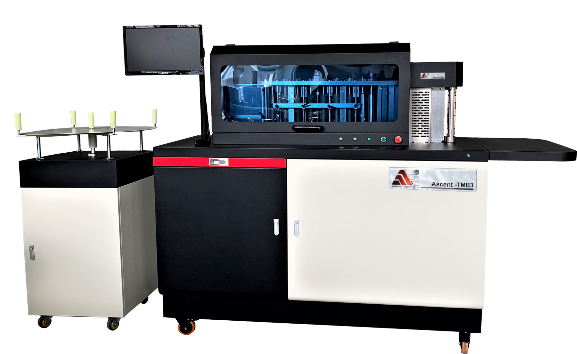
Ascent TMB-3
Based on Ascent Equipment's review of publicly available North American machines as of August 2026, we have not identified another machine offering this same combination of capabilities: converting aluminum coil directly into trim — 25% cheaper per foot than plastic — while also handling standard plastic trim and making flanged side returns from coil.
- Aluminum trim from coil — eliminates the cost of pre-formed plastic trim stock
- Processes standard 3/4" and 1" plastic trim caps for notching
- Flanged side returns from 0.040" aluminum coil
- 360° cutter: accurate front and back notch position
- Custom aluminum coil colors for national sign programs
Ascent EDGE-3
A full-featured 6-axis servo CNC bender for traditional notching, flanging, and bending. Handles 0.080" aluminum for bending — thicker stock than the 4AS or 5AS — and includes an integrated output cutter.
- Notching, flanging, and bending for traditional trim-cap letters
- 0.040" / 0.063" aluminum for notching & flanging; 0.080" for bending only
- Stainless steel for bending
- Integrated output cutter
- Minimum U-bend 0.78"; minimum angle clearance 0.40"
- 6-axis servo system with vacuum cleaning
Ascent EDGE-4
The most automated traditional letter bender in the lineup. 8-axis fully servo-driven with robotic-arm feeding, V-groove accuracy ≤0.01 mm, and built-in hole punching for weeping and rivet connections.
- 8-axis fully servo-driven — robotic alternating feed system
- V-groove accuracy ≤0.01 mm — tightest tolerance in the lineup
- Punches weeping holes (bottom) and Z-connection rivet holes (top)
- Eight interchangeable cutting tips: zero-cost consumables
- Integrated output cutter
- Lifetime free software upgrades
You can also use the full capability comparison table and machine selection wizard to see all six machines side by side.
When the Change Makes Sense
Shops that have made this transition consistently describe the same experience: the first month feels like a learning curve, and by the third month they wonder how they managed without it. The machine doesn't solve every production problem — assembly, quality control, and sales are still on you — but it removes bending from the list of things that limit your capacity.
If you're at the point where channel letter production is constrained by how fast your team can hand-bend returns, the machine is the right answer. If you're not there yet but growing toward it, it's worth understanding the investment now before you're making the decision under pressure.
Contact Ascent Equipment to talk through your production volume and get a quote on the Ascent 5AS — or explore the machine specifications to see how it fits your letter types and materials.