
Laser Welder Safety: What Every Sign Shop Needs to Know
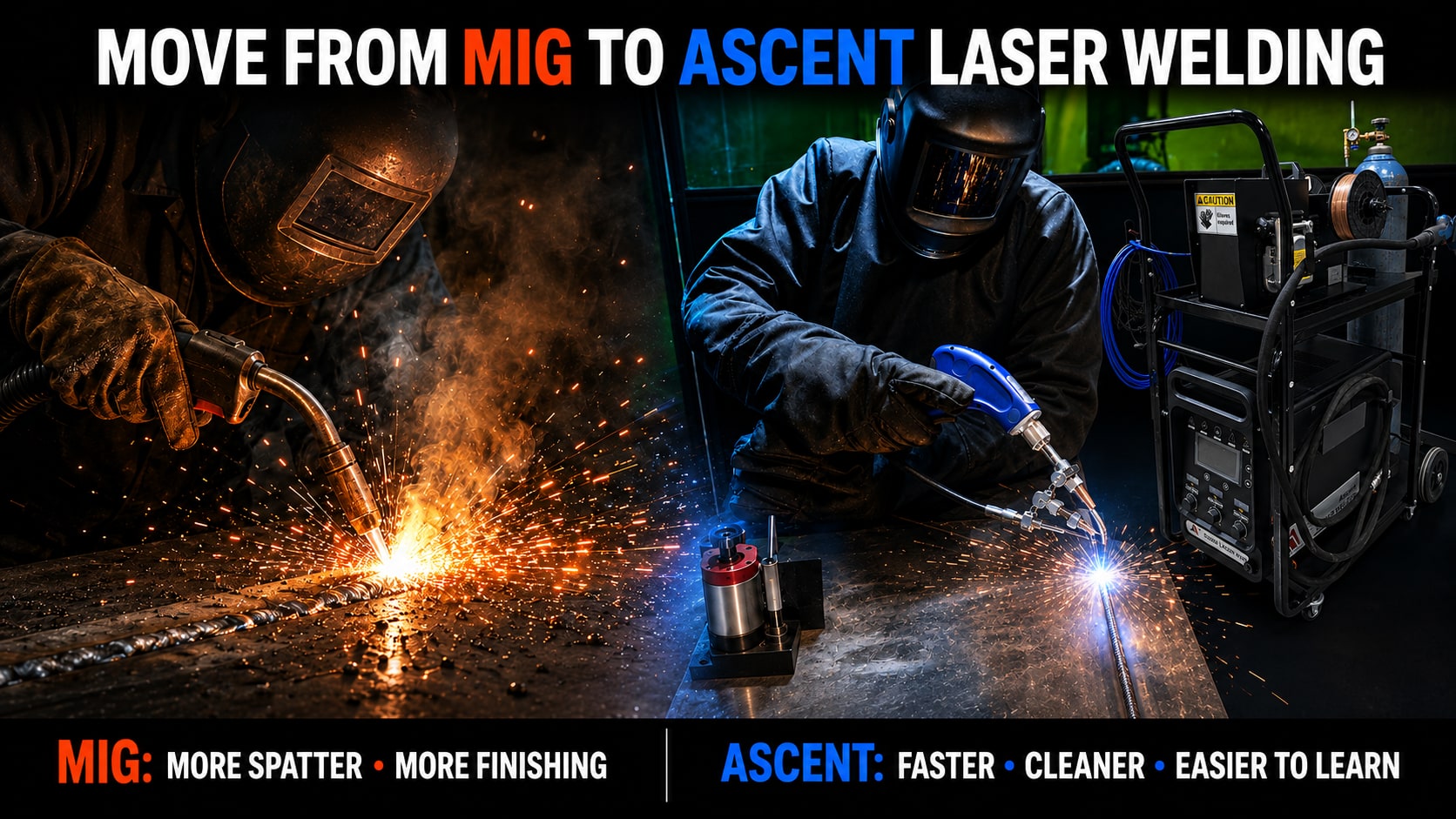
Fiber laser welders have transformed channel letter production. They are faster, cleaner, and easier to learn than TIG welding. But they are Class 4 laser devices — the highest-risk laser classification — and they require proper safety measures before your first weld.
This guide covers what you actually need: eye protection, fume extraction, fire precautions, and workspace controls. It is written specifically for sign shops running handheld or tabletop fiber laser welders on aluminum, stainless steel, and galvanized materials.
Why Laser Welders Require Specific Safety Measures
A fiber laser welder operates at approximately 1070 nm (near-infrared). This wavelength is:
- Invisible to the naked eye — you cannot see the beam
- Immediately hazardous to unprotected eyes — a single brief exposure can cause permanent retinal damage
- Capable of producing toxic metal fumes — especially on aluminum, coated materials, and galvanized steel
- A fire risk — the focused beam can ignite combustible materials in the work area
Standard welding helmets and dark tinted glasses do not protect against laser radiation. You need wavelength-specific laser safety eyewear.
1. Laser Safety Eyewear
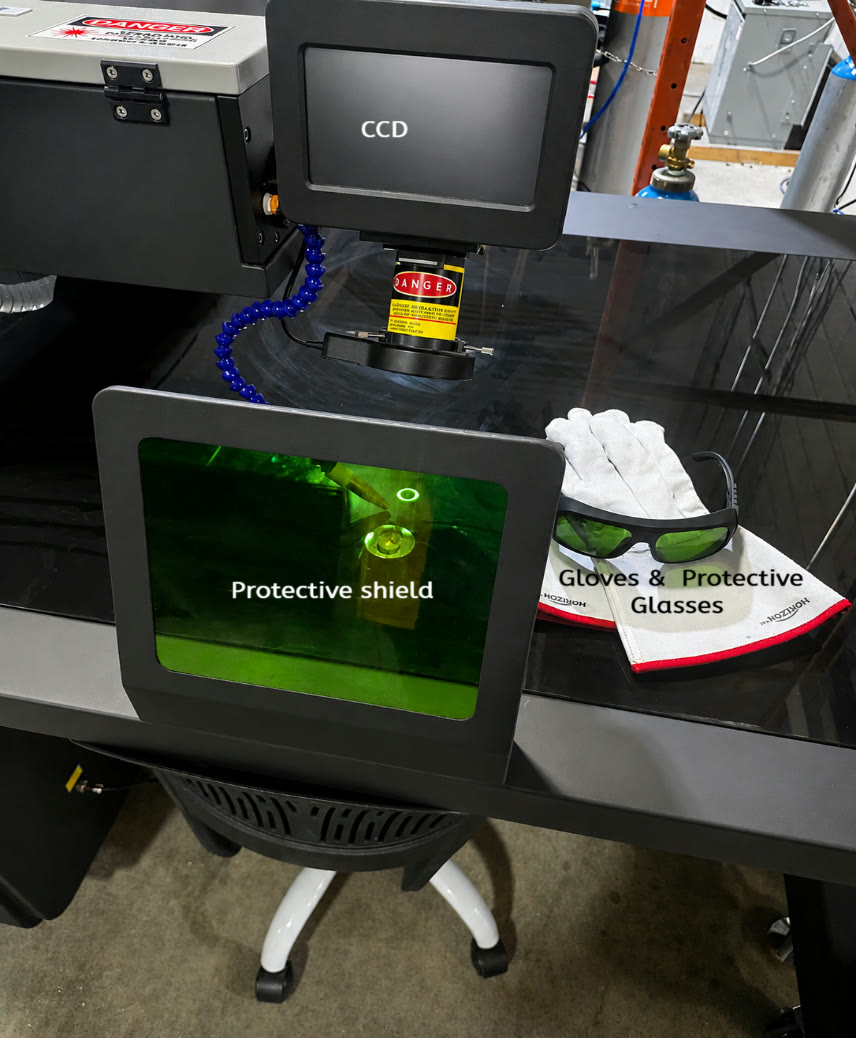
This is the most critical item. Everyone in the immediate work area — operators and bystanders — must wear appropriate laser safety glasses while the machine is in use.
What to look for:
- Wavelength coverage: Your eyewear must specify protection at 1064 nm–1100 nm (covers fiber laser welders at ~1070 nm)
- Optical Density (OD): Minimum OD 5+ is standard for Class 4 fiber laser welders. Higher OD = more protection. Many shops use OD 6 or OD 7 for additional margin.
- Visible Light Transmission (VLT): Higher VLT means you can see your work better while protected. Look for 20–30% VLT minimum.
- Certification: Look for EN 207 or ANSI Z136.1 compliance marking on the lens
Practical tip: Buy laser safety glasses from a reputable supplier that provides the optical density spec sheet. Generic "laser glasses" sold without OD ratings are not adequate — do not use them.
Who needs to wear them: The operator, anyone within the nominal hazard zone (NHZ), and anyone who might walk through the workspace while welding is active.
2. Fume Extraction
Metal welding fumes are hazardous, and laser welding is no exception. The focused energy of the laser vaporizes a small amount of metal at the weld point, producing ultrafine metallic particles and gases that must not be inhaled.
Materials of particular concern in sign shops:
- Aluminum — produces aluminum oxide fume, a respiratory irritant
- Galvanized steel — produces zinc oxide fume; inhalation causes metal fume fever
- Coated or anodized materials — coating vapors vary by material; some are acutely toxic
- Stainless steel — produces chromium and nickel compounds; chronic exposure risk
What you need:
A dedicated laser fume extractor (also called a laser fume filter or weld fume extractor) with:
- HEPA filtration — captures ultrafine particles
- Activated carbon stage — captures chemical vapors and gases
- Adequate CFM — sized to your workspace and weld duty cycle; your machine supplier should provide a recommendation
- A capture nozzle positioned close to the weld point — typically within 2–4 inches
Do not rely on general shop ventilation alone. A shop exhaust fan does not filter fumes — it moves them around the workspace.
3. Fire Safety
The laser beam will ignite combustible materials if they are in the path of a stray reflection or if the beam contact point shifts unexpectedly.
Common hazards in sign shops:
- Acrylic scraps or sheets near the welding area
- Cardboard, foam, and packaging materials
- Paper templates and layout sheets
- Flammable cleaning solvents
Minimum precautions:
- Keep a clear 3-foot radius around the welding area free of combustibles
- Never weld near acrylic — even small scraps can ignite from reflected laser energy
- Have a Class ABC fire extinguisher within reach
- Never leave an active welding session unattended
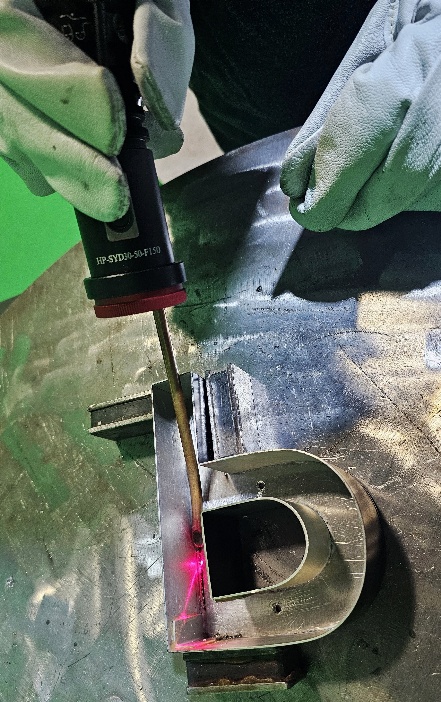
Reflective surfaces: Handheld fiber laser welders can produce specular (mirror-like) reflections from polished metals. Position the weld head at a slight angle to the workpiece surface to redirect any reflection downward into the part, not toward the operator or the room.
4. Skin Protection
At 1070 nm, the fiber laser beam will cause skin burns on contact. The risk is highest for the operator's hands and forearms.
- Wear leather welding gloves on both hands while using a handheld welder
- Wear long sleeves — cotton or leather; avoid synthetic fabrics that can melt
- Avoid reflective jewelry (watches, rings) on hands and wrists
For tabletop laser welders, the exposure risk is lower because the workpiece is held in a fixture — but gloves are still recommended when handling hot parts and operating near the beam path.
5. Workspace Controls
Laser warning signage: Post a visible laser warning sign at every entrance to the workspace. ANSI-standard laser warning labels are available from safety suppliers and are often required by insurance policies and local safety regulations.
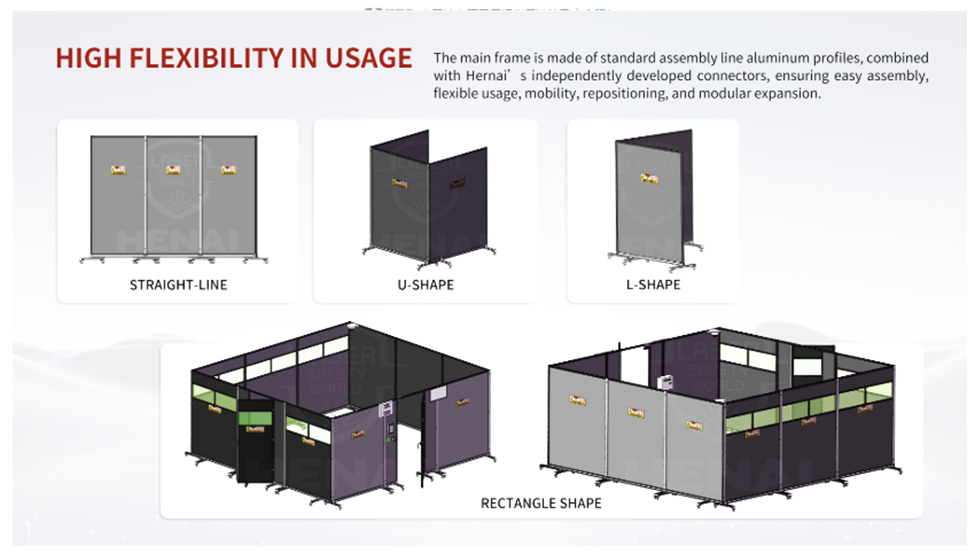
Access control during operation: No untrained personnel should enter the welding area while the machine is active. In smaller shops, a simple verbal "laser on" call and a closed door are often sufficient. Larger production environments may use a warning light outside the work area.
Windows and partitions: Near-infrared laser light at 1070 nm passes through standard glass and many plastic partitions. If your welding station is visible through a window or doorway, block the line of sight with a laser-rated barrier or opaque partition during use.
Flooring and work surface: Avoid highly reflective floors and surfaces near the weld area. Matte-finish work surfaces (dark anodized aluminum, painted steel, concrete) are preferable to bright polished ones.
6. Training
Every operator must be trained before using the machine. Training should cover:
- How the machine operates and how to stop it immediately (emergency stop location)
- The specific hazards of fiber laser welding
- Correct use of PPE (eyewear fit, when to wear it)
- Fume extractor startup and nozzle positioning
- Fire hazard recognition and extinguisher use
- What to do if equipment malfunctions
Ascent Equipment provides on-site installation and operator training with every machine we sell — this training covers all of the above in the context of your specific setup.
7. Regulatory and Insurance Considerations
Laser welders are regulated as Class 4 laser devices in both the United States and Canada. Relevant standards include:
- ANSI Z136.1 (US) — Safe Use of Lasers; the primary American standard for laser safety
- OSHA 29 CFR 1910.97 (US) — OSHA's nonionizing radiation standard for general industry
- IEC 60825-1 (International) — Laser product classification standard
Check with your insurance carrier before installation. Some commercial policies require documentation of laser safety training and PPE provision for Class 4 laser equipment. This is straightforward to obtain and usually adds no significant cost — but surprises after an incident are far more expensive.
What Your Machine Supplier Should Provide
When you purchase a fiber laser welder, your supplier should provide:
- The laser classification and wavelength specification for your specific machine
- PPE recommendations (OD rating and wavelength range for required eyewear)
- Fume extraction recommendation (CFM and filtration requirements)
- On-site training covering all safety procedures
- Copies of relevant safety documentation
If a supplier cannot answer these questions clearly before the sale, that is important information.
Summary: What Every Sign Shop Needs
| Item | Minimum Requirement |
|---|---|
| Laser safety eyewear | OD 5+ at 1064–1100 nm, EN 207 or ANSI Z136 rated |
| Fume extractor | HEPA + activated carbon, with capture nozzle |
| Welding gloves | Leather, full hand and wrist coverage |
| Fire extinguisher | Class ABC, within reach of weld station |
| Warning signage | ANSI laser warning label at each workspace entry |
| Training | On-site operator training before first use |
| Clear workspace | No combustibles within 3 feet of weld area |
The good news: the total cost of the safety equipment on this list is modest compared to the cost of the machine. And with the right PPE and setup, fiber laser welding is a safe, clean, and efficient process.
Contact us if you have questions about safety requirements for your specific setup or workspace.