
Ascent 2000W Handheld Fiber Laser Welder
Faster welding. Cleaner results. Continuous production. When production speed, weld quality, and operating efficiency matter, the Ascent 2000W Handheld Fiber Laser Welder offers a genuine alternative to conventional MIG welding.
Why Laser Welding Outperforms MIG Welding
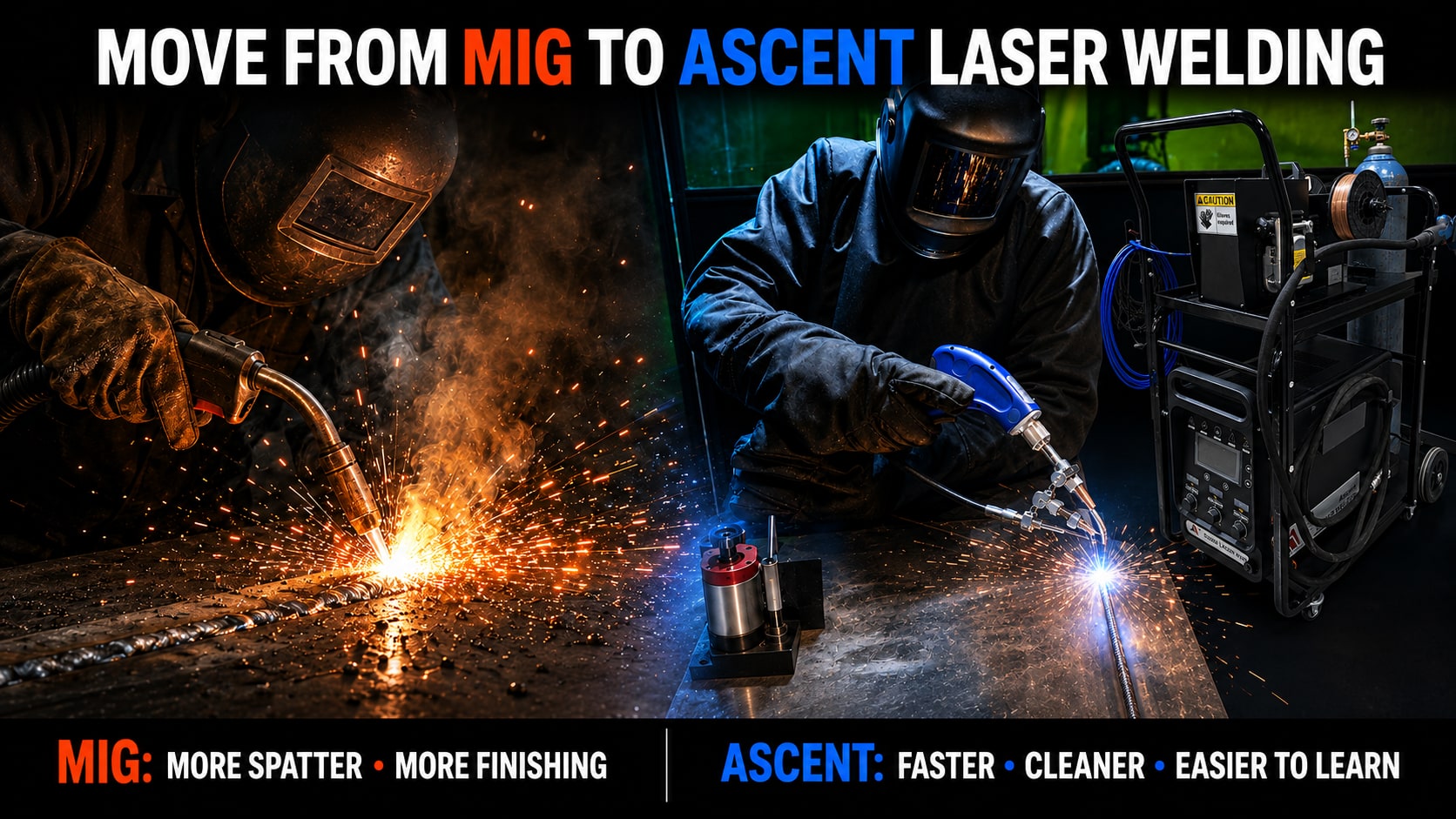
For thin- and medium-gauge stainless steel, carbon steel, galvanized steel, and aluminum, the Ascent fiber laser welder produces welds that are faster, cleaner, and more precise than traditional MIG welds. Operators with no prior welding experience can be trained to weld aluminum in just 3 to 4 hours.
Its concentrated laser beam creates a narrow, controlled weld while transferring less heat into the surrounding material:
- Faster welding speeds
- Deep, consistent penetration
- Less warping and distortion
- Reduced discoloration and minimal spatter
- Smaller, cleaner weld seams
- Less grinding, polishing, and post-weld finishing
MIG welding remains useful for heavy fabrication, large gaps, and components with less precise fit-up. But when appearance, speed, precision, and reduced finishing time matter, laser welding provides a real production advantage.
Advantages of Industrial Refrigeration Cooling
Unlike basic air-cooled systems, the Ascent 2000W uses an industrial refrigeration cooling system with two independent circuits — one cools the laser source, the other independently cools the torch. This keeps operating temperatures stable during extended use and protects the system's most important components:
- Stable laser output during continuous production
- Sustained welding performance and penetration
- Reliable operation across −20°C to +60°C (−4°F to +140°F)
- A 100% duty cycle, with no scheduled cooling breaks
- Longer component life through controlled operating temperatures
- Up to 60% lower energy consumption than less-efficient cooling systems, depending on the application
This cooling platform is built for demanding, high-volume production environments.
Super High-Speed Wobble Technology
The super high-speed wobble head rapidly moves the laser beam across the weld area, creating a wider, more controllable weld seam. This lets operators weld faster while producing strong, uniform results, and the adjustable wobble pattern accommodates different materials, joint configurations, and weld widths.
Advantages of the Lightweight Torch
A torch may feel manageable for a few minutes, but its weight becomes extremely important over a full production shift. The Ascent laser torch weighs only 1.32 pounds (600 grams):
- Less hand, wrist, arm, and shoulder fatigue
- Better torch control and accuracy
- Easier access to corners and tight positions
- More comfortable vertical and overhead welding
- Higher productivity during long shifts
- A shorter learning curve for new operators
For extended reach, Ascent also offers an industry-leading 15-meter (49-foot) torch cable, so operators can work on oversized signs, cabinets, frames, and assemblies without constantly repositioning the welder.
Why Choose Ascent
A laser welder is more than a piece of equipment — its long-term value depends on cooling performance, torch design, included accessories, proper training, and dependable technical support. The Ascent 2000W combines:
- Industrial refrigeration cooling
- Independent dual-circuit temperature control
- A lightweight, 600-gram welding torch
- Super high-speed wobble head
- 100% continuous-duty operation
- An optional 15-meter torch cable
- Automatic single- or dual-wire feeding
- On-site installation and operator training
- Local North American technical support
- Lifetime technical assistance
While many suppliers simply deliver a machine, Ascent helps customers install it, learn to operate it safely, optimize welding settings, and integrate it into production. With support available from Buffalo, Toronto, and Kentucky, help is close to home.
Complete, Production-Ready Package
The Ascent 2000W package includes:
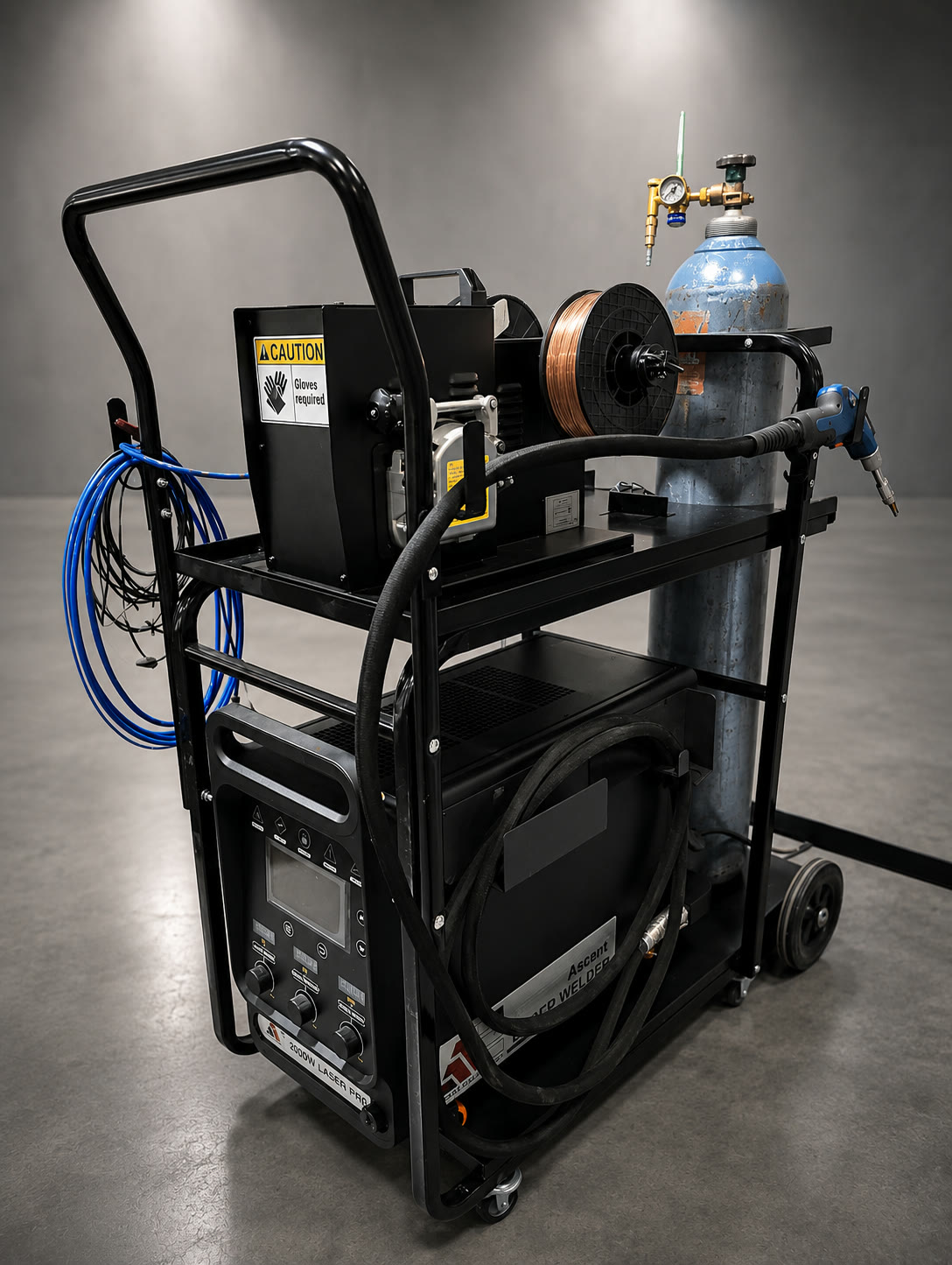
- Automatic wire feeder for single- or dual-wire operation
- One spool of 1.2mm aluminum welding wire
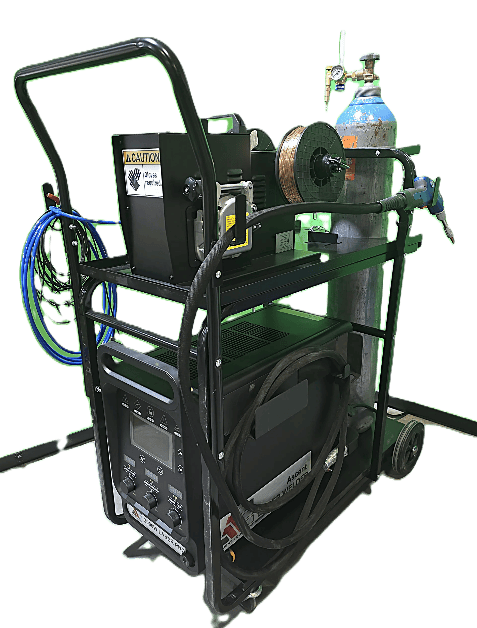
- Combined laser-welder and argon-gas-tank trolley
- Fiber laser welding helmet (one)
- OD 8 laser safety goggles (one pair)
- Standard welding gloves
- Assorted laser welding nozzles
- Replacement laser-torch protective lenses
The Ascent 2000W Handheld Fiber Laser Welder delivers the speed of advanced laser technology, the stability of industrial refrigeration cooling, and the confidence of local training and support.
Weld faster. Reduce finishing. Increase production.
See full specs and request a quote on the Ascent 2000W product page, or read how it compares to the competition.