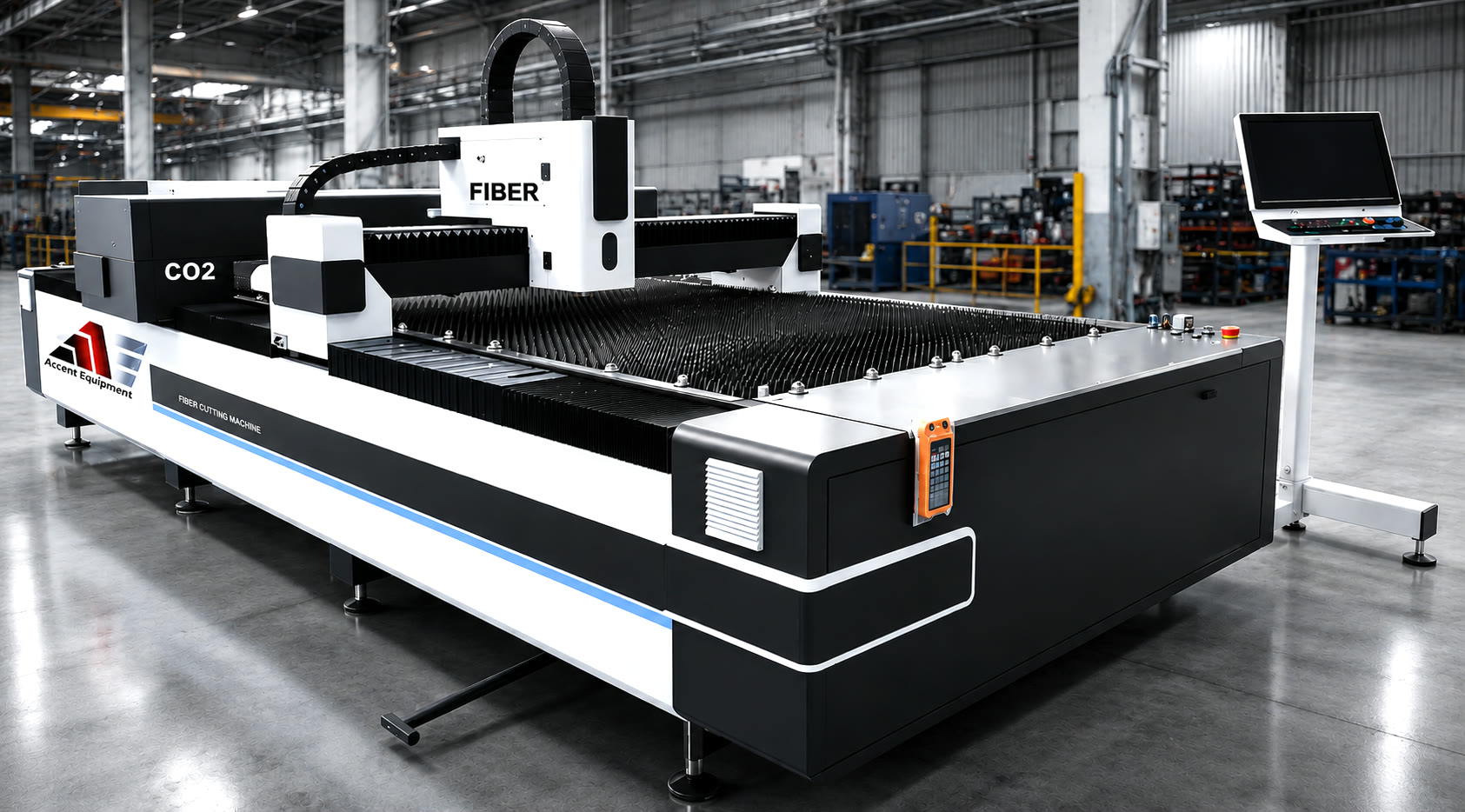

If you run a dual-gantry laser cutter — one head for CO₂ (acrylic, wood, plastics) and one for fiber (aluminum, steel) — you're operating two fundamentally different technologies on the same table. That's a major throughput advantage, but it also means two distinct sets of consumables to track, stock, and budget for.
This guide covers exactly what wears out, how often, what to keep on the shelf, and what to expect in annual costs. Consumables can be purchased directly from Ascent Equipment or from any reputable laser parts supplier.
Why CO₂ and Fiber Consumables Are Different
CO₂ lasers generate light through a gas-filled tube and bounce it through a series of mirrors before focusing it with a lens. Every optical surface in that path is a potential wear item.
Fiber lasers generate light directly inside a doped fiber cable and deliver it through a flexible beam path to the cutting head. There are no mirrors, no tube to replace, and far fewer optical components — which is why the consumable list is shorter.
| Consumable | 500W CO₂ | 3000W Fiber | Typical Replacement |
|---|---|---|---|
| Cutting nozzles | ✅ | ✅ | As needed — damage or spatter buildup |
| Protective window (cover glass) | — | ✅ | Every 1–6 months depending on production volume |
| Focus lens | ✅ | Rarely | Every 1–3 years if damaged |
| Mirrors | ✅ | — | Every 1–3 years |
| Ceramic ring | — | ✅ | When cracked or visibly worn |
| Laser tube | ✅ | — | 8,000–12,000 operating hours |
| Fiber laser source | — | Rarely | 100,000+ hours — not a routine consumable |
| Air filters | ✅ | ✅ | Monthly to quarterly |
| Chiller coolant | ✅ | ✅ | Yearly |
| Assist gas | Air | Oxygen, Nitrogen | As consumed |
CO₂ Laser Consumables (500W)
The CO₂ side has more wear items because light travels through more components before it reaches the material.
Primary wear items:
- CO₂ laser tube
- Focus lens
- Mirrors (typically three in the beam path)
- Cutting nozzles
- Lens cleaning tissue and optical cleaning fluid
- Water chiller coolant
- Air-assist filters
- Exhaust / fume filters (if your system is equipped)
Typical replacement schedule for a well-maintained system:
- Laser tube: every 2–4 years depending on operating hours
- Mirrors: every 2–5 years
- Focus lens: every 1–3 years
The laser tube is the single biggest cost item on the CO₂ side. Keeping it clean, keeping your chiller at the correct temperature, and not running the tube at maximum power continuously will all extend its life significantly.
Fiber Laser Consumables (3000W)
The fiber laser side has a much shorter consumables list — this is one of the practical advantages of fiber technology over CO₂ for cutting metal.
Main wear items:
- Cutting nozzles (the most frequently replaced item)
- Protective windows (cover glass that sits in front of the focusing optic)
- Ceramic rings
- O-rings
- Lens cleaning supplies
- Chiller coolant
- Gas filters
- Assist gas (oxygen, nitrogen, or compressed air depending on material)
The fiber laser source itself is not a routine consumable. At 100,000+ rated hours, most shops will never replace it. The items you'll actually be ordering regularly are nozzles, cover glass, and ceramic rings.
Recommended Spare Parts Kit
For a shop running one shift per day, this is a sensible minimum stock to keep on hand. Adjust quantities upward for two- or three-shift operations.
CO₂ side:
- 2 focus lenses
- 2 complete mirror sets
- 5 cutting nozzles (mixed diameters)
- 1 spare laser tube (optional — only necessary if unplanned downtime is critical to your operation)
- Lens cleaning kit (tissue + optical cleaning fluid)
- Chiller coolant (manufacturer-specified)
Fiber side:
- 10–20 cutting nozzles in various diameters
- 10 protective windows (cover glass)
- 5 ceramic rings in various sizes
- O-ring assortment kit
- Lens cleaning kit
- Chiller coolant (distilled water — check your chiller spec)
Having these on the shelf means most maintenance events are a 15-minute swap rather than a multi-day wait for parts. Protective windows in particular can go quickly in high-production environments — running out of them is one of the most avoidable causes of downtime.
Approximate Annual Consumable Cost
These figures reflect a single-shift operation at moderate production volume. Heavier production or cutting reflective metals will push costs toward the upper end.
| Machine | Annual Consumable Cost (Light Production) |
|---|---|
| 500W CO₂ Laser | $300 – $800 / year |
| 3000W Fiber Laser | $500 – $1,500 / year |
For most sign shops, annual consumable costs across both systems run well under $2,500 — a fraction of the labor savings from running automated cutting versus hand-routing and sawing.
What to Keep on the Shelf
The dual-gantry setup gives you two technologies, two material capabilities, and one footprint. The CO₂ side asks you to maintain an optical path; the fiber side asks you to keep the cutting head clean and stocked with nozzles and cover glass. Neither is demanding if you stay ahead of it.
The shops that have the most downtime are the ones that run out of protective windows on a Friday afternoon. Stock the kit above, check your coolant annually, and keep your optics clean — and the machine will run consistently for years.
Questions about consumables for the Ascent dual-gantry system? Contact us or visit the product page for full specifications.