
CO₂ vs. Fiber Laser Cutters for the Sign Industry
Choosing the right laser cutter is one of the most important investments a sign company can make. Today's shops produce everything from acrylic dimensional letters and illuminated channel letters to stainless steel logos, aluminum cabinets, and architectural signage. Two laser technologies dominate the industry:
- CO₂ laser cutters
- Fiber laser cutters
Although both are called "laser cutters," they use completely different technologies and are designed for different materials. Understanding their strengths and limitations will help you select the right equipment, improve production efficiency, and maximize your return on investment.
How Does a CO₂ Laser Cutter Work?
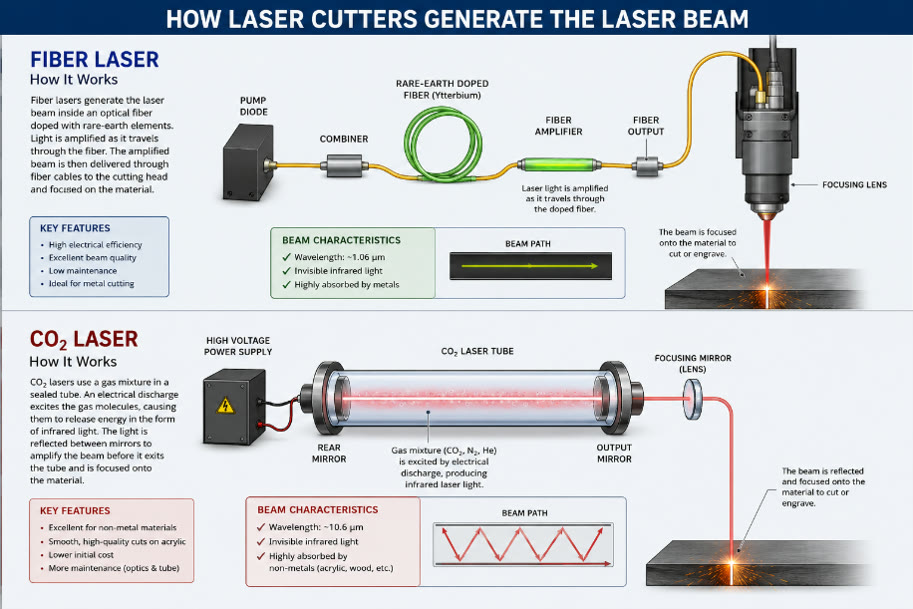
A CO₂ laser uses a gas mixture — primarily carbon dioxide — to generate an infrared laser beam with a wavelength of approximately 10.6 μm. This wavelength is highly absorbed by organic and non-metallic materials, making CO₂ lasers ideal for sign fabrication.
Best materials:
- Acrylic
- Wood and MDF
- PVC-free plastics
- Foam, rubber, leather, fabric
- Paper and cardboard
For most sign shops, a CO₂ laser is the preferred choice for producing acrylic components because it leaves a smooth, polished edge that often requires little or no finishing.
How Does a Fiber Laser Cutter Work?
Fiber lasers generate light through optical fibers doped with rare-earth elements such as ytterbium. Operating at approximately 1.06 μm, the beam is readily absorbed by metals, enabling extremely fast, precise cutting.
Best materials:
- Stainless steel
- Aluminum
- Mild steel and galvanized steel
- Brass, copper, titanium
Fiber lasers have transformed metal fabrication by replacing slower methods such as plasma cutting, waterjet cutting for thin materials, and many mechanical cutting processes.
Material Comparison
| Material | CO₂ Laser | Fiber Laser |
|---|---|---|
| Acrylic | ★★★★★ | ✖ |
| Wood | ★★★★★ | ✖ |
| MDF | ★★★★★ | ✖ |
| Plastics | ★★★★★ | Limited |
| Stainless Steel | Limited | ★★★★★ |
| Aluminum | Poor | ★★★★★ |
| Brass | Poor | ★★★★★ |
| Copper | Poor | ★★★★★ |
| Mild Steel | Limited | ★★★★★ |
Edge Quality
CO₂ laser: Produces exceptionally smooth, flame-polished edges on acrylic — high optical clarity, minimal finishing, premium appearance. Excellent for illuminated signs where the edge is visible through the face.
Fiber laser: Produces very square edges with minimal burr and high dimensional accuracy. The resulting edges are ideal for channel letters, architectural signage, and fabricated metal products where fit-up for welding matters.
Speed
For acrylic: CO₂ laser wins. For metal: Fiber laser wins.
Each technology is optimized for different materials rather than competing directly. Comparing them head-to-head on speed only makes sense when both can cut the same material — and for the materials that matter most in sign production, each technology has a clear advantage in its own domain.
Typical Sign Industry Applications
CO₂ laser applications:
- Acrylic letters and push-through faces
- LED diffuser panels
- Wayfinding and ADA signage
- Acrylic logos and stencils
- Display components and interior signage
- Point-of-purchase displays
Fiber laser applications:
- Channel letter returns
- Stainless steel logos
- Aluminum cabinet parts and raceway components
- Mounting brackets and decorative metal panels
- Architectural signage
- Precision sheet metal parts and fabricated sign structures
Operating Costs
CO₂ laser typical operating considerations:
- Laser tube maintenance or replacement
- Optical mirror and lens cleaning
- Beam alignment
- Higher electrical consumption than an equivalent fiber system
Fiber laser general requirements:
- Minimal optical maintenance — no mirrors for beam delivery
- Longer laser source life
- Lower maintenance requirements overall
- High electrical efficiency
Maintenance Comparison
CO₂ routine maintenance:
- Cleaning mirrors and lenses
- Beam alignment
- Cooling system checks
- Laser tube servicing
Fiber routine maintenance:
- Cleaning the protective lens
- Maintaining the chiller
- Checking assist gas systems
- General preventive inspections
Fiber lasers carry a lower ongoing maintenance burden, which matters for shops running high daily production volume.
Which Produces Better Quality?
The answer depends entirely on the material.
For acrylic: CO₂ lasers produce superior cosmetic results. For metal: fiber lasers provide outstanding precision, speed, and repeatability.
Neither technology replaces the other — they complement each other.
Why Many Modern Sign Shops Run Both
Growing sign manufacturers often install both technologies because each excels in different applications. A common production workflow:
- Design the project
- Cut acrylic faces and display components with the CO₂ laser
- Cut stainless steel or aluminum parts with the fiber laser
- Bend channel letter returns on the bending machine
- Weld assemblies using a handheld fiber laser welder
- Paint, assemble, and install
This combination creates a highly efficient production process while maintaining excellent quality across the full range of letter types a sign shop is likely to produce.
The Ascent Equipment Advantage
Ascent Equipment offers laser solutions designed specifically for the sign industry, including an innovative dual-gantry system that combines independent CO₂ and fiber-laser cutting technologies on a single integrated platform.
Key benefits include:
- Independent CO₂ and fiber laser gantries
- Simultaneous processing of acrylic and metal components
- Large-format cutting areas for sign production
- Optimized workflow for mixed-material projects
- Reduced handling and setup time
- Increased productivity for modern sign shops
For a shop producing a mix of acrylic and metal components — dimensional letters, stainless steel logos, reverse halo channel letters, architectural signage — that's one machine handling the full range instead of two.
Match the Laser to the Material
The question isn't whether CO₂ or fiber laser technology is better — it's which is better for the material you're cutting.
If your business focuses on acrylic signs, displays, and illuminated faces, a CO₂ laser remains the gold standard. If your production centers on metal fabrication, channel letters, and architectural signage, a fiber laser is the clear choice.
For many growing sign manufacturers, the most productive setup uses both technologies together, covering the widest range of sign applications without a quality tradeoff. Contact us to discuss the right laser configuration for your production mix.