
How to Price Channel Letters in 2026 When Using Ascent Equipment
Pricing channel letters is not complicated — but most shops get it wrong in one of two ways: they price from habit without knowing their actual costs, or they know their costs but don't account for the fact that their equipment has changed what those costs actually are.
If you've added a CNC bending machine, a laser welder, or a laser cutter in the last few years, your cost structure is different from a shop still doing those steps by hand. The pricing logic needs to reflect that — not because it lets you charge more, but because if it doesn't, you're leaving margin on the table or losing jobs you could win comfortably.
This post covers the two main pricing frameworks, breaks down the real cost of a channel letter by component, explains how each Ascent machine — the 5AS, Ascent EDGE-3, Ascent TMB-3, laser welder, and laser cutter — changes those costs, and shows five shop configurations side by side so you can see exactly where your pricing power comes from.
The Two Pricing Models
1. The Inch Rule
The most widely used shorthand in the sign industry. Price is set as a dollar amount per vertical inch of letter height, multiplied by the number of characters.
Price = letter height (inches) × price per inch × number of letters
For example: 12 letters at 18" height, at $22/inch = 12 × 18 × $22 = $4,752
The "price per inch" varies by letter type:
| Letter type | Typical fabrication-only range |
|---|---|
| Standard front-lit aluminum | $12–18/inch |
| Trimless (Ascent extrusion system) | $14–20/inch |
| Reverse halo | $16–22/inch |
| Stainless steel, brushed or mirror | $25–40/inch |
| Painted custom colors | add $2–5/inch |
These are fabrication-only rates — letters delivered to a sign company for installation. If your shop handles installation directly, add crew, vehicle, and electrical on top.
The inch rule is fast to quote, but it's a shorthand, not a cost model. It works only if your actual costs come in below that rate — and the right way to know that is to do the cost-plus calculation and compare.
2. Cost-Plus
Build the price from actual cost: materials + direct labor + machine overhead + shop overhead, then apply your target margin.
Price = (materials + labor + overhead) ÷ (1 − target margin)
Cost-plus takes longer to calculate but it's the right method for unusual jobs, large orders, high-material-cost letters, or any time the inch rule feels like a guess. It also tells you whether your inch-rule rates are calibrated correctly. If the two methods diverge significantly, one of your numbers is wrong.
What a Channel Letter Actually Costs
Materials
Aluminum coil (side returns): The primary structural material. Cost depends on gauge, coil width, and current commodity pricing. Track your cost per letter by gauge and height — aggregate material cost per job hides the per-letter reality.
Acrylic face: Usually 1/8" or 3/16" translucent acrylic. White is cheapest; opal, prismatic, and custom colors run higher. Your nesting efficiency from the laser cutter directly affects this number — better utilization means less waste per job.
Aluminum back panel: Standard 0.040" aluminum sheet, cut to letter shape. Low unit cost but material-significant for large letters or large quantities.
LEDs and driver: One of the more variable line items. Quality LED modules appropriate for the letter depth and ambient temperature, plus the right driver, can range from $12 to $25 per letter depending on size and specification.
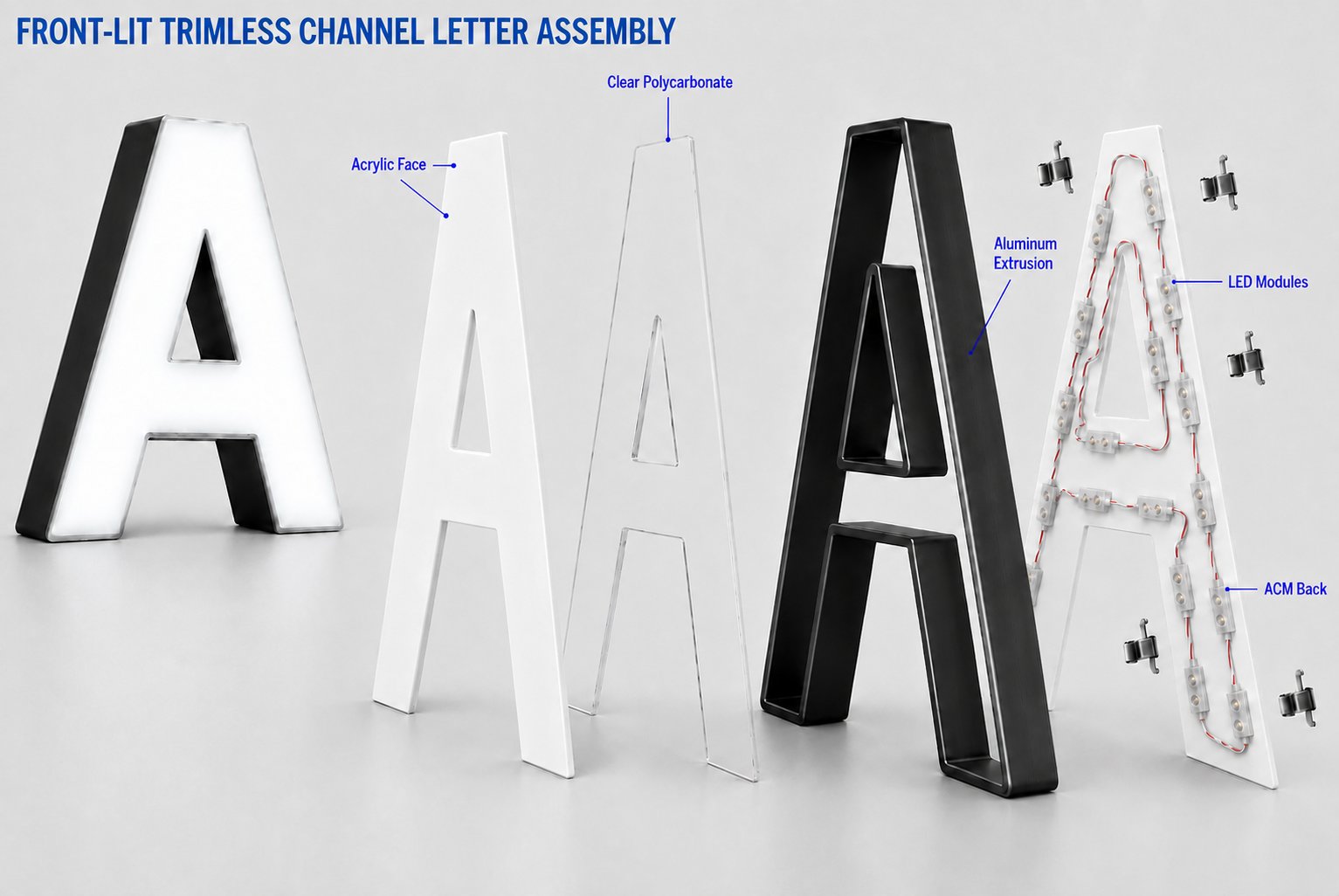
Trim cap or extrusions: For conventional letters, plastic trim cap is sold by the foot. For aluminum trim letters (Ascent TMB-3), the raw aluminum coil for trim runs approximately 25% cheaper per foot than plastic trim. For trimless letters (5AS), Ascent aluminum extrusion profiles replace trim cap entirely — the extrusion cost is competitive with plastic trim while eliminating the labor to apply it.
Hardware and consumables: Clips, screws, wire, connectors, paint touch-up. Small per unit; it adds up across a month.
Direct Labor — and How Each Machine Changes It
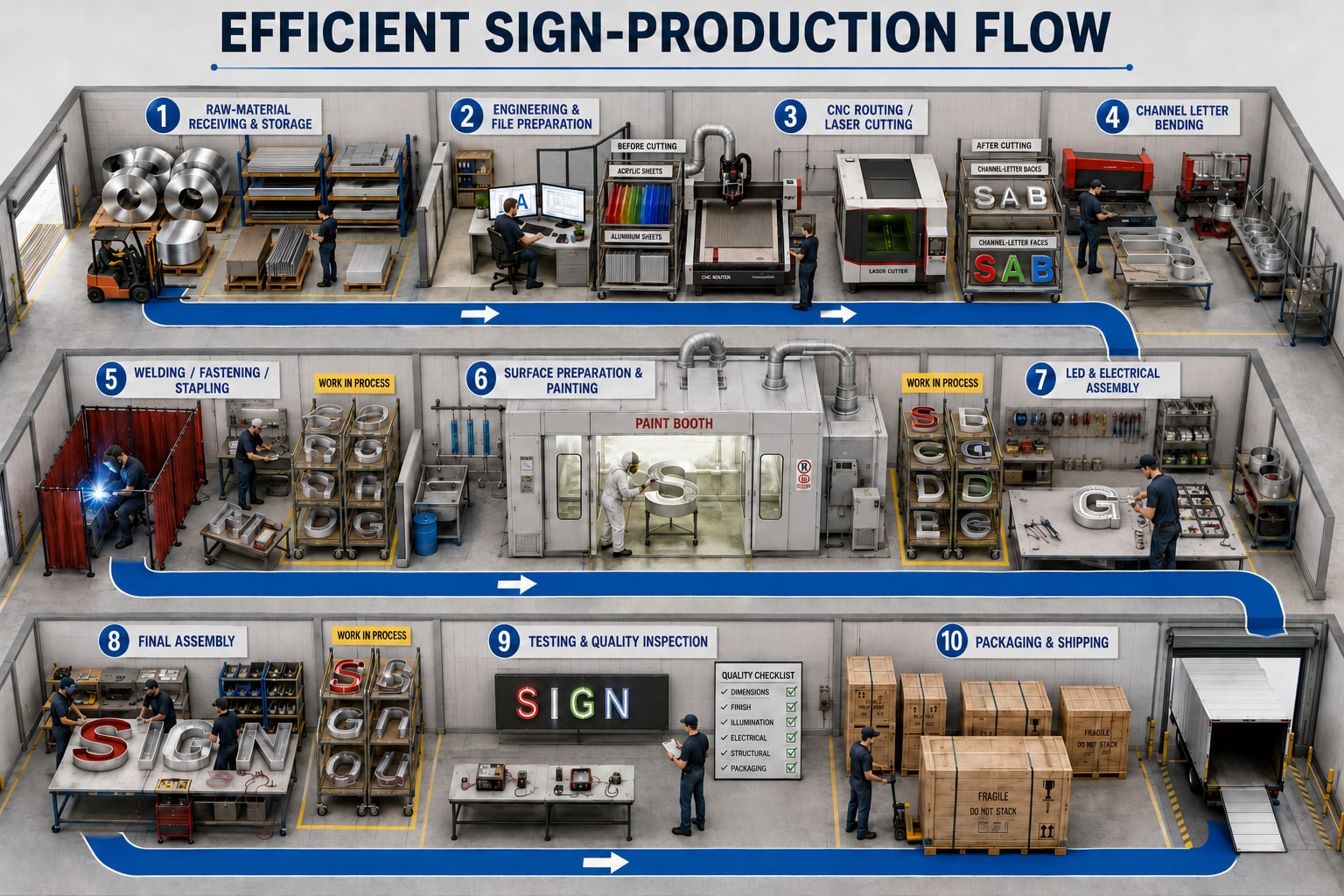
Labor is the most controllable cost in channel letter production, and the most dramatically affected by equipment. The table below shows time per letter for each key production step, across machine configurations.
| Step | By hand | Ascent EDGE-3 | Ascent TMB-3 | 5AS | + Laser welder | + CO2 / fiber cutter |
|---|---|---|---|---|---|---|
| Design / DXF prep | Same | Same | Same | Same | Same | Same |
| Bend side returns | 30–45 min | 6–10 min | 5–8 min | 3–4 min | 3–4 min | 3–4 min |
| Trim cap / trim (plastic) | 10–20 min | 10–20 min | — | — | — | — |
| Aluminum trim (from coil) | — | — | 3–5 min | — | — | — |
| Extrusion system (trimless) | — | — | — | 2–3 min | 2–3 min | 2–3 min |
| Close letter (welding) | TIG: 15–25 min | TIG: 15–25 min | TIG: 15–25 min | TIG: 15–25 min | Laser: 5–8 min | Laser: 5–8 min |
| Weld cleanup / grinding | 5–10 min | 5–10 min | 5–10 min | 5–10 min | Minimal | Minimal |
| Cut acrylic faces | Outsourced | Outsourced | Outsourced | Outsourced | Outsourced | In-house: fast |
| Cut aluminum backs | Outsourced | Outsourced | Outsourced | Outsourced | Outsourced | In-house: fast |
| LED installation / QC | Similar across all configurations |
What Each Machine Contributes to Your Pricing Power
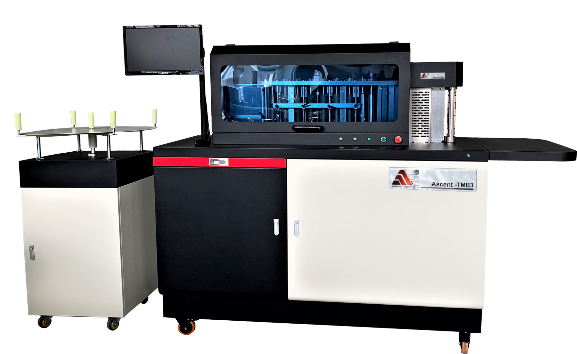
Ascent 5AS — Trimless and Halo Specialist
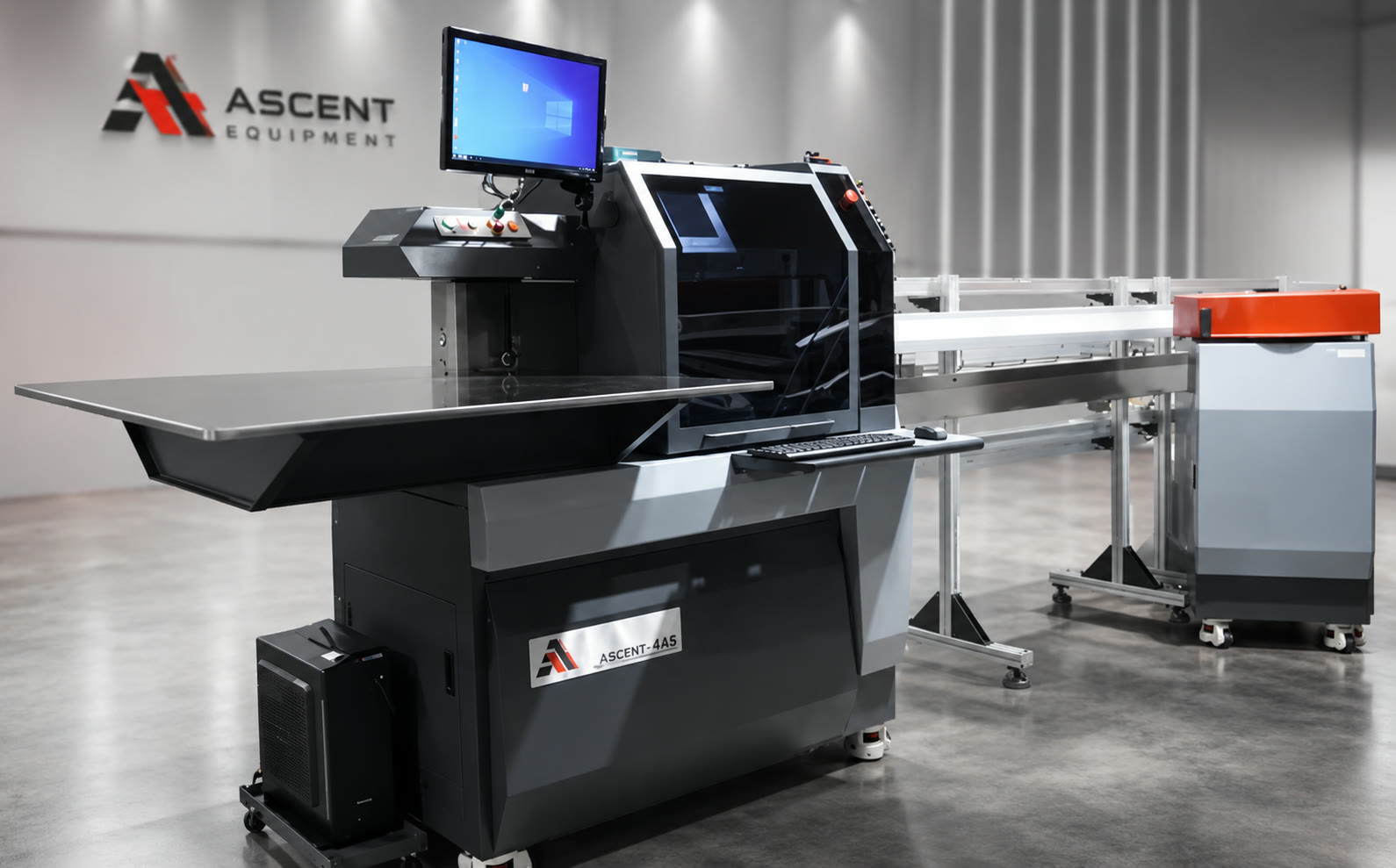
The 5AS reduces bending time from 30–45 minutes per letter to 3–4 minutes. For a 15-letter job, that's the difference between 10 hours of skilled bending labor and 1 hour. At $30/hour, that's $270 saved on bending alone — every job.
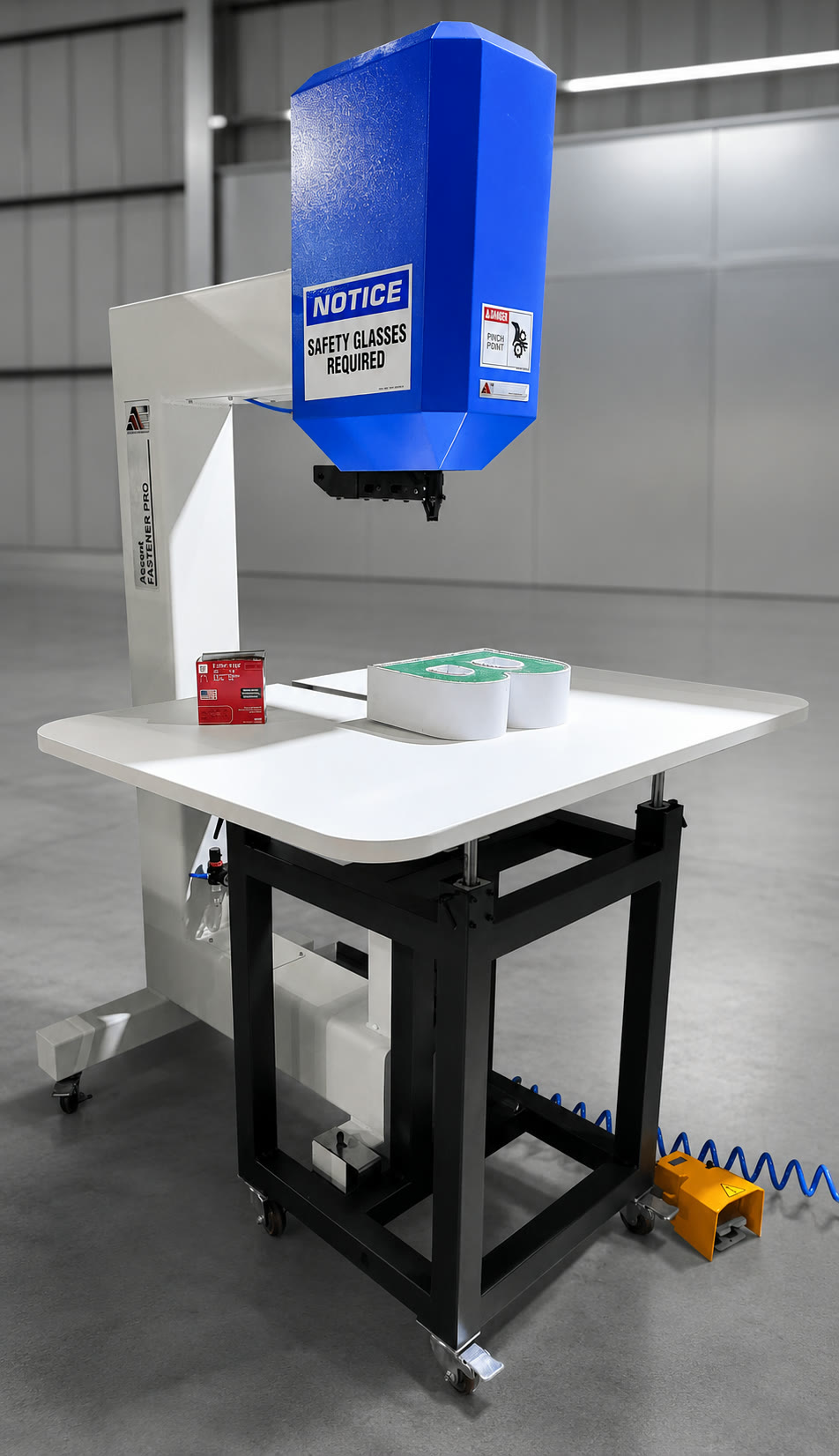
Beyond speed, the 5AS eliminates the trim cap step entirely for trimless letters. No trim to cut, fit, corner-miter, staple, or finish. The extrusion profile is applied in 2–3 minutes per letter using Ascent's pneumatic nail system — faster and cleaner than the trim cap process it replaces.
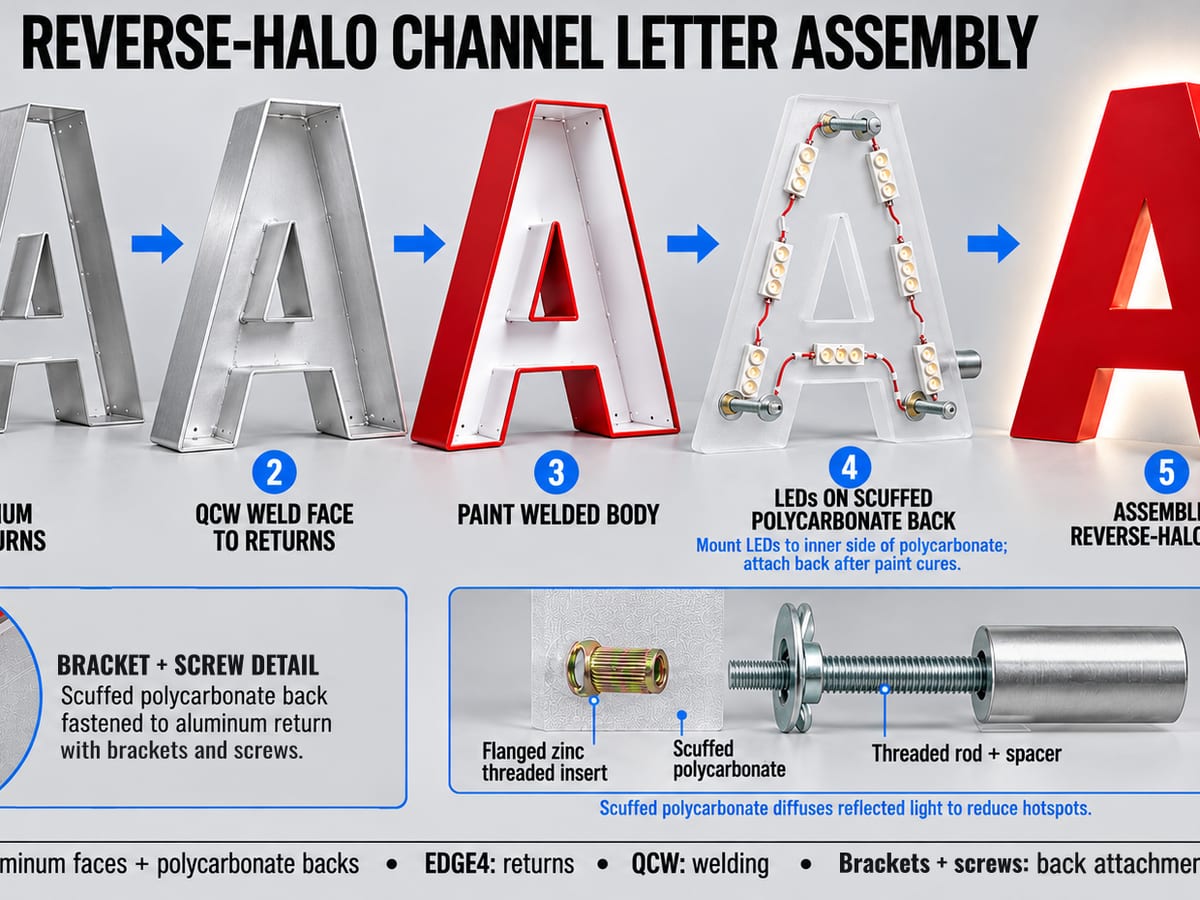
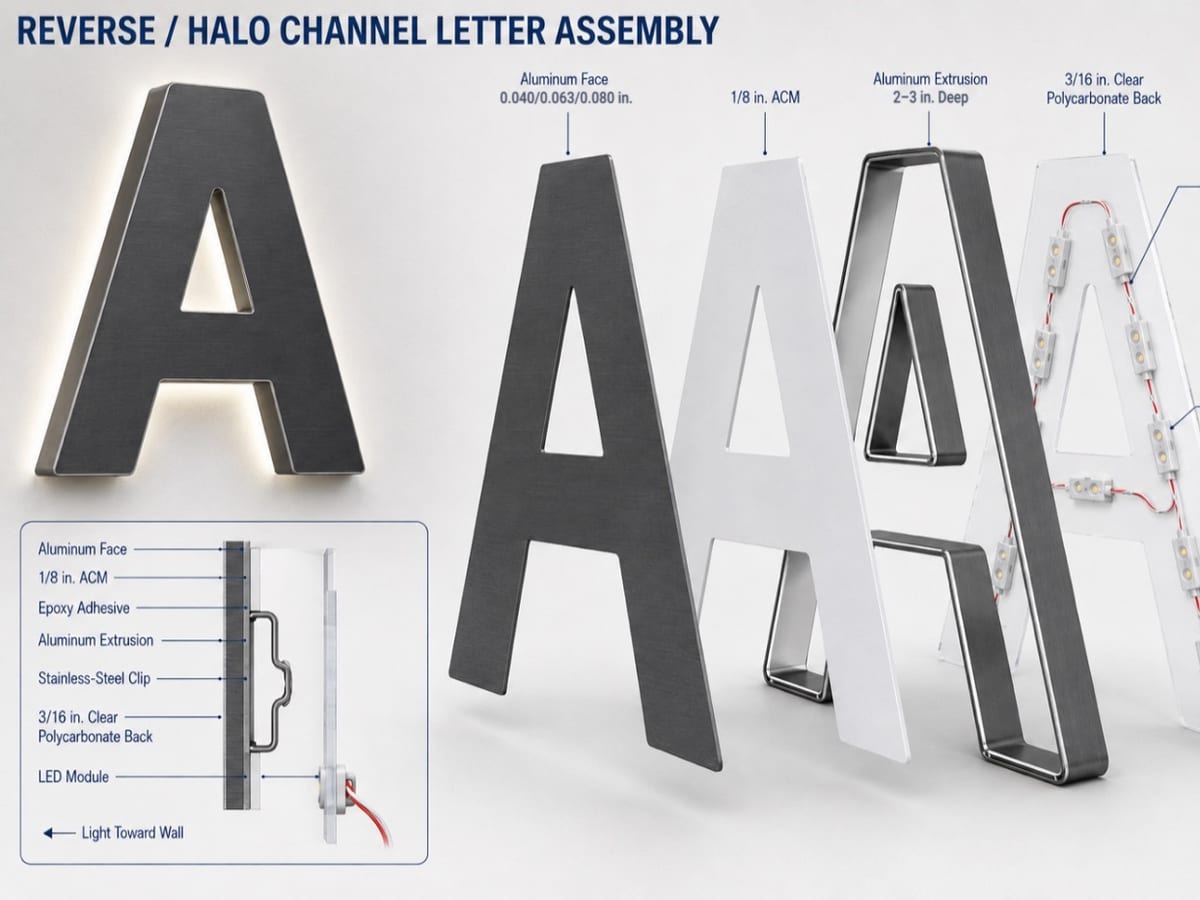
For reverse halo letters, the 5AS also eliminates the welding step on the return itself, because the extrusion system holds the back without welds. This further reduces both labor and material cost on halo jobs.
Pricing implication: A 5AS shop can offer trimless and halo letters at competitive prices while maintaining higher margins than conventional shops, because their labor cost on those styles is dramatically lower.
Ascent EDGE-3 — Traditional Letters, Automated
The Ascent EDGE-3 automates notching, flanging, and bending for traditional trim-cap letters — the conventional front-lit and halo-with-welding styles most sign shops produce. Bending time drops from 30–45 minutes to 6–10 minutes per letter.
Unlike the 5AS, the Ascent EDGE-3 doesn't eliminate the trim cap step — you still apply plastic or aluminum trim after bending. But the bending step itself is significantly faster and more consistent, and the Ascent EDGE-3 handles 0.080" aluminum for bending, which is thicker stock than the 5AS handles. It also includes an integrated output cutter.
The Ascent EDGE-3 is the right machine for shops whose primary volume is conventional front-lit letters with trim, where the 5AS's extrusion system isn't the right fit, or where thicker aluminum is regularly used.
Pricing implication: An Ascent EDGE-3 shop saves roughly $240 in bending labor on a 15-letter job compared to hand-bending. This creates margin headroom without requiring a change in letter style.
Ascent TMB-3 — Traditional Letters with Aluminum Trim
Based on Ascent Equipment's review of publicly available North American machines as of August 2026, we have not identified another machine offering this same combination of capabilities. The Ascent TMB-3 converts flat aluminum coil directly into trim cap — the shaped extrusion that frames the letter face. This matters for two reasons.
First, aluminum trim costs approximately 25% less per foot than standard plastic trim. On a letter-heavy job, that material savings is meaningful. Second, the Ascent TMB-3 automates both the bending and trim production step — the machine shapes the side returns and makes the trim from the same coil, reducing the number of separate operations.
The Ascent TMB-3 also handles standard plastic trim for shops that still use it, making it a versatile machine for shops doing high volume in traditional trim-cap letters.
Pricing implication: The Ascent TMB-3 delivers a material cost reduction (aluminum vs plastic trim) and a labor reduction (automated trim production), making traditional letters cheaper to produce without changing their appearance to the end customer.
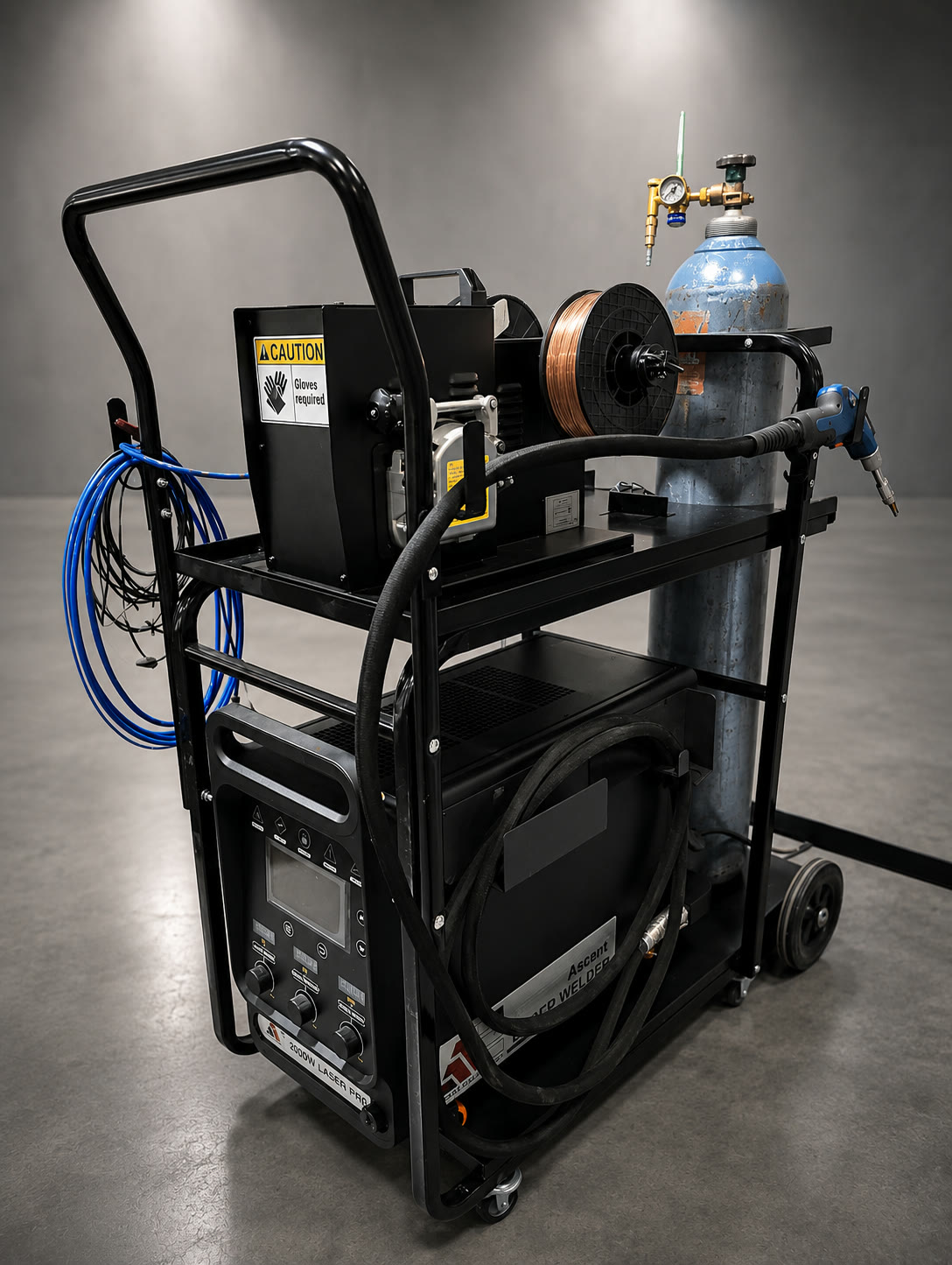
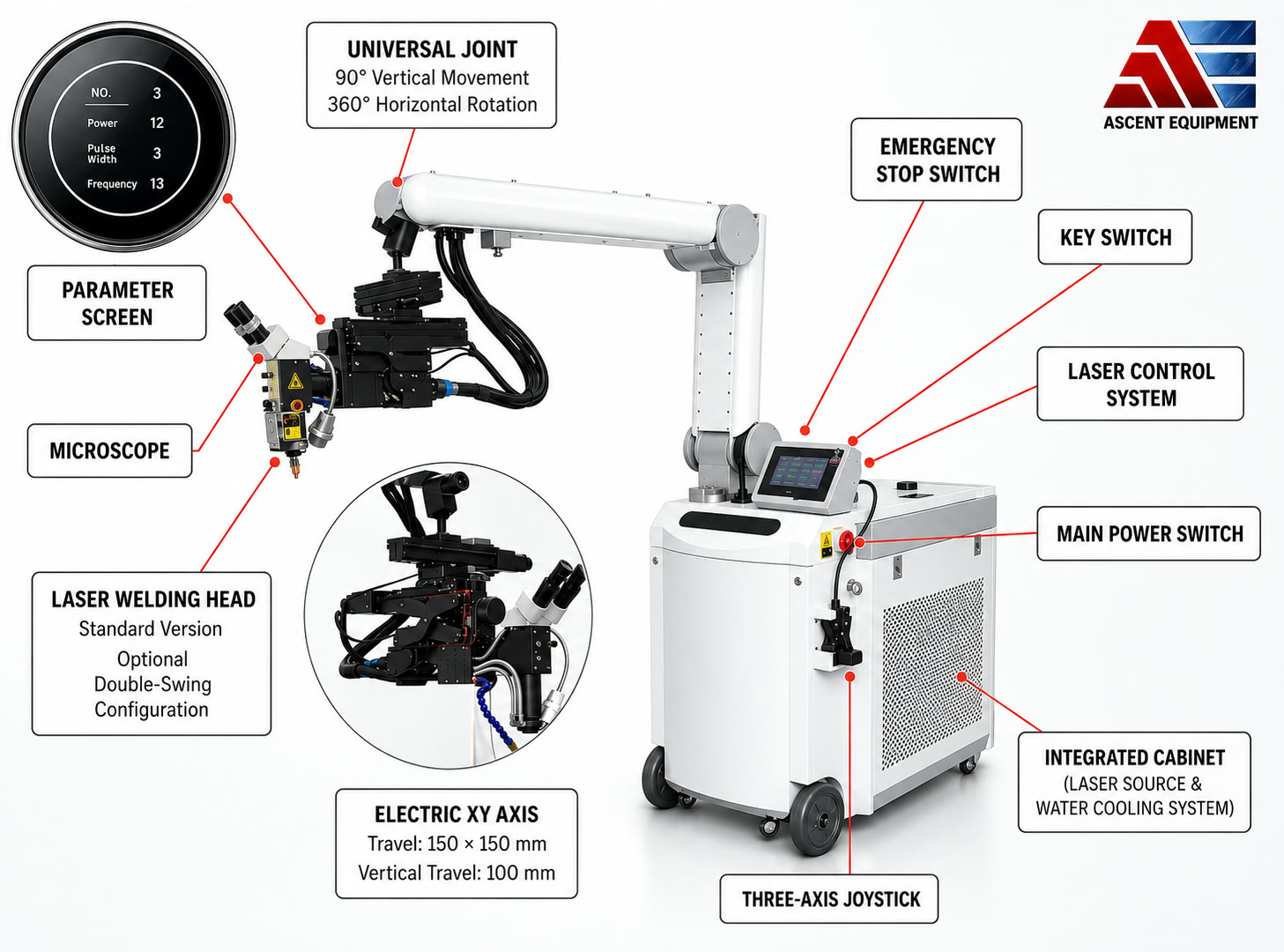
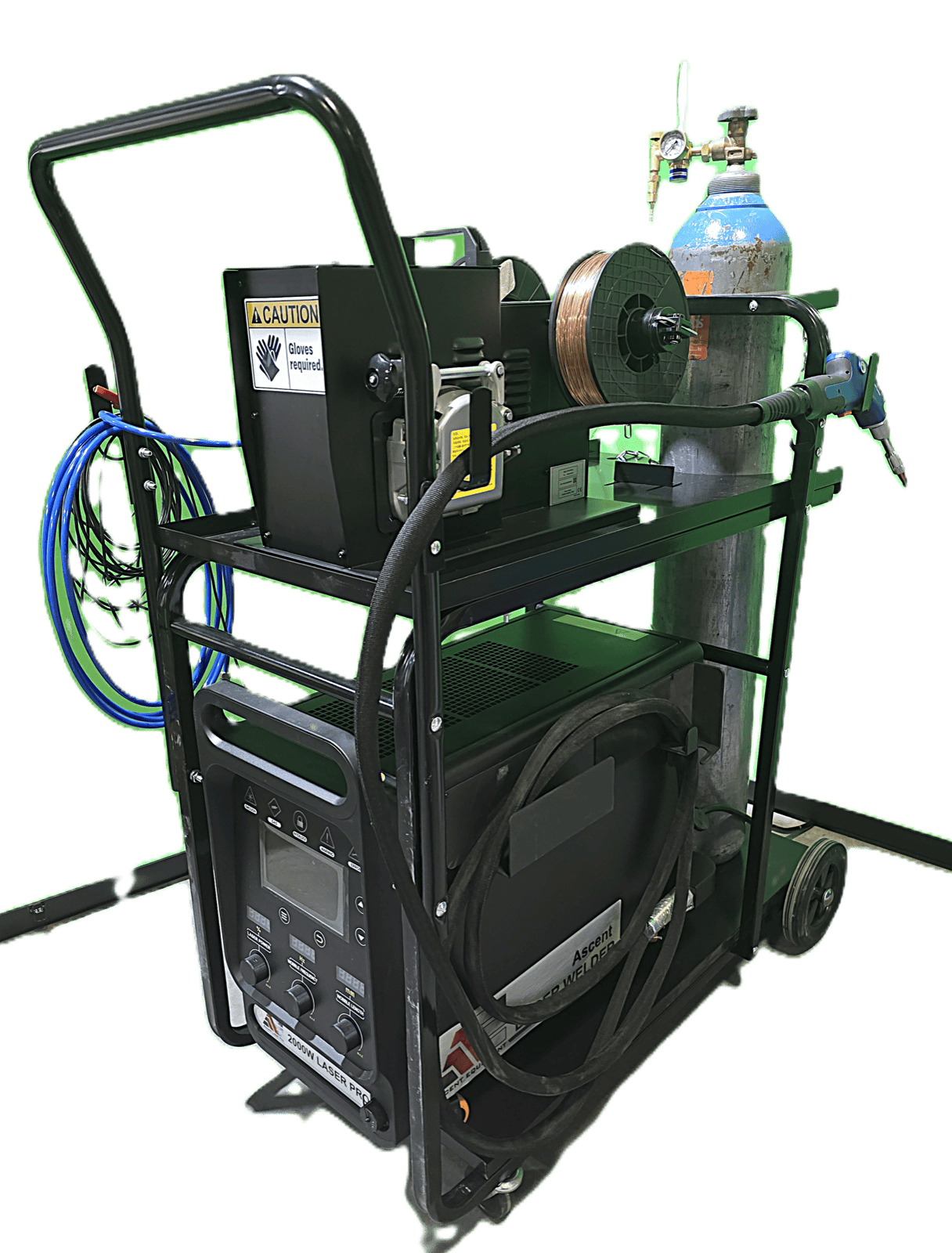
Laser Welder (Refrigeration Handheld)
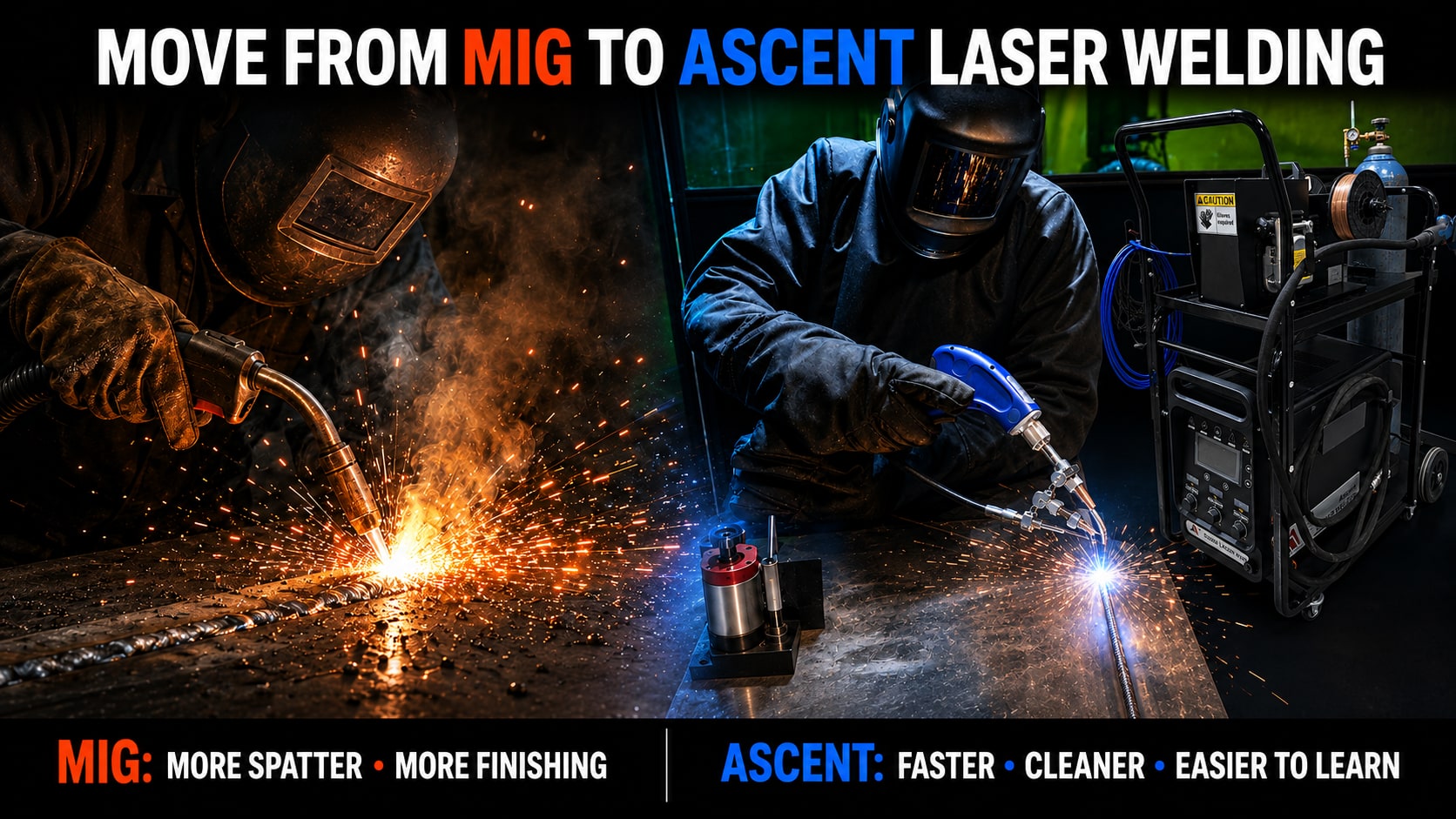
A fiber laser welder closes letters in 5–8 minutes versus 15–25 minutes for TIG. On a 15-letter job, that's the difference between 5 hours and 1.5 hours of welding labor — a savings of around $105 per job at $30/hour, before accounting for reduced rework.
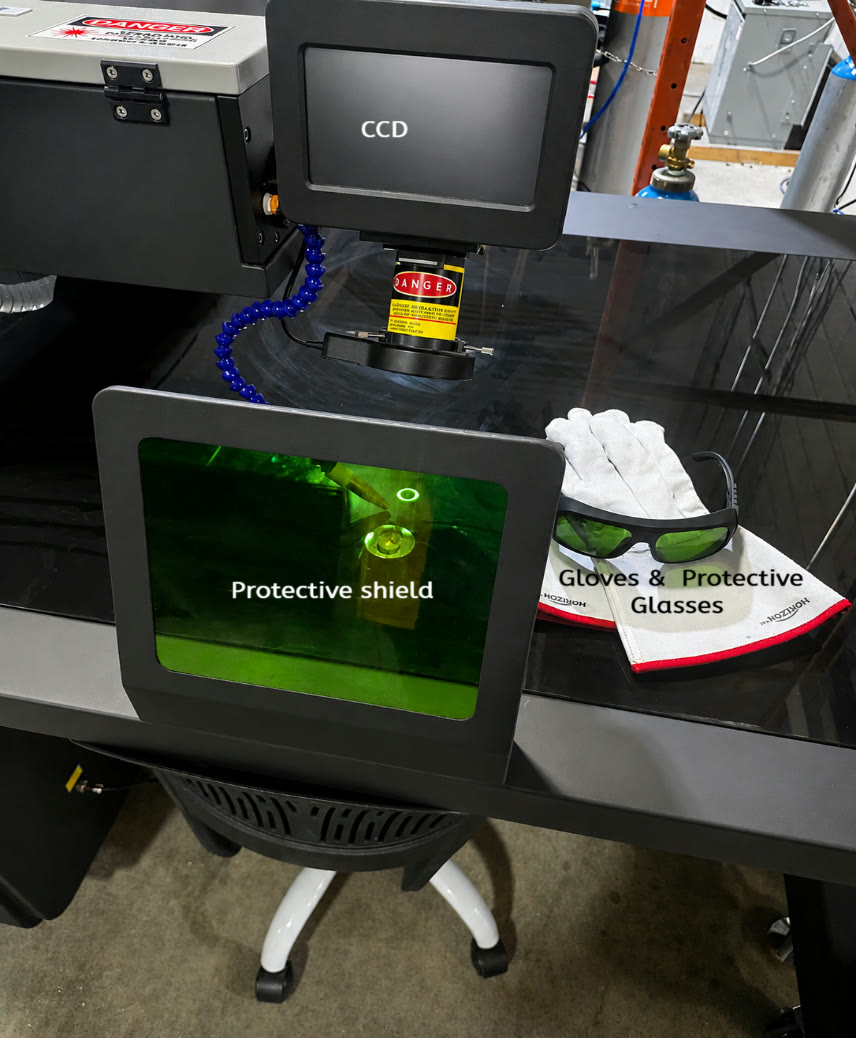
TIG welding channel letters — especially aluminum — introduces heat distortion that requires grinding, refinishing, and touch-up. Laser welding operates with a much smaller heat-affected zone. The weld is cleaner, distortion is minimal, and the grinding and cleanup step that follows TIG welding is largely eliminated.
Additionally, a laser welder can be operated productively by a less experienced fabricator after a few hours of training. The barrier to adding a welder to your team is lower than adding a qualified TIG welder.
Ascent's refrigeration fiber laser welders use a refrigerant heat pump to provide a 100% duty cycle for continuous operation without scheduled cooling breaks, within the published operating range of −20 °C to +60 °C. See the product page for the rated-power basis, cooling configuration and environmental limits.
Pricing implication: The laser welder saves $90–120 per 15-letter job in direct welding labor, eliminates most rework labor, and lets you staff the welding position more flexibly.
CO2 Laser Cutter — Acrylic and Non-Metal Cutting
Most channel letter shops that don't own a laser cutter outsource their acrylic face cutting to a trade shop, paying a markup on the cut parts plus absorbing the lead time. A CO2 laser cutter brings that step in-house.
The benefits are financial and operational. Financially, you capture the trade shop's markup as margin. Operationally, you control lead time — critical when a customer needs a rush turnaround. You also control nesting — how the letters are laid out on the sheet — which directly affects acrylic waste and material cost per job.
Pricing implication: Bringing acrylic cutting in-house typically saves $80–150 per job in outsource markup, and enables faster quoting and faster delivery on rush work.
Fiber Laser Cutter — Metal Cutting
A fiber laser cutter brings aluminum back panel cutting and steel hardware cutting in-house. Like the CO2 cutter, this captures outsource markup and gives you control over lead time and nesting. It also opens capabilities — cut aluminum brackets, custom mounting hardware, and other fabricated components that a shop without a fiber cutter has to source or outsource.
For shops already running a fiber cutter for metal channel letter work, the combination CO2 + fiber machine handles both workflows on one table.
Machine Overhead
Equipment ownership has a cost that belongs in every job's cost model.
Machine cost per job = annual equipment cost ÷ jobs per year
Annual equipment cost = (purchase price ÷ useful life) + maintenance + consumables
Below is an illustrative allocation for common Ascent equipment at 200 jobs per year:
| Machine | Useful life | Est. annual cost | Per job at 200/yr |
|---|---|---|---|
| 5AS bending machine | 10 yr | ~$5,600 | ~$28 |
| Ascent EDGE-3 bending machine | 10 yr | ~$5,400 | ~$27 |
| Ascent TMB-3 bending + trim machine | 10 yr | ~$5,200 | ~$26 |
| Laser welder (2000W refrigeration) | 10 yr | ~$4,000 | ~$20 |
| CO2 laser cutter | 10 yr | ~$4,500 | ~$23 |
| Fiber laser cutter | 10 yr | ~$9,000 | ~$45 |
This is how you justify the equipment investment in your pricing — not by charging customers a visible line item for the machine, but by building a cost model where the labor savings from the machine far outpace the overhead cost allocated to each job.
Worked Example: Five Shop Configurations
Job: 15 front-lit aluminum letters, 20" height. Fabricator rate: $30/hour.
| Cost item | Hand shop | Ascent EDGE-3 | Ascent TMB-3 | 5AS | 5AS + welder + CO2 |
|---|---|---|---|---|---|
| Materials | $490 | $490 | $455 (alum. trim) | $490 | $490 |
| Bending labor | $300 | $65 | $60 | $30 | $30 |
| Trim labor | $112 | $112 | $40 | $0 | $0 |
| Welding + cleanup | $225 | $225 | $225 | $225 | $60 |
| Cutting (outsourced) | $100 | $100 | $100 | $100 | $20 |
| Assembly / LED / QC / design | $150 | $150 | $150 | $150 | $150 |
| Machine overhead | $0 | $27 | $26 | $28 | $71 |
| Shop overhead (80% of direct labor) | $630 | $450 | $380 | $324 | $208 |
| Total cost | $2,007 | $1,619 | $1,436 | $1,347 | $1,029 |
| Price at 40% gross margin | $3,345 | $2,698 | $2,393 | $2,245 | $1,715 |
| Per inch (15 × 20") | $11.15 | $8.99 | $7.98 | $7.48 | $5.72 |
Reading the table:
The hand shop needs to charge $11.15/inch to hit 40% gross margin. The full Ascent shop — 5AS bender, laser welder, and CO2 cutter — can hit the same 40% margin at $5.72/inch.
That means the full Ascent shop can:
- Match the hand shop's price ($11.15/inch) and capture a much larger margin
- Price at market rate (say $16/inch) and grow volume aggressively
- Price between those two points and balance margin improvement with volume growth
Each machine added moves the breakeven price lower. Even adding just the Ascent EDGE-3 drops from $11.15 to $8.99/inch. The 5AS alone gets to $7.48/inch. Adding the laser welder and CO2 cutter pushes to $5.72/inch.
Note: These figures are illustrative. Your actual cost will depend on your local labor rate, actual machine cost, overhead structure, and job mix. Use the Ascent cost calculators with your real numbers.
Choosing Your Configuration
Different machine combinations suit different business models:
| Your primary work | Configuration to consider |
|---|---|
| High volume of conventional front-lit letters | Ascent EDGE-3 + laser welder |
| Traditional letters, want to cut trim costs | Ascent TMB-3 + laser welder |
| Trimless and halo specialist | 5AS + laser welder |
| Full range — conventional and trimless | Ascent EDGE-3 + 5AS, or start with one and add |
| Complete production control | 5AS + laser welder + CO2 cutter |
| Large-format outdoor letters (over 8" depth) | Ascent MAX-V2 |
The right starting point depends on your current volume, your letter mix, and what step is currently your biggest cost constraint. Shops that hand-bend almost always find the bending machine pays back first. Shops that TIG-weld high volumes find the laser welder follows quickly.
Common Pricing Mistakes
Pricing from memory, not from cost. If your inch-rule rates were set years ago and your equipment or material costs have moved, rebuild your cost model annually.
Not separating letter types in your inch rate. A stainless mirror letter and a painted aluminum letter have different costs. A reverse halo is not the same as front-lit. Blending everything into one rate hides where you make money and where you lose it.
Undercharging for small jobs. Every job has fixed costs — setup, DXF import, quality check, packing — regardless of letter count. A 3-letter job is not one-fifth the cost of a 15-letter job. Apply a minimum job charge that covers your fixed costs.
Not capturing the extrusion advantage. Trimless letters carry a small market premium for the cleaner finish. If you're producing them with the 5AS at lower labor cost and pricing them at the same rate as conventional letters, you're giving away margin.
Ignoring material waste. Acrylic nesting efficiency, coil end-cuts, and reject rates affect actual cost. Track waste by material type and fold it into your model.
Treating outsourced cutting as free. Outsource markup is a real cost that belongs in your price. Bringing cutting in-house with a CO2 laser cutter converts that markup into margin — and shows up immediately in your per-job cost.
Use the Free Calculators
Ascent offers two free interactive calculators for estimating job cost and sell price on trimless and reverse halo channel letters — built specifically for shops using the Ascent extrusion system.
Use the free channel letter cost calculators →
Enter your actual material costs, labor rate, and target margin. The calculators produce a per-job cost breakdown and suggested sell price you can use to check your inch-rule rates or quickly estimate any job before quoting.
Check the Price Against the Job
Every Ascent machine in your shop reduces the cost it takes to produce a letter. The bending machine cuts the biggest labor line. The laser welder cuts the next biggest. The laser cutter eliminates the outsource markup and the lead time constraint. Together, they move your breakeven price well below what a hand-bending competitor needs to charge — which is your pricing advantage, as long as your pricing model reflects it.
Contact Ascent Equipment to talk through which machine configuration matches your letter mix and production volume.