
Channel Letter Materials Guide: Aluminum Gauges, Extrusions, and Profiles
The material choices in a channel letter — aluminum gauge, face type, back panel, extrusion profile — affect fabrication time, finished quality, durability, and margin. Most experienced fabricators develop preferences through trial and error. This guide puts the key decisions in one place, with the reasoning behind each choice.
Aluminum Coil for Returns
Side returns — the walls of the letter that give it depth — are most commonly formed from aluminum coil. Aluminum is lightweight, corrosion-resistant, accepts paint and powder coat well, and bends cleanly on a CNC bending machine without cracking.
Gauges
0.040" (approximately 1mm): The lightest commonly used gauge for channel letter returns. Bends easily, reduces material cost, and is standard for interior letters and smaller exterior letters where structural load is minimal. Letters up to about 18" height in 0.040" perform well in most conditions. The risk at this gauge is denting during handling and minor distortion from heat if the letter is welded.
0.063" (approximately 1.6mm): The workhorse gauge for exterior channel letters. Noticeably more rigid than 0.040", handles shipping and installation without denting, and holds its shape better over time on large-format letters. Most wholesale fabricators default to 0.063" for exterior work. Costs more per letter than 0.040" but reduces callbacks from field damage.
0.080" (approximately 2mm): Used for large-format letters — cabinet signs, monument letters, letters above 36" — where the additional rigidity matters structurally. Not all bending machines handle 0.080"; the Ascent EDGE-3 and Ascent MAX-V2 are rated for this gauge.
0.125" (approximately 3.2mm): Structural-grade aluminum, used for very large cabinets and architectural letter applications. Requires a machine with significant forming power — only the Ascent MAX-V2 in the Ascent lineup handles 0.125" at up to 8" depth.
Alloy
Most channel letter aluminum coil is 3003-H14 or 5052-H32 alloy. Both are corrosion-resistant and form well. 3003-H14 is softer and bends more easily; 5052-H32 is stronger and holds its shape better under load. For most channel letter work, 3003-H14 is standard. 5052-H32 is preferred for larger letters and outdoor applications where wind load matters.
Coil width
Coil width determines letter depth. Standard widths available from most suppliers range from 2" to 15". Most channel letters fall in the 3" to 8" depth range. Confirm that your bending machine can handle the coil width you need — the Ascent 4AS and 5AS handle up to 8"; the MAX handles up to 15".
Ascent Aluminum Extrusion Profiles
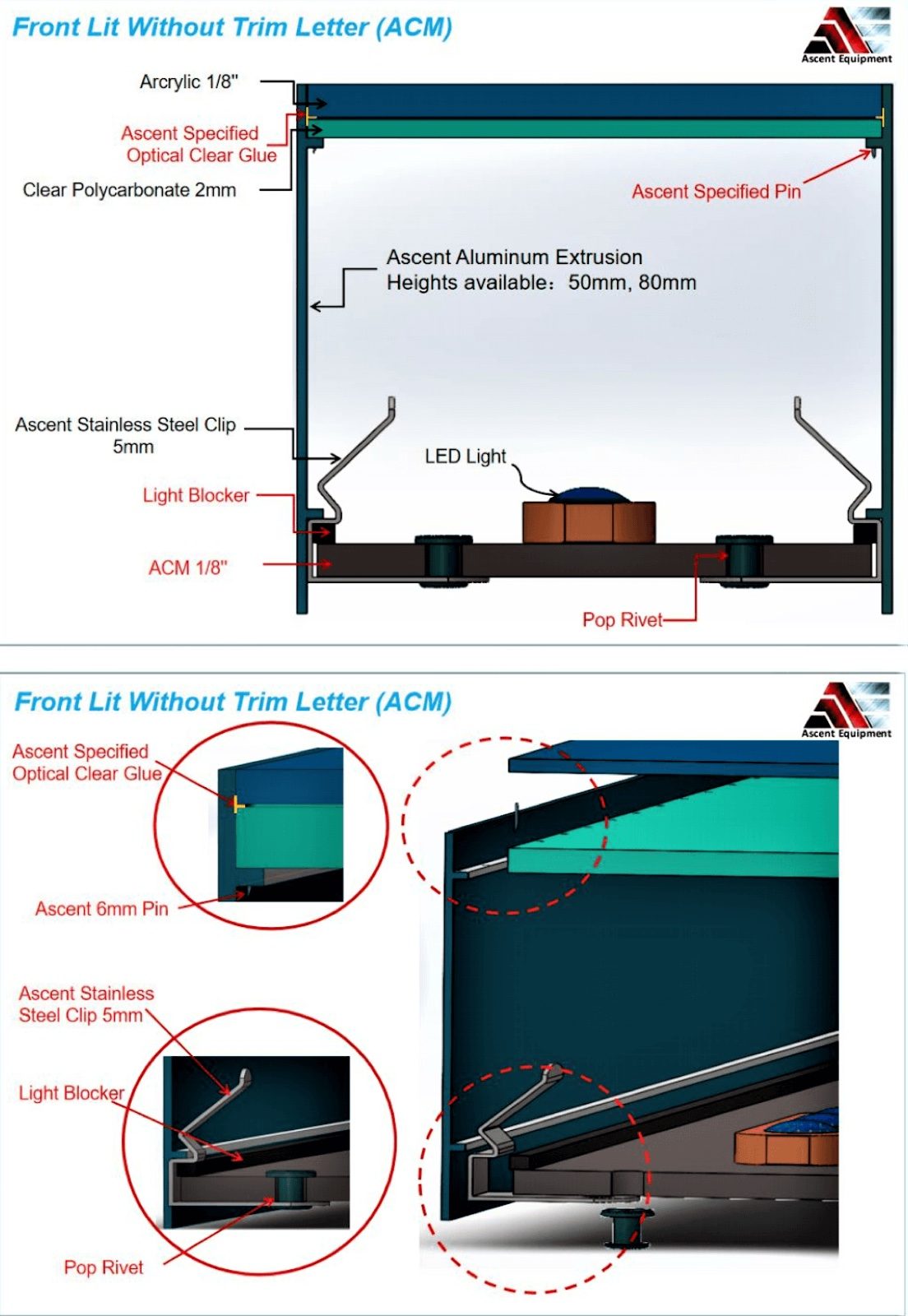
Ascent extrusion profiles are a fundamentally different material from flat aluminum coil. Rather than a flat strip that gets bent and fitted with trim cap, the extrusion is a pre-formed profile with built-in features on the face edge that hold the face assembly.
What the profile does
The profile eliminates the need for trim cap entirely. A clear polycarbonate layer is pinned to the extrusion with tiny 6 mm stainless-steel pins, and the acrylic face is glued on with optically clear glue. The result is a trimless channel letter with a clean face edge and no visible seam.
Profile variants
Standard extrusion: Used for trimless front-lit letters and reverse halo letters. Available in four sizes, 1.37, 2, 3, and 4 inches, primed white with epoxy.
F-trim profile: A wider-flanged variant of the standard extrusion, used for a specific letter style where the face extends beyond the return perimeter. Unique to the Ascent 5AS — no other production bending machine processes F-trim profiles.
Processing requirements
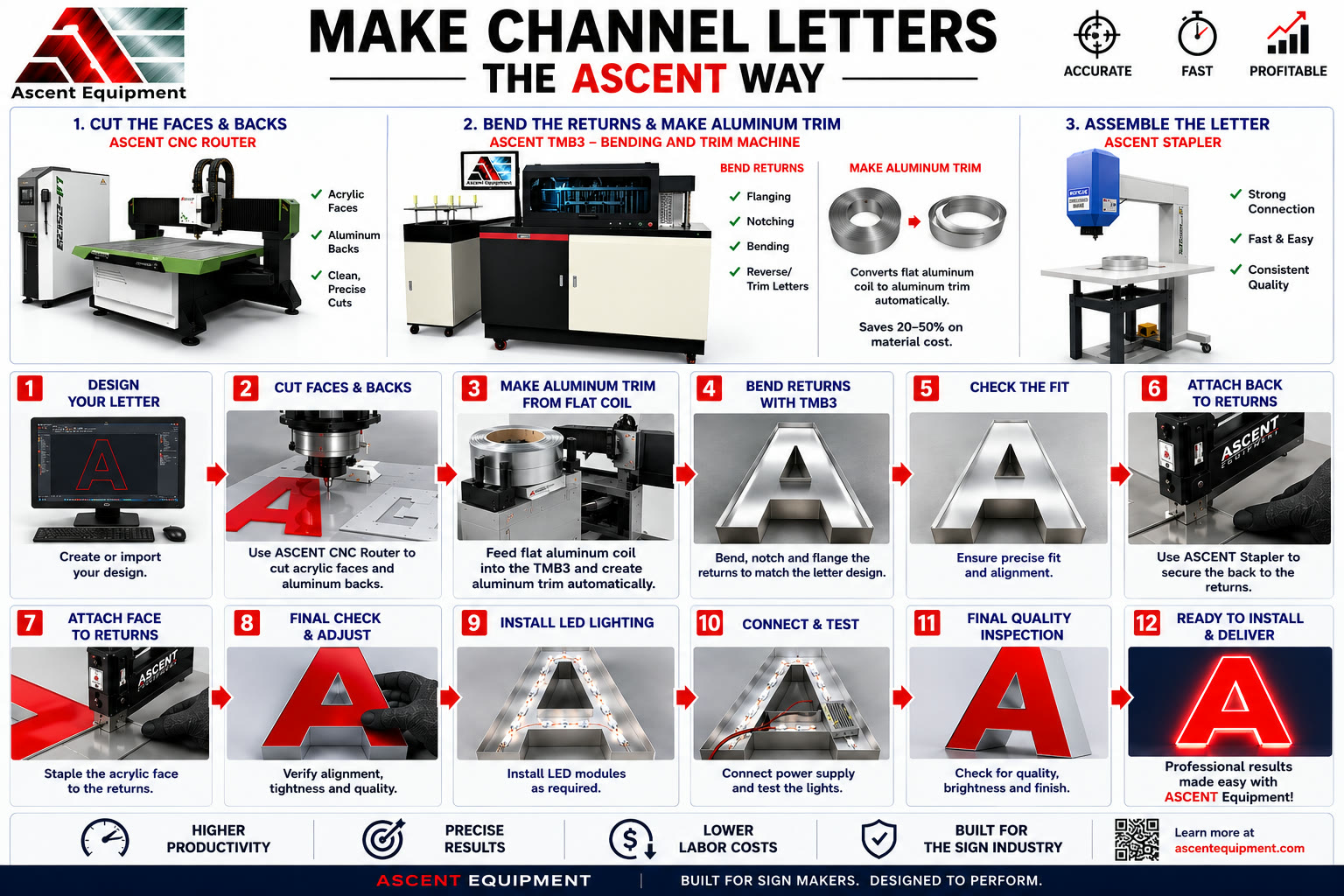
Extrusion profiles cannot be processed on a standard bending machine designed for flat coil. The cross-section geometry requires different tooling, different notching geometry, and different bending parameters. The Ascent 4AS and 5AS are purpose-built for both flat coil and extrusion profiles.
Stainless Steel
Stainless steel returns are specified for premium letters — hospitality interiors, corporate lobbies, monument signs, and applications where a brushed or mirror-polished metal surface is part of the design intent.
Type 304 stainless: The most common grade for channel letters. Corrosion-resistant, available in brushed and mirror finishes, welds cleanly. Standard for interior and most exterior applications in non-coastal environments.
Type 316 stainless: Higher corrosion resistance due to added molybdenum. Required for coastal environments where salt air accelerates surface oxidation. Costs more than 304 and is less commonly stocked.
Gauge for stainless
Most stainless steel channel letters use 20 gauge (0.036") or 18 gauge (0.048"). Stainless is denser and stronger than aluminum, so lighter gauges provide equivalent rigidity. The Ascent 4AS, 5AS, and Ascent EDGE-3 all handle stainless steel; the Ascent TMB-3 does not.
Fabrication notes
Stainless steel requires different tooling in the bending machine than aluminum — confirm compatibility with your machine supplier before ordering stainless coil. Welding stainless requires either TIG or laser welding; the stainless steel clips used for aluminum extrusion assemblies work on stainless returns as well.
Face Materials
The face is the front surface of the letter — the part visible to the viewer. On front-lit letters, it transmits light. On reverse halo letters, it blocks light from the front and reflects the logo color.
Acrylic sheet
The standard face material for front-lit channel letters. Available in hundreds of colors, translucencies, and finishes. Cuts cleanly on a CNC router or CO₂ laser cutter. The CO₂ laser produces a sealed, polished edge that fits the extrusion particularly well.
Standard thickness: 3mm (approximately 1/8") for most letters. 6mm for larger letters or where structural rigidity of the face panel matters.
Color selection: Translucent acrylic transmits a percentage of the light behind it while appearing colored. The specific color and translucency level should be specified to match the brand's intended daytime and nighttime appearance — a color that looks correct in daylight may appear significantly different when backlit.
Polycarbonate sheet
More impact-resistant than acrylic but more expensive and slightly less optically clear. Used in applications where vandalism resistance matters — lower-level letters on pedestrian-traffic storefronts, sports venues, high-crime locations. Not as common as acrylic for standard commercial channel letters.
Aluminum face (reverse halo and open-face letters)
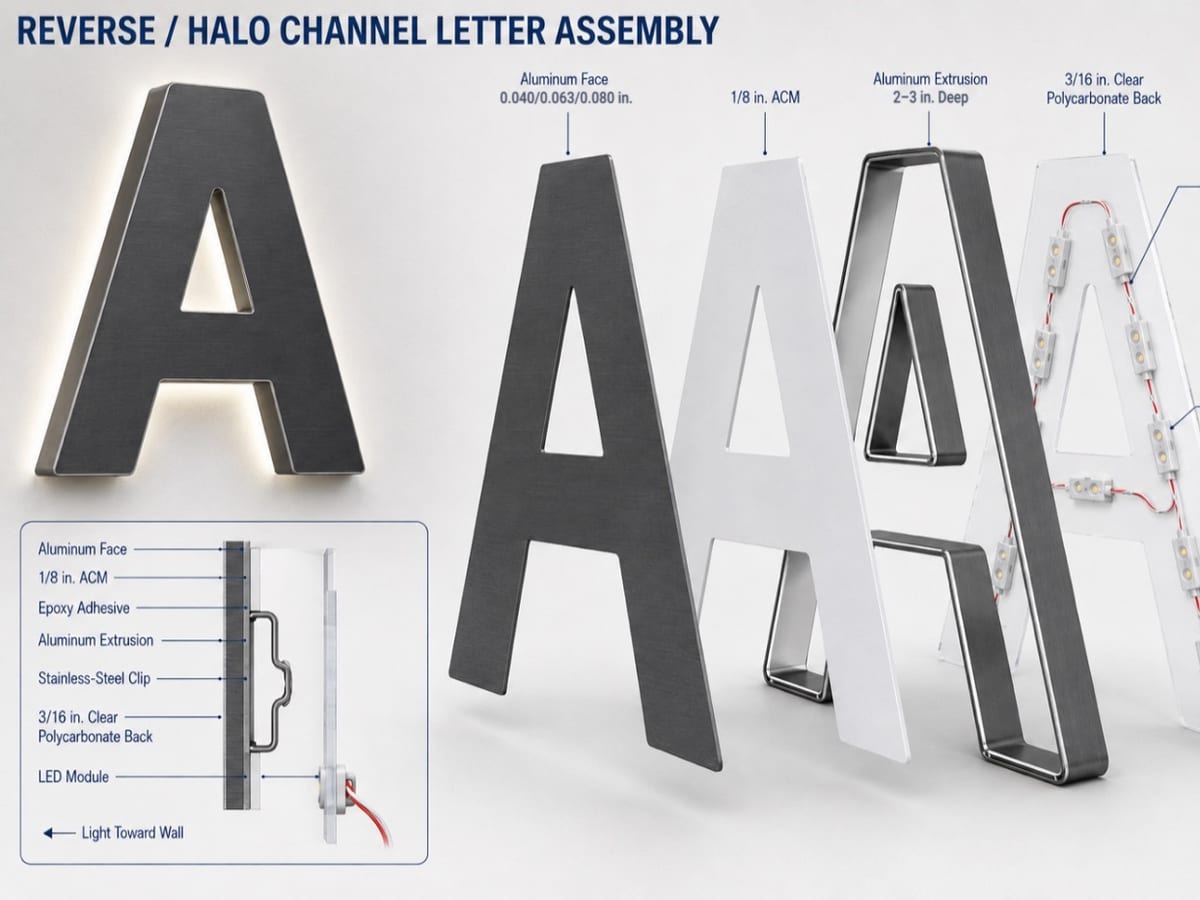
Reverse halo letters use a solid aluminum face that blocks all light from the front. The face is cut to the letter outline, painted or powder-coated to the brand color, and mounted against the return. Light shines out through the back toward the wall, creating the halo effect.
Thickness: 0.040" to 0.063" aluminum, matching or slightly heavier than the return material. The face does not need to be structural — it only needs to hold its shape and finish.
Open face
Some letter styles omit the face entirely, exposing the LED modules inside the return. The look is intentionally industrial or retro. Less common in commercial signage; more common in hospitality and entertainment venues.
Back Panels
The back panel closes the letter, provides a mounting surface for the LED driver, and on direct-mount letters, includes the standoff mounting points.
Aluminum back panel
0.040" or 0.063" aluminum, cut to the letter outline. Most common for exterior letters. Durable, accepts paint and powder coat, and provides a rigid mounting surface for the driver and wiring.
Polycarbonate back panel
Clear or translucent polycarbonate back panels are used on reverse halo letters when the installer wants to be able to see the LED configuration from the front side during installation. Not the structural choice for large or heavy letters.
Closing the back
With welding (TIG or laser): The back panel is welded to the return around the perimeter. Produces a permanent, sealed assembly. Required for letters that will be exposed to weather without additional protection.
With stainless steel clips (Ascent system): The back panel is held on the return profile with stainless steel clips. Faster than welding, requires no skilled welder, and produces a mechanically secure assembly. Used with Ascent extrusion profiles and compatible with aluminum and stainless steel returns.
Hardware
Stainless steel clips
Used in the Ascent system to hold back panels on the return without welding. The 8 mm clip is for front-lit letters and the 5 mm clip is for reverse halo letters. They grip the back panel and the return simultaneously, pulling the back flat against the return perimeter, and the back can come off again for service.
LED modules and drivers
LED modules for channel letters are typically 12V or 24V DC, in module-on-strip format. Standard color temperatures are 3000K (warm white), 4000K (neutral white), and 5000K–6500K (cool white). RGB modules are available for color-changing applications.
Driver sizing: the driver should be rated for at least 120% of the total LED load. Running a driver at full rated capacity reduces its lifespan significantly.
Standoffs
Standoffs hold the letter body away from the wall. For front-lit letters, standoffs are usually 0.5" to 1.5" — enough to allow a raceway or to accommodate the mounting hardware, but not enough to create a visible gap from the front. For reverse halo letters, standoff distance controls halo width — typically 1.5" to 3" for standard exterior applications.
Material: Painted aluminum or stainless steel. Stainless is preferred for coastal and high-humidity environments.
Choosing Materials by Letter Type
| Letter type | Return material | Face | Back | Closing method |
|---|---|---|---|---|
| Front-lit, conventional | 0.040"–0.063" aluminum | Translucent acrylic | 0.040" aluminum | Weld or clips |
| Front-lit, trimless | Ascent extrusion profile | Acrylic or polycarbonate | 0.040" aluminum | Clips (no weld) |
| Reverse halo | 0.040"–0.063" aluminum or extrusion | Solid aluminum | Polycarbonate or aluminum | Weld or clips |
| Stainless steel | 20–18 ga stainless | Acrylic or aluminum | Stainless or aluminum | Weld or laser weld |
| Large format (15"+) | 0.063"–0.080" aluminum | Acrylic | 0.063" aluminum | Weld |
| F-trim | Ascent F-trim extrusion | Acrylic | 0.040" aluminum | Clips |
Where to Go From Here
Material choice drives letter quality, fabrication time, and margin. The biggest leverage point for most shops is switching from flat aluminum coil with trim cap to Ascent extrusion profiles for trimless production — eliminating trim cap labor entirely while producing a cleaner letter. The second biggest is eliminating welding on back panels using the clip system.
Both changes require a bending machine capable of processing Ascent extrusion profiles — the 4AS or 5AS. If you want to understand how the material change maps to your specific letter mix and production volume, contact us and we will walk through it.