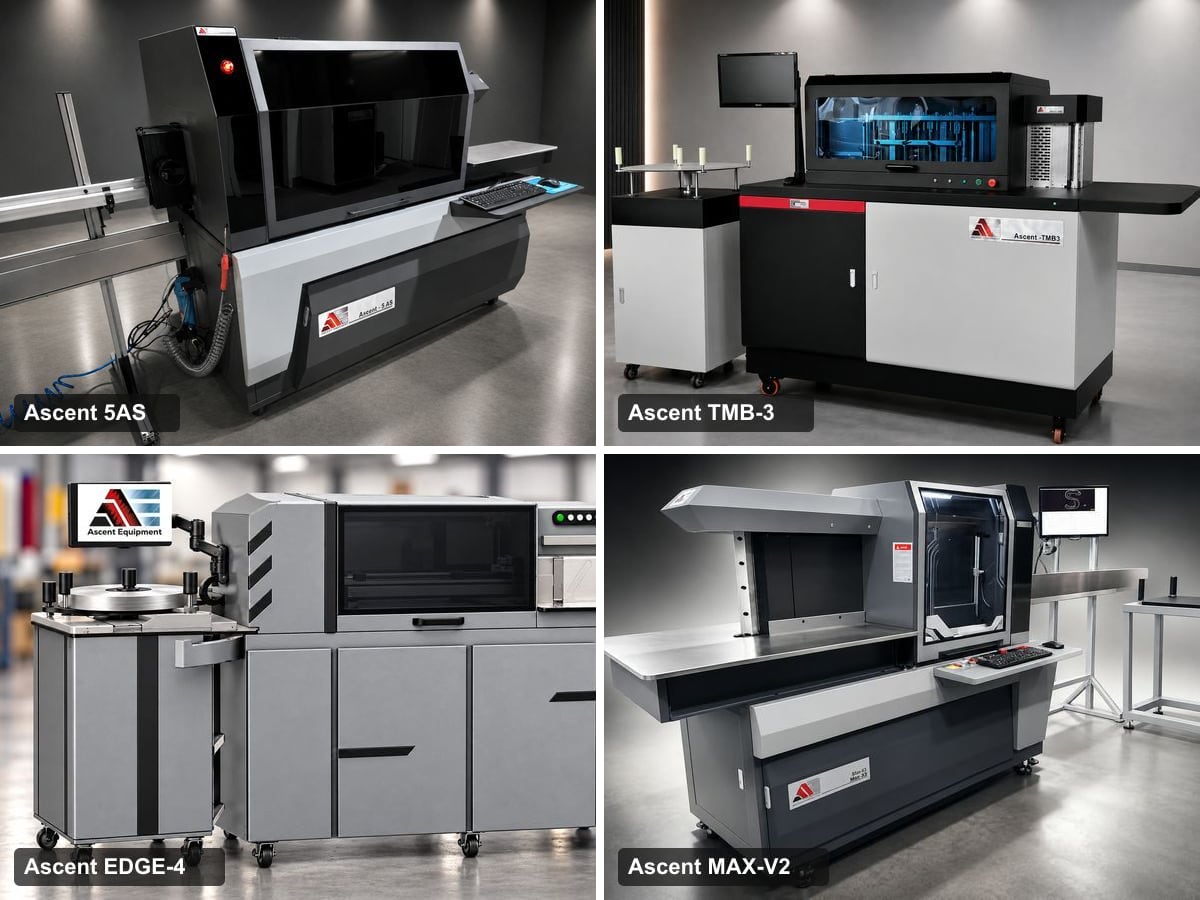

A well-formed return is only part of a good channel letter. An outdoor letter also needs a way for water to get out, and it needs holes in the right places for the parts that join. The Ascent EDGE-4 channel letter bender punches holes while it forms the return, so there is less marking and drilling left for the assembly bench.
This post covers the two kinds of holes, a workflow for the EDGE-4, and the drain opening sizes in the May 2025 revision of UL 48. What the machine can do and whether the finished sign complies are two separate questions, and each needs its own check.
Why channel letters need drain holes
Drain holes, also called weep holes, let rainwater and condensation leave the letter. Water that stays inside can stain the letter, corrode it, and wear out the parts inside.
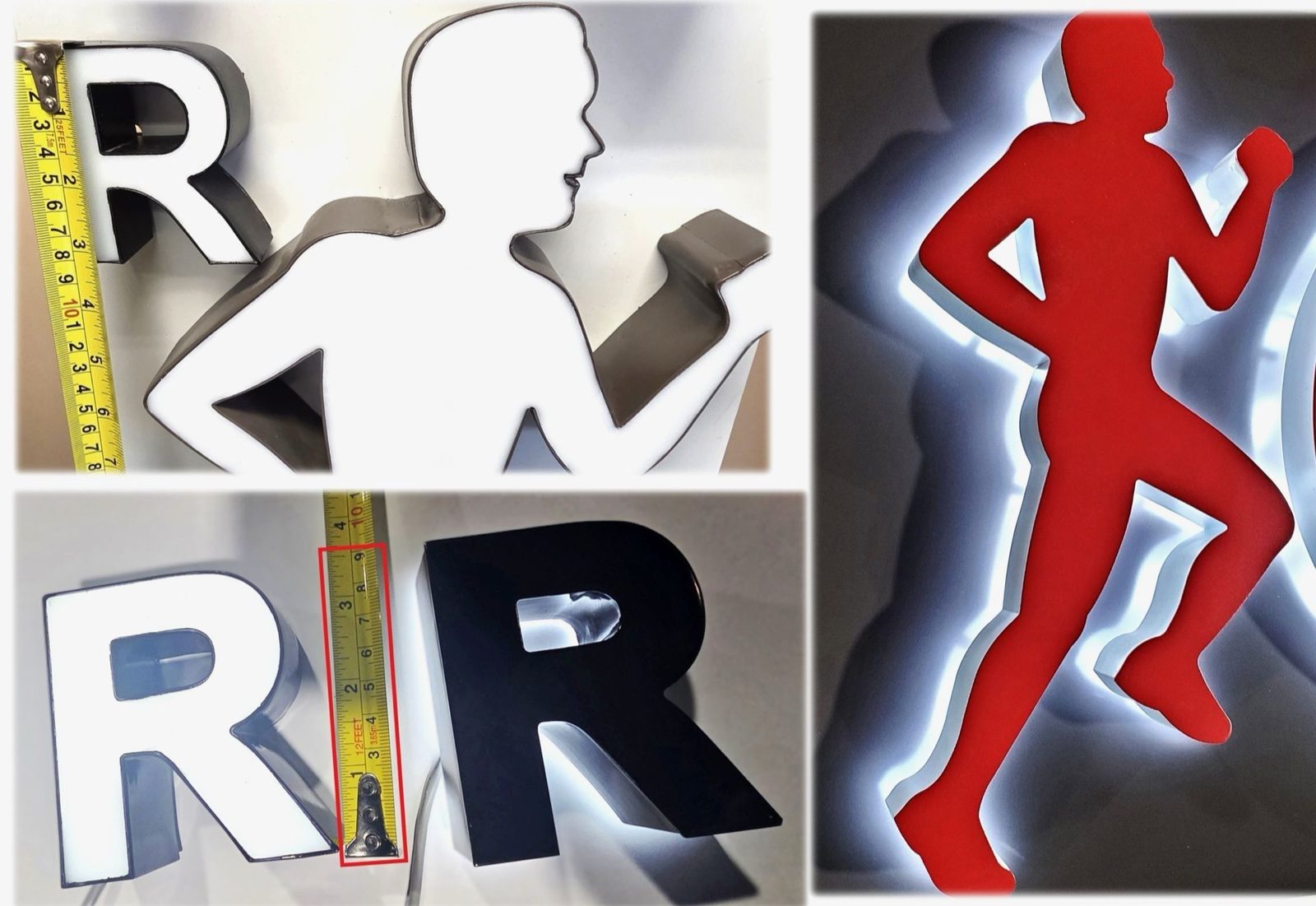
Plan drainage around the way the letter will hang. A hole has to sit at a low point where water actually collects. Letters and logos can have several separate pockets, and a hole in one pocket cannot drain another if the shape blocks the flow. A letter such as a W may need several drain holes.
Keep the path clear while you build. Sealant, adhesive, paint buildup, mounting hardware, and debris can block a hole that was punched in the right place. Check the finished assembly after finishing, not only the fresh return.
What connecting holes do
Connecting holes take the screws or rivets that hold parts of the letter together. Their positions depend on the joint design, how far the parts overlap, whether you can reach the fastener, and how far the hole sits from an edge. They are for assembly, so they are not a substitute for drain holes.
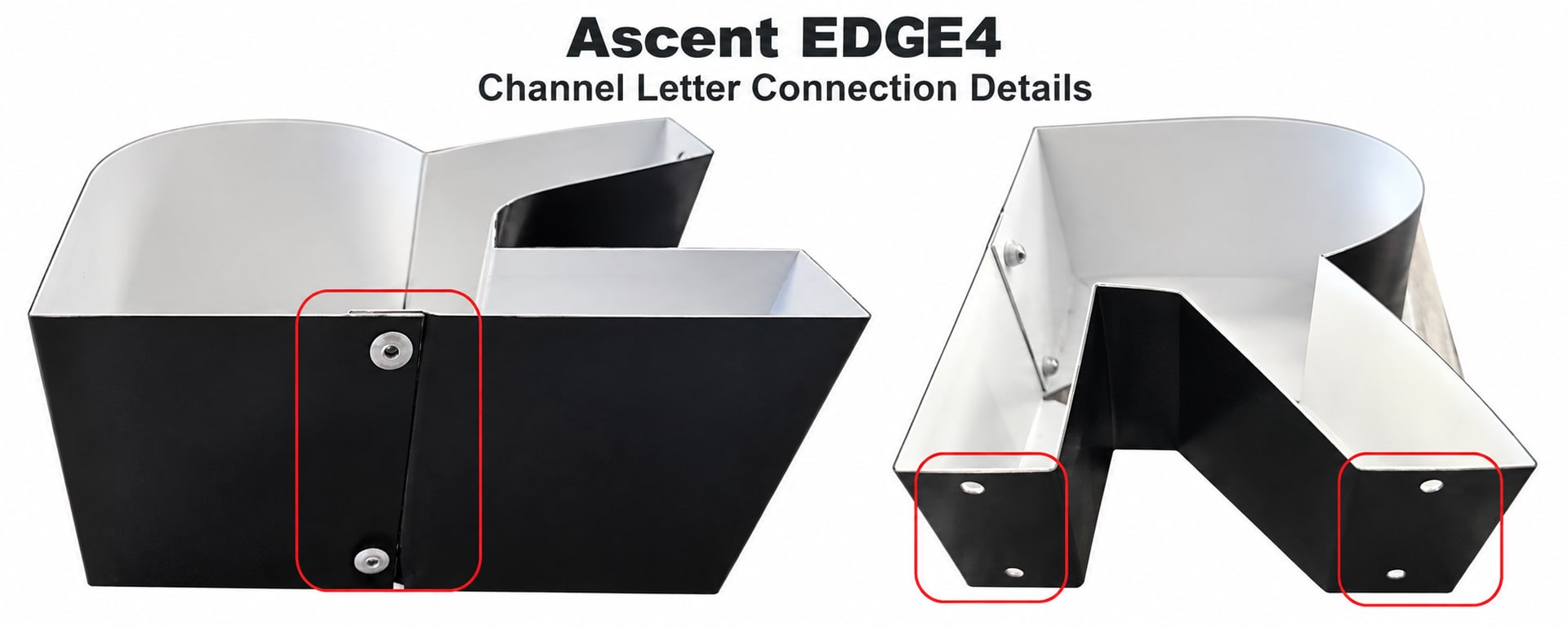
Ascent describes stepped (Z) connection holes at the top of the return and screw or rivet punching on the EDGE-4, with 1/8 inch (3 mm) holes. Follow your shop's approved construction details for the mating parts and the fasteners. Wall-mounting holes and wiring openings in the back of the letter are separate features.
UL 48 drain opening sizes
UL 48 is the Standard for Electric Signs. The sizes below come from a standards update notice for clause 4.1.3.2.3.4 in the May 14, 2025 revision. They summarize that one clause. They are not a review of the whole standard.
| Opening or condition | Requirement in the revision |
|---|---|
| Circular opening | Diameter of 1/4 to 1/2 inch (6.4 to 12.7 mm) |
| Non-circular opening | Smallest dimension at least 1/4 inch (6.4 mm), and area at least 41 mm² (about 0.06 in²) |
| Edges | The opening must be free of burrs |
| Smaller opening exception | Allowed when the sign has only circuits within the wet-location Class 2 voltage limits and carries the instructions required by clause 8.1.7 |
The revision replaces the earlier area range for non-circular openings, 32.3 to 129 mm². The notice gives May 14, 2027 as the effective date for updating certification reports. Check what applies to you against your shop's certification file and your certification provider.
Do not assume an LED letter qualifies for the smaller-opening exception. Its circuits and instructions have to meet the stated conditions.
What about Canada?
The sizes above come from UL 48, the US standard. Do not assume Canada uses the same numbers. Illuminated signs in Canada are covered by CSA C22.2 No. 207, Portable and stationary electric signs and displays. The current edition is the second edition, published in 2015 and reaffirmed in 2025, and CSA Group sells the full text. Before you size drain holes for a Canadian job, check the clauses with your certification body.
What to confirm on the EDGE-4
The EDGE-4 page documents drain holes on the bottom and stepped Z-joint holes on the top for 0.040-inch aluminum. The machine handles other thicknesses too, but do not assume the same hole punching applies to every material and every operation. Confirm it first.
The EDGE-4 punches 1/4 inch (6.35 mm) weep holes and 1/8 inch (3 mm) screw or rivet holes. A 1/4 inch weep hole sits at the lower limit of the UL 48 range for a round opening, 0.25 inch, which the standard lists as 6.4 mm. That leaves no margin. Measure a punched sample against the limit before you rely on it for a UL-listed sign, and ask your certification body whether a larger drain hole suits your construction.
A machine that punches holes does not by itself make the finished letter compliant. The letter, its circuits, and its instructions all count.
An EDGE-4 production workflow
This is a planning overview. For software commands, punch selection, and the order of operations, follow the machine instructions and your installed tooling.
- Prepare the letter files. Confirm the outline, inner contours, return depth, material thickness, and the way the letter will hang. Check the allowances for the face, back, and trim.
- Plan the drainage and the connections. Mark each place where water collects and each fastener position the joint needs. Keep drain holes separate from fastening, mounting, and wiring features.
- Check the punching setup. Choose tooling that suits the material. Check a sample hole for size, shape, edge quality, and fit with the certification requirements that apply to you.
- Run a sample return. The EDGE-4 feeds, grooves, bends, and cuts as well as punches. Check the configured operations on a sample before you run the full job.
- Check the fit. Trial-fit the return to the face and back. Check that the connection holes line up, that you can reach the fasteners, and that the return follows the intended contour.
- Inspect the finished letter. After assembly and finishing, confirm that the drain paths are open and that the fasteners, wiring, and internal parts match the approved construction.
What the shop gains
Punching holes while the return is formed means less handling and less manual layout. Assemblers get a more complete part, and repeat jobs can use the same setup. Those gains depend on checking the first part and keeping the tooling and job settings correct.
Drain holes manage collected moisture. Connecting holes support assembly. Planning both before you form the return helps the EDGE-4 move work into assembly while you keep the checks the finished sign needs. See all of Ascent's CNC channel letter benders, or read how to make front-lit and reverse-halo channel letters with them.
Sources
- Ascent EDGE-4 specifications and FAQs
- UL 48 standards update notice, issued November 10, 2025 (revision of May 14, 2025, clause 4.1.3.2.3.4)
- CSA C22.2 No. 207:15 (R2025)
Sources checked October 25, 2026. This post does not show that any EDGE-4 punch or finished sign meets UL 48 or CSA C22.2 No. 207. Use the full standard and your certification file for final construction decisions.