
YAG vs. Fiber vs. QCW for Mold Repair: What Actually Matters
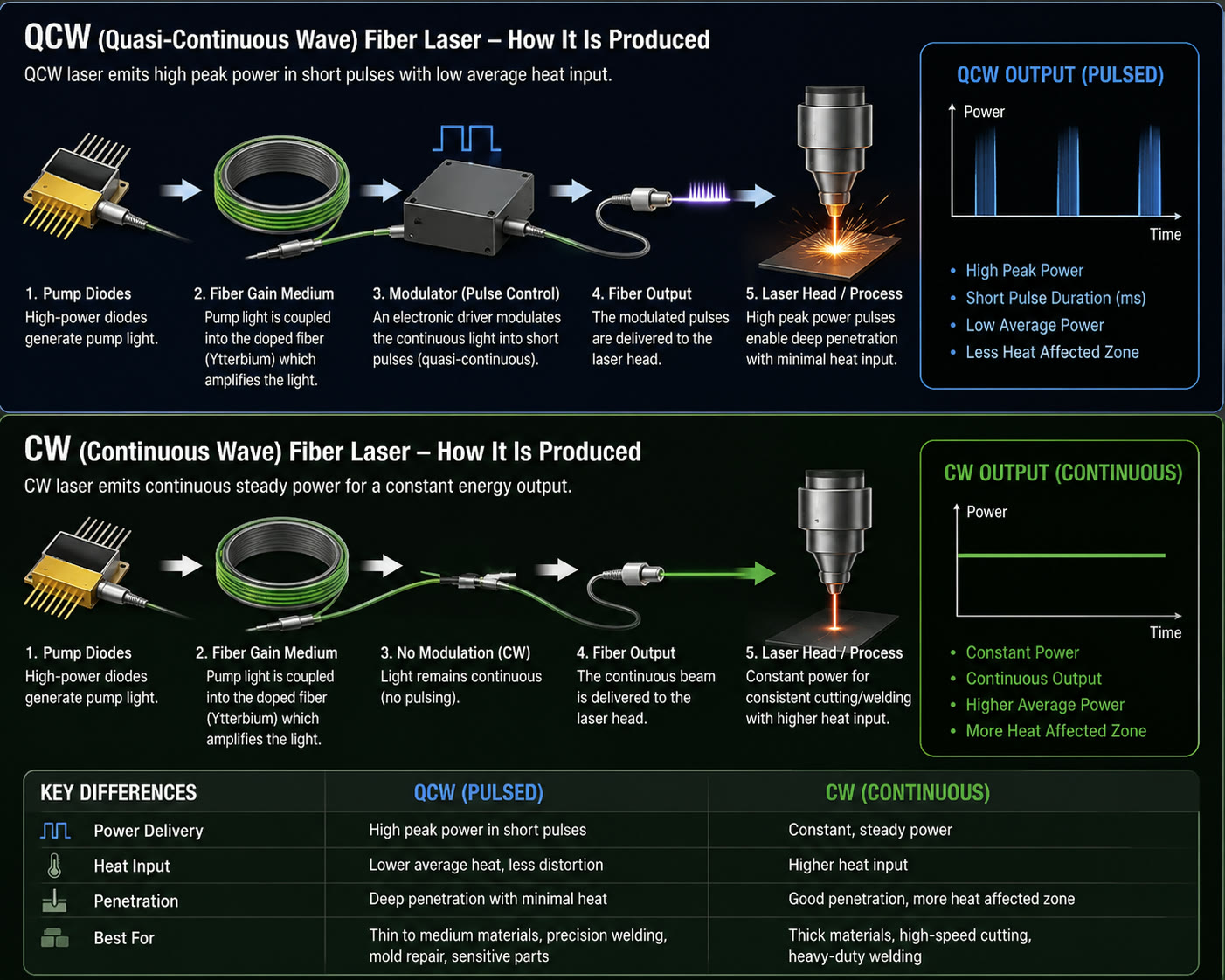
If you've shopped for a mold repair laser, you've probably seen "YAG," "fiber," and "QCW" thrown around like three competing products. They're not. YAG usually means a pulsed Nd:YAG laser. Fiber just describes what's generating the beam. QCW is a pulsed mode a fiber laser runs in. The real comparison is pulsed YAG vs. QCW fiber vs. continuous-wave (CW) fiber — and for mold work specifically, it mostly comes down to pulsed YAG vs. QCW fiber, since CW is a fabrication tool built for open welds, not precision repair.
| Feature | Pulsed Nd:YAG | QCW Fiber | CW Fiber |
|---|---|---|---|
| Wavelength | 1,064 nm | ~1,080 nm | ~1,080 nm |
| How it delivers power | Short, individually timed pulses | High-frequency pulse bursts (~1–500 Hz), high peak power | Continuous beam, no pulsing |
| Typical average power | 200–400W | 150–600W | Often 1,000W+ (handheld) |
| Typical peak power | Comparable to QCW in a well-built system | Up to 10x average (e.g., 300–400W → 3,000–4,000W) | Equal to average power; nothing to spike |
| Beam quality (M²) | ~90 multimode (rod heats unevenly, bends its own beam) | Under 2 multimode, under 1.2 single-mode | Same as QCW (fiber-grade) |
| Heat-affected zone | Narrow, but typically wider than QCW | Often under 0.5 mm | Wider; depends on travel speed and power |
| Wall-plug efficiency | 3–5% | 25% and up | Similar to QCW, sometimes higher |
| Source lifespan / upkeep | Flashlamp: 500,000–2,000,000 pulses; reflectors and optics also wear | Fiber source: 50,000–100,000+ hours; no flashlamp | Same long fiber lifespan as QCW |
| Best-suited materials | Tool/mold steel (H13, P20, S7); best on deep, heavy fills | H13, P20, S136 stainless, SKD11, aluminum, beryllium copper | Stainless and aluminum sheet/fabrication work |
| Best fit for mold repair | Fine detail; still sound where it's already installed | Fine detail and heavier buildup on reflective/hardened material, at lower running cost | Rarely used for mold repair; suited to shop fabrication welding |
The Light Itself Isn't the Difference
Nd:YAG puts out 1,064 nm. Fiber lasers run around 1,080 nm. That's close enough that mold steel, a copper insert, or an aluminum die absorbs and reflects the beam almost identically either way. So if you've heard that fiber "cuts through" metal that YAG can't, that's not really what's going on — the two wavelengths behave almost the same in front of the material. What's actually different is beam quality and how the power gets delivered over time.
Why a Fiber Spot Stays Smaller
A Nd:YAG rod heats unevenly while it's lasing, and that uneven heating bends the beam path inside the rod itself — thermal lensing, a well-known limit of rod lasers. Multimode Nd:YAG rod systems have been measured with a beam-quality number (M²) around 90. A fiber laser runs under 2 for multimode, under 1.2 for single-mode. Lower M² focuses to a smaller, steadier spot at the same lens, so more of the power lands exactly where it's aimed. That's a big part of why a well-tuned QCW system can hold its heat-affected zone under half a millimeter, pulsing anywhere from about 1 to 500 times a second depending on the job — the difference between a clean, controlled bead on a hairline crack and one that spreads more than you'd like.
The Real Cost Is in the Flashlamp
Flashlamp-pumped Nd:YAG lasers turn roughly 3–5% of the electricity they draw into laser light. Fiber lasers commonly hit 25% and up. That gap shows up everywhere: a bigger chiller, a bigger electrical draw, more heat in the shop for the same output. The flashlamp itself is also a wear part — most run somewhere between 500,000 and 2 million pulses before they need replacing, and the reflectors and optics around them wear too. A fiber source runs 50,000 to 100,000-plus hours with no lamp to swap at all.
Why Peak Power Beats Average Power on Mold Steel and Copper
Mold work often means welding onto bright, reflective material — beryllium copper cooling inserts, polished cavity steel, aluminum die-cast tooling — that can bounce back most of the beam before a weld pool even starts. A pulsed source packs the same average power into short, intense bursts, so the instantaneous peak runs far above the average rating. Ascent's own QCW mold repair system is a real example: 300W or 400W average, but 3,000W or 4,000W peak — a 10-to-1 ratio. That peak is what punches through the initial reflection and gets a stable melt going. A continuous-wave source delivering that same average power never produces that spike, which is exactly why CW is built for open fabrication welds, not for starting a weld on a small, shiny mold insert.
One nuance worth knowing: for the deepest, heaviest fills, a lower-power QCW module can lose ground to a Nd:YAG system's simpler, higher per-pulse energy — the small QCW spot welders built for jewelry or electronics work top out well below what mold repair needs. That's not a knock on QCW as a category, though. A properly sized QCW mold system, like Ascent's 3,000–4,000W peak unit, has plenty of headroom where that trade-off would otherwise matter.
Which Material Favors Which Technology
Pulsed YAG and QCW fiber both handle standard tool steel — H13, P20, S7 — without much difference in the result. Where they start to separate is reflective and specialty material:
- Beryllium copper cooling inserts, brass, and polished aluminum tooling reflect a large share of the beam before a weld pool forms. QCW's peak-power spike is built for exactly this; a comparable YAG system can still do it, but usually takes more operator skill to get a consistent start.
- S136 stainless and SKD11 — common in plastic injection and die-casting mold steel — hold up well under either pulsed technology, though QCW's tighter heat-affected zone means less grinding and polishing on a visible cavity surface afterward.
- Large, heavy fills on general tool steel (a badly worn edge, a big chipped corner) are where Nd:YAG's straightforward, higher-per-pulse energy can still hold its own against an undersized QCW module — though a mold-grade QCW system has the peak power to match it.
- CW fiber isn't really a mold-repair tool. It's built for continuous fabrication welds on stainless and aluminum sheet, where speed over an open area matters more than fine control on a small cavity detail.
Matching Filler Wire and Watching the Heat-Affected Zone
Whichever pulsed source you're running, match the filler wire to the base steel — H13 filler for H13 tooling, P20 for P20, and so on for S7 or 420 stainless inserts — so the repair can be remachined, polished, or EDM'd to the same finish as the rest of the cavity. Pulsed welding keeps the heat-affected zone narrow enough that hardness in the surrounding hardened steel typically drops only 2 to 4 points on the Rockwell C scale. That matters more than it sounds like it should: a wide soft zone next to a repair is its own defect on cavity steel that's already heat-treated.
Which One Fits Your Shop
If you're already running pulsed YAG and it does the job, moving to QCW fiber isn't really a capability upgrade — it's a running-cost one. Shops that make the switch commonly see 40% to 70% less grinding and polishing after each repair, since a smaller heat-affected zone leaves less to clean up, and mold life often stretches 20% to 50% longer with less accumulated thermal stress in the cavity. Most shops see that pay for itself in 12 to 24 months in lower electricity, cooling, and lamp-replacement costs alone.
That's the whole reason most new mold repair installations are moving toward QCW fiber: the weld quality was already there, and the cost of keeping the machine running finally caught up to it.
Contact Ascent Equipment if you want to talk through which laser source actually fits the repairs you run.