
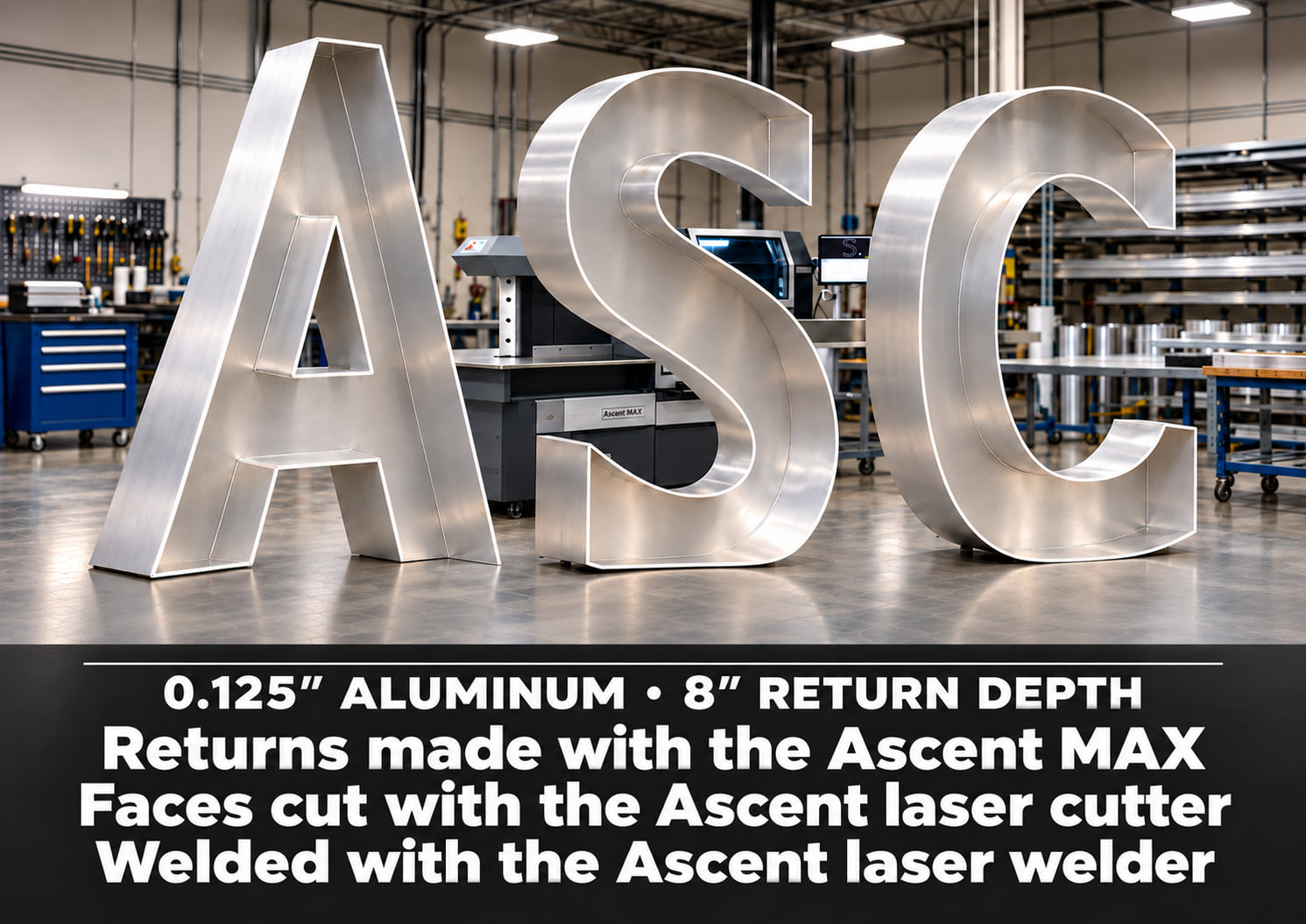
Large letters on a building facade, a monument sign, or a corporate entrance take careful coordination between design, cutting, bending, welding, and finishing. This post walks through one way to do it. The Ascent MAX bends the returns, an Ascent fiber laser cutter cuts the faces, and an Ascent handheld laser welder joins the parts.
Settle the letter design first
Before you cut any material, decide on the letter height, stroke width, return depth, finish, lighting method, and how the letters will mount.
Letter height and return depth are two different measurements. A letter can stand several feet tall and still have an 8-inch return, the sidewall that gives it its depth.
Say a job calls for oversized letters with 0.125-inch aluminum returns at an 8-inch depth. The Ascent MAX-V2's published aluminum configuration covers that combination. Ascent also lists a separate configuration for returns about 15 inches deep in aluminum up to 0.080 inch thick. Confirm the material and design configuration before you start production.
Large outdoor letters also need a reinforcement and mounting plan that fits their size, weight, installation surface, and wind exposure. Material thickness alone does not decide how strong the finished sign will be.
Cut the faces with an Ascent fiber laser cutter
The face sets the visible outline of the letter. A clean, accurate cut helps the bent return fit that outline and cuts down on adjustment during assembly.
Use the approved artwork to prepare matching files for the face and the return. Allow for material thickness, assembly clearances, internal contours, and the joint you plan to use.
Ascent's fiber laser cutter for metal has an enclosed 5-by-10-foot work area, a useful sheet size for large sign parts. Check the height and width of every part against the usable cutting area. Larger parts may need a different table size, or you may need to build the letter in sections.
If the letters have acrylic faces, cut the acrylic with a CO₂ laser. Ascent's dual-gantry cutter pairs separate CO₂ and fiber systems, so it can process both nonmetal and metal.
Bend the returns on the Ascent MAX
The return follows the outside contour of the letter and any inside openings, such as the counter in an "A."
The operator loads the prepared DXF file and sets up the machine for the aluminum stock. The Ascent MAX forms the returns, so there is less manual layout and hand bending. Its published equipment package includes a flat-material holder and a coil holder.
Oversized work still needs care. Support the material as it feeds, and leave enough clearance for the letter contour as it grows. Check the first formed return against its matching cut face before you process the full set.
Watch curves, corners, closure joints, and inside contours in particular. A small mismatch is easier to see on a large letter.
Fit and fixture the assembly
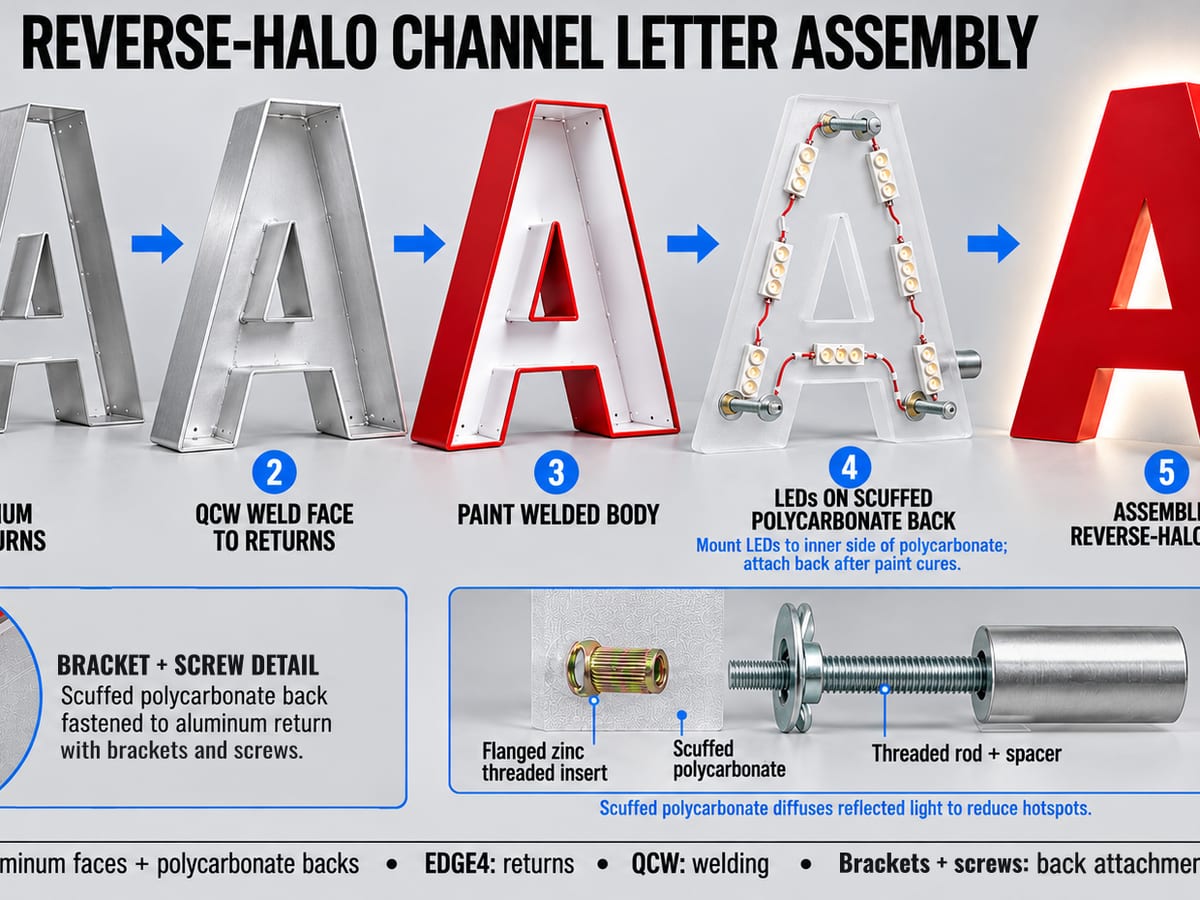
Set the cut face on a clean, flat assembly surface and fit the formed return around it.
Check the outline, depth, squareness, and joint fit before you weld. Fixtures and clamps hold the parts in position and keep the return in steady contact with the face.
Prepare the weld areas with a procedure that suits the aluminum alloy. Remove contamination and oxide from the joint area, and select filler material if your approved welding procedure calls for it.
Good fit-up is one of the best ways to avoid rework.
Weld with an Ascent handheld laser welder
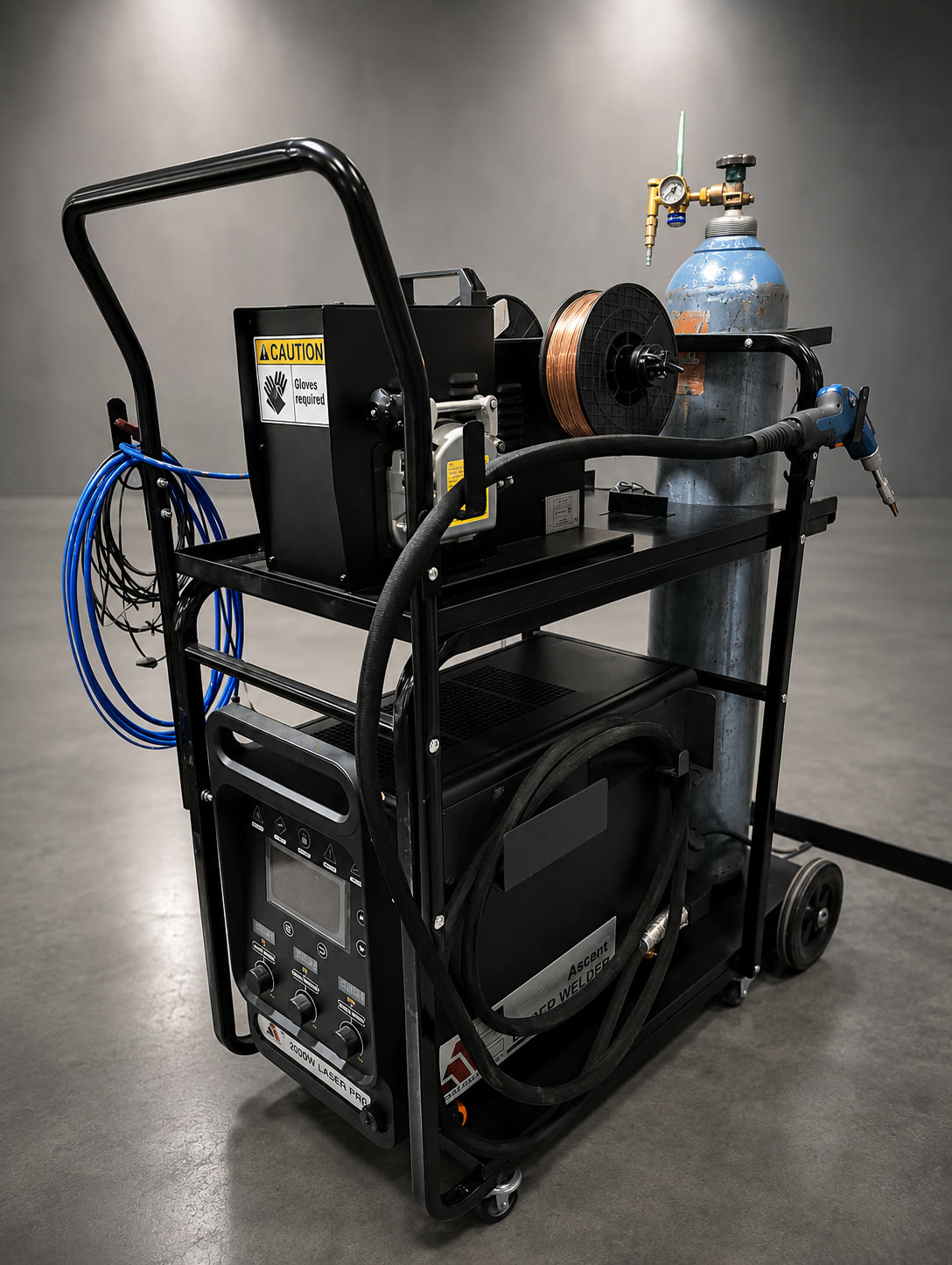
A handheld fiber laser welder lets the operator reach around a large letter assembly. Ascent's refrigeration-cooled welders are offered for aluminum fabrication and include an automatic wire feeder. The right model and settings depend on the alloy, thickness, joint shape, and the weld performance you need.
Test the process on sample joints made from the actual production material. Use a controlled tack and weld sequence to hold alignment and limit distortion.
On oversized letters, the goal is a sound joint with a clean look and little finishing work. Inspect the welds before the assembly goes to paint or coating.
Laser safety
Laser welding must take place in a properly controlled laser work area, with beam containment, access controls, fume extraction, trained personnel, and protective equipment rated for the laser's wavelength. Reflective aluminum calls for extra attention to beam direction and reflections. Our laser safety guide covers the details.
Finish, reinforce, and prepare for installation
After welding, check each letter for dimensional accuracy, surface condition, and joint quality. Prepare the aluminum for the finish you specified: painted, powder-coated, or bare metal.
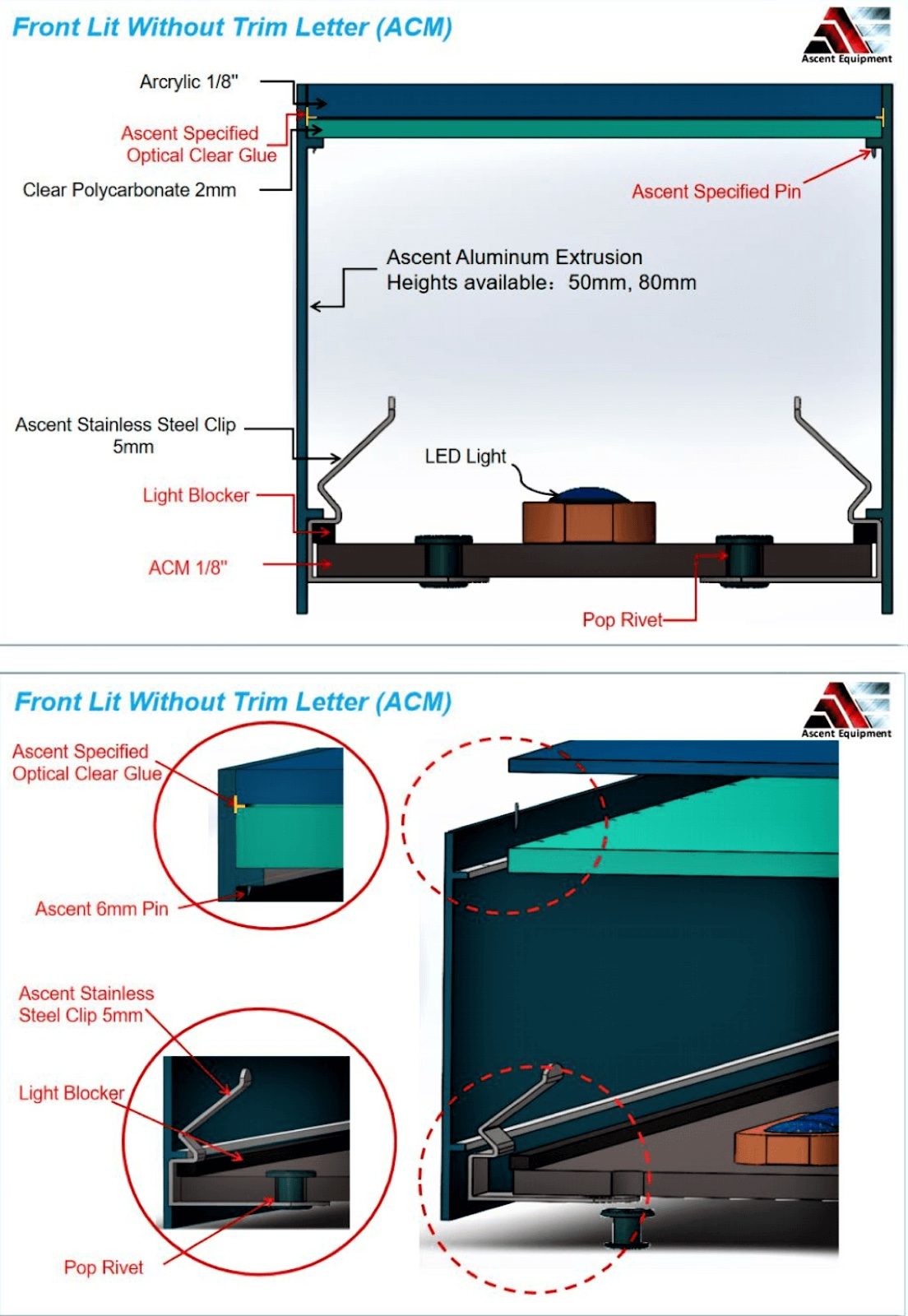
Install the reinforcement and mounting parts according to the approved design. Illuminated letters also need a plan for the LEDs, wiring, service access, and drainage.
Last, plan how each letter will be lifted, packed, moved, and installed. Oversized letters need protection from bending and surface damage the whole way.
Which machine does what
- Ascent fiber laser cutter: cuts the aluminum faces and other metal parts.
- Ascent MAX: forms the deep, heavy-gauge returns.
- Ascent handheld laser welder: joins the prepared aluminum parts.
- Ascent CO₂ laser cutter: makes the acrylic parts when the design needs them.
Using the same digital files for cutting and bending helps the parts fit together more consistently. Add careful fixturing, welding you have tested, and a sound installation design, and you have a workable way to build oversized aluminum letters.
To talk through an oversized letter project, call Ascent Equipment at 1-800-927-5107, ext. 1008, or see the Ascent MAX-V2 page.