
Call us: 1-800-927-5107 647-494-7800 ext. 1008

Handheld Laser Welders Deliver Up to 4x Faster Travel Speeds

By Dave Rom, President and Chief Engineer, Ascent Equipment

Handheld laser welders offer travel speeds up to four times faster, deeper penetration, and minimal distortion compared to traditional welding methods. A non-experienced operator can learn to weld aluminum in just 4 to 6 hours.

Ascent Equipment laser welders feature a unique set of specifications designed specifically for sign shops and sheet metal fabricators. When comparing Ascent to the broader laser welding market, their standout features include advanced cooling technology, an ultra-lightweight torch, and a complete ready-to-weld package.

Key Differences: Ascent vs. The Competition

1. Cooling Technology (Refrigeration vs. Standard Air/Water)

Ascent Equipment: The flagship 2000W Fiber Laser Welder employs a unique dual-circuit refrigerant-direct cooling system (an inverter heat pump), allowing the machine to run continuously 24/7 without interruption — no coolant to top up, no heat-cycling downtime.

The Competition: Most industrial welders, including premium and mid-tier models, rely on basic air-cooling or water-cooling systems that require regular maintenance and scheduled cool-down periods.

2. Torch Weight & Ergonomics

Ascent Equipment: Features an ultra-lightweight torch weighing under 600g (1.3 lb), significantly reducing operator fatigue during long production runs.

The Competition: Budget and mid-tier models often feature bulky torches that exceed 1 kg, making all-day manual operation tiring and less precise.

3. Complete Package — Everything Included

Ascent Equipment: The laser comes complete with the machine, dual wire feeder, safety goggles, fiber laser helmet, and a gas pressure regulator — everything needed to start welding immediately.

The Competition: A dual wire feeder, safety goggles, a fiber laser helmet, and a gas pressure regulator are typically sold as costly add-ons.

Ascent vs. Competition — At a Glance

Feature Ascent Equipment Competition
Cooling System Direct Inverter Heat Pump (Refrigerant) Standard Air/Water Cooling
Torch Weight Under 600 g Over 1 kg
Control Interface Mobile Android App & 3-button physical controls Basic Controls
Best For Sign shops, all-weather 24/7 fabrication, dual-wire feeding needs General fabricators

The Verdict: Which Should You Choose?

Choose Ascent Equipment if you operate a commercial sign shop or high-volume sheet metal business that needs continuous, all-day welding without downtime. The refrigerant cooling system, lightweight torch, and complete out-of-the-box package make it the clear choice for professional fabricators.

A 2000W handheld laser welder is widely regarded as the "sweet spot" for professional fabrication shops — powerful enough for production-grade work, yet manageable enough for a single trained operator.

2000W Material & Thickness Capabilities

The 2000W fiber laser penetrates deeply and travels up to four times faster than traditional TIG welding on equivalent materials:

  • Stainless Steel: Up to 5–6 mm (approximately ¼ inch). Produces a clean, silver-to-straw-colored weld bead with minimal post-processing.
  • Carbon Steel / Mild Steel: Up to 5–6 mm. Deep, consistent penetration suitable for structural and decorative fabrication.
  • Aluminum Alloys (3000, 5000, 6000 series): Up to 4–5 mm. Aluminum dissipates heat rapidly and is notoriously difficult to weld traditionally — the 2000W laser handles it with ease.
  • Brass: Up to 2 mm. Highly reflective metals absorb laser energy poorly, but 2000W provides the necessary threshold for clean results.

The "Wobble" Parameter

The 2000W systems feature a wobble-welding head. Instead of a static laser dot, the beam moves in circular or figure-eight oscillation patterns. This widens the melt pool, bridges gaps up to 1–2 mm, and dramatically reduces porosity — particularly valuable for aluminum.

Multi-Function Flexibility (3-in-1 Systems)

Given that 2000W represents a significant amount of energy, Ascent designs these units as multi-tool platforms:

  • Laser Welding: The primary function — continuous, high-speed fusion welding.
  • Laser Cutting: Cleanly slicing through thin sheet metal up to 2 mm thick.
  • Laser Cleaning / Rust Removal: Using a wide, pulsed scan beam to strip rust, paint, scale, and oxidation from metal surfaces without abrasives or chemicals.

Specialized Material Focus: QCW Technology for Small to Medium Channel Letters

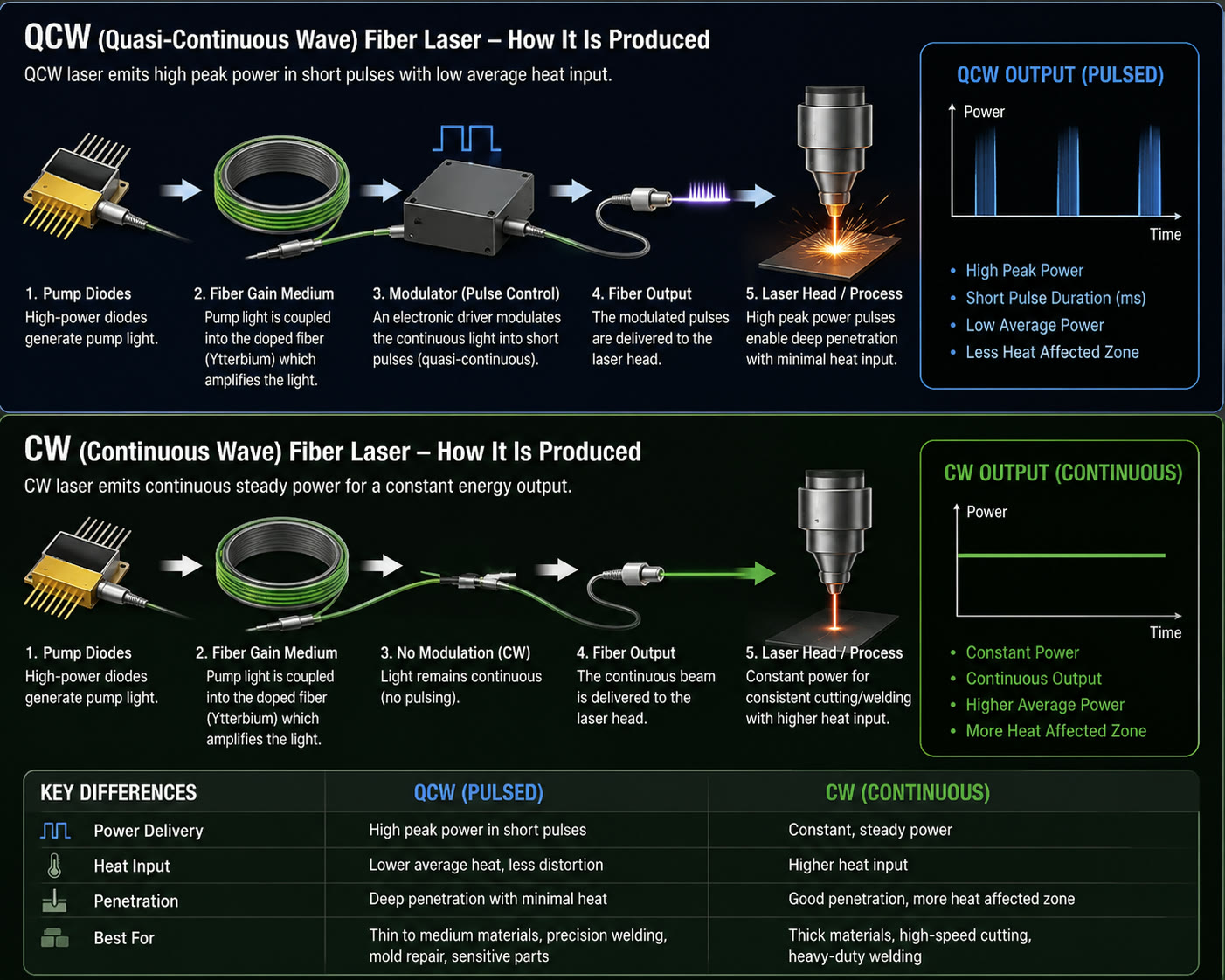
Ascent Equipment also offers a highly specialized 300W QCW (Quasi-Continuous Wave) combination tabletop/handheld laser welder, purpose-built for small to medium channel letters in aluminum and stainless steel — a niche that standard CW (Continuous Wave) laser welders cannot address effectively.
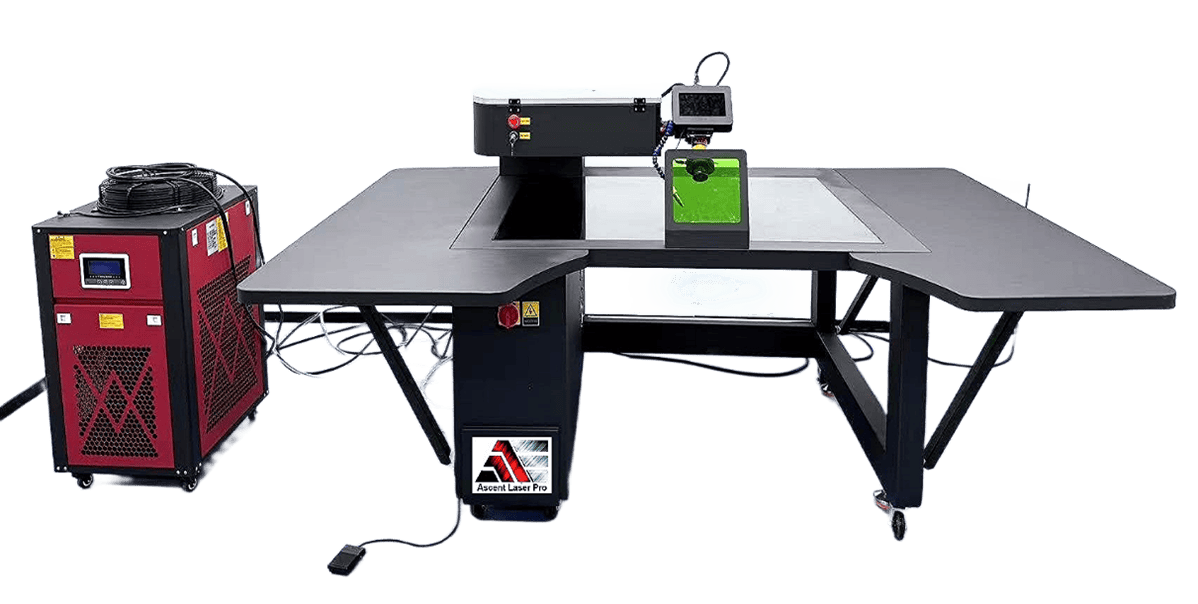
Ascent Laser Pro QCW combination tabletop and handheld laser welder with refrigerant chiller unit

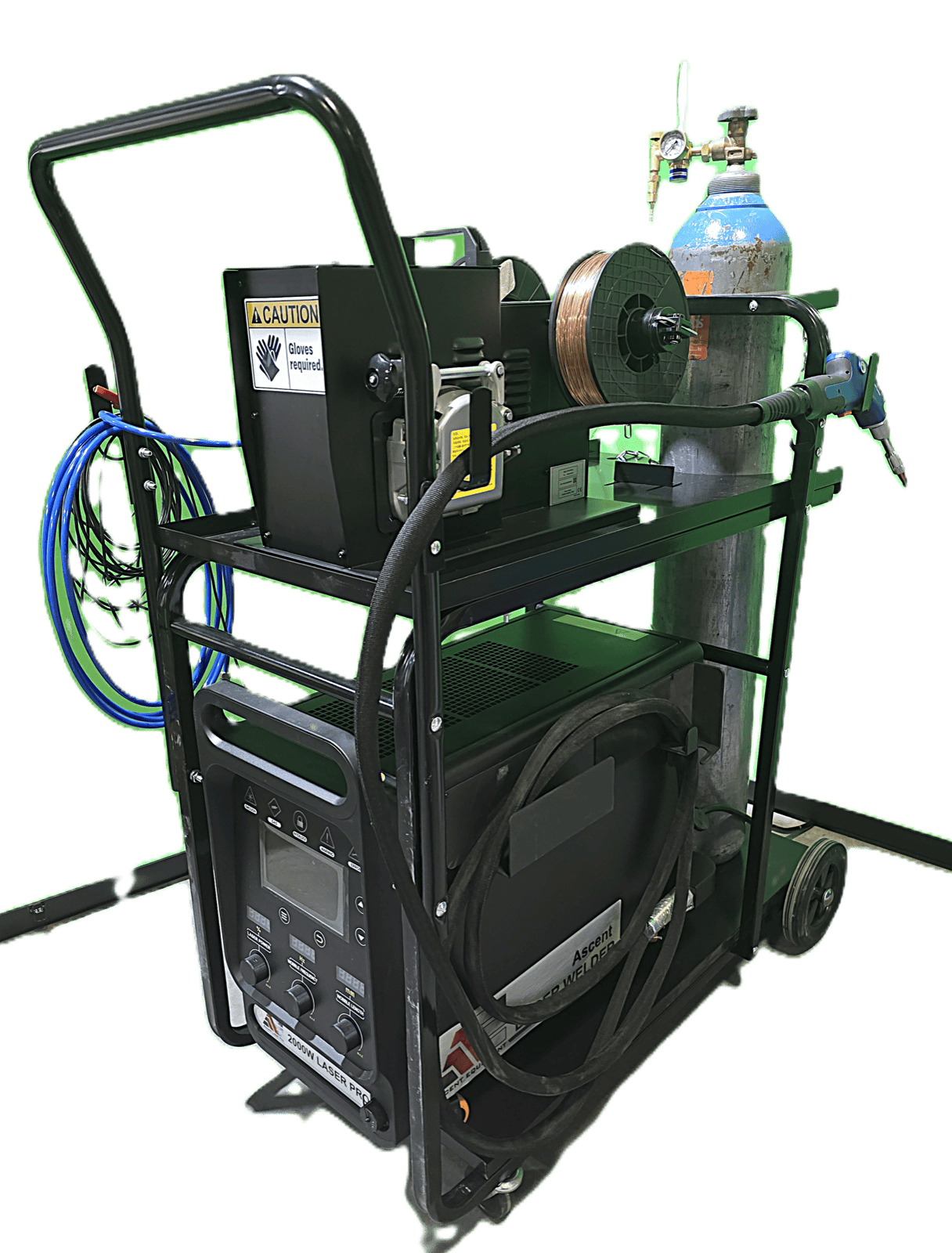
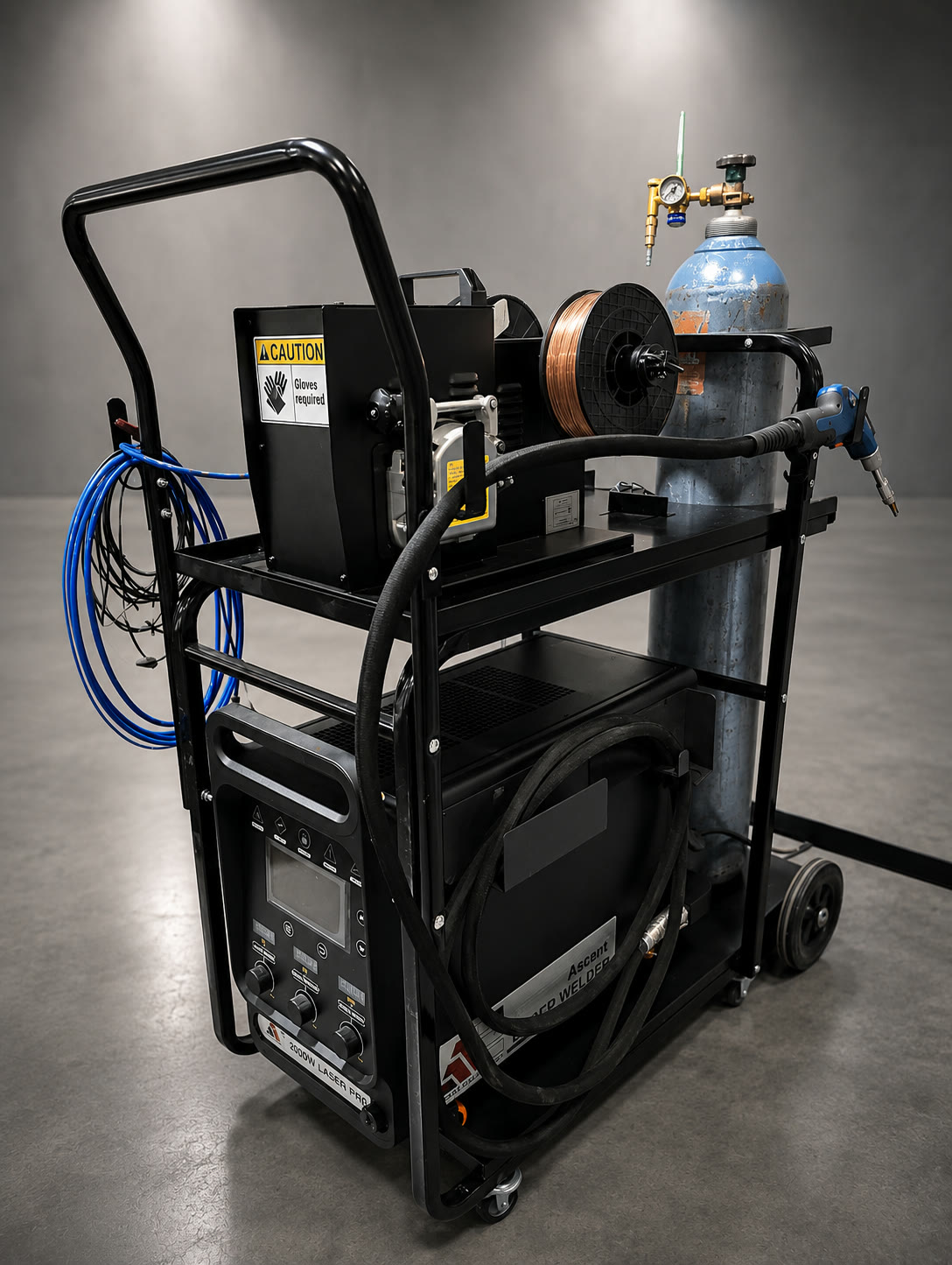
Ascent Equipment 2000W fiber laser welder on cart with dual wire feeder and Argon gas tank


For more information:

ascentequipment.com · Watch on YouTube

Buffalo, NY · Toronto, ON · Kentucky

Direct line: 416-953-8104 Toll-free: 1-800-927-5107 Extension 1008 Tel: 647-494-7800 Extension 1008 Email: dov@ascentge.com · drom@rogers.com
← All articles
More from Ascent

Related articles

How to Make a Channel Letter — The Ascent Way with TMB3
A step-by-step walkthrough of building a channel letter using the Ascent CNC Router, TMB3 bending and trim machine, and Ascent Stapler — including how the TMB3 converts flat aluminum coil into trim cap automatically, saving 20–50% on material cost.
How to Make a Channel Letter — The Ascent Way with EDGE3
A complete step-by-step walkthrough of building a channel letter from design to delivery using the Ascent CNC Router, EDGE-3 bending machine, and Ascent Stapler — faster, more accurate, and more profitable than hand methods.
Making Aluminum Trim with the TMB3 — Better Than Plastic, Cheaper Per Foot, and Glues the Same Way
How the Ascent TMB3 converts flat aluminum coil into finished trim cap on demand — why aluminum outlasts plastic, how the PVC-coated coil lets you use standard contact cement, and what the cost savings look like in practice.
What Sign Manufacturers Are Buying in 2026 — and Why Ascent Has the Answer
The sign industry's equipment buying decisions in 2026 are driven by labor shortages and profitability — not equipment age. Here's who is actively buying, what problem they're solving, and why Ascent Equipment is positioned to solve all of it from one source.
Laser Cutter Consumables: What to Stock for Your CO₂ and Fiber System
A practical guide to consumables, replacement schedules, and spare parts for shops running a dual-gantry CO₂ and fiber laser cutter — so downtime never catches you off guard.
Laser Safety for Industrial Laser Cutters: What U.S. Operators Need to Know
A practical guide to OSHA, FDA, and ANSI laser safety requirements for shops running industrial CO₂ and fiber laser cutting systems — covering engineering controls, PPE, ventilation, and daily checklists.
Safety Considerations for the Ascent QCW Laser Welder
A complete safety guide for the Ascent QCW fiber laser welder — covering Class 4 laser requirements, eye protection, PPE, controlled areas, fume extraction, and daily inspection procedures.
How to Price Channel Letters in 2026 When Using Ascent Equipment
A practical pricing guide for channel letter fabricators — the inch rule, cost-plus method, how each Ascent machine (5AS, EDGE-3, TMB3, laser welder, laser cutter) changes your cost structure, and worked examples comparing five shop configurations.
Ascent 2000W Refrigeration Laser Welder vs. the Competition
A feature-by-feature comparison of the Ascent Equipment 2000W Refrigeration Handheld Fiber Laser Welder against leading competitors — cooling technology, duty cycle, operating costs, and what matters most for production shops.
From Hand-Bending to Machine-Bending: What It Means for Your Shop
Hand-bending channel letters takes 30–45 minutes per letter. A bending machine does the same job in 3–4 minutes. Here's what that shift actually looks like inside a sign shop — production, labor, quality, and the transition itself.
How to Select a Laser Cleaner: The Complete Buyer's Guide
Pulsed or continuous wave? 100W or 3000W? This guide covers every major decision when buying a fiber laser cleaning machine — power, laser type, cooling, applications, and what to ask your supplier.
One Supplier for Your Bender, Your Welder, and Your Laser Cutter
Most sign shops piece together their channel letter equipment from multiple vendors. Ascent Equipment is the only supplier in North America that covers the complete workflow — bending machine, laser welder, and laser cutter — with on-site installation and training on all three.
Laser Welder Safety: What Every Sign Shop Needs to Know
A practical safety guide for sign shops using fiber laser welders — eye protection, fume extraction, fire safety, and how to know exactly what your setup requires.

Let Ascent Experts Assemble All the Pieces of The Equipment Puzzle for your Company

Contact us