
When a customer asks us what a piece of equipment costs, we start with what they need. Usually that means asking what they're trying to make.
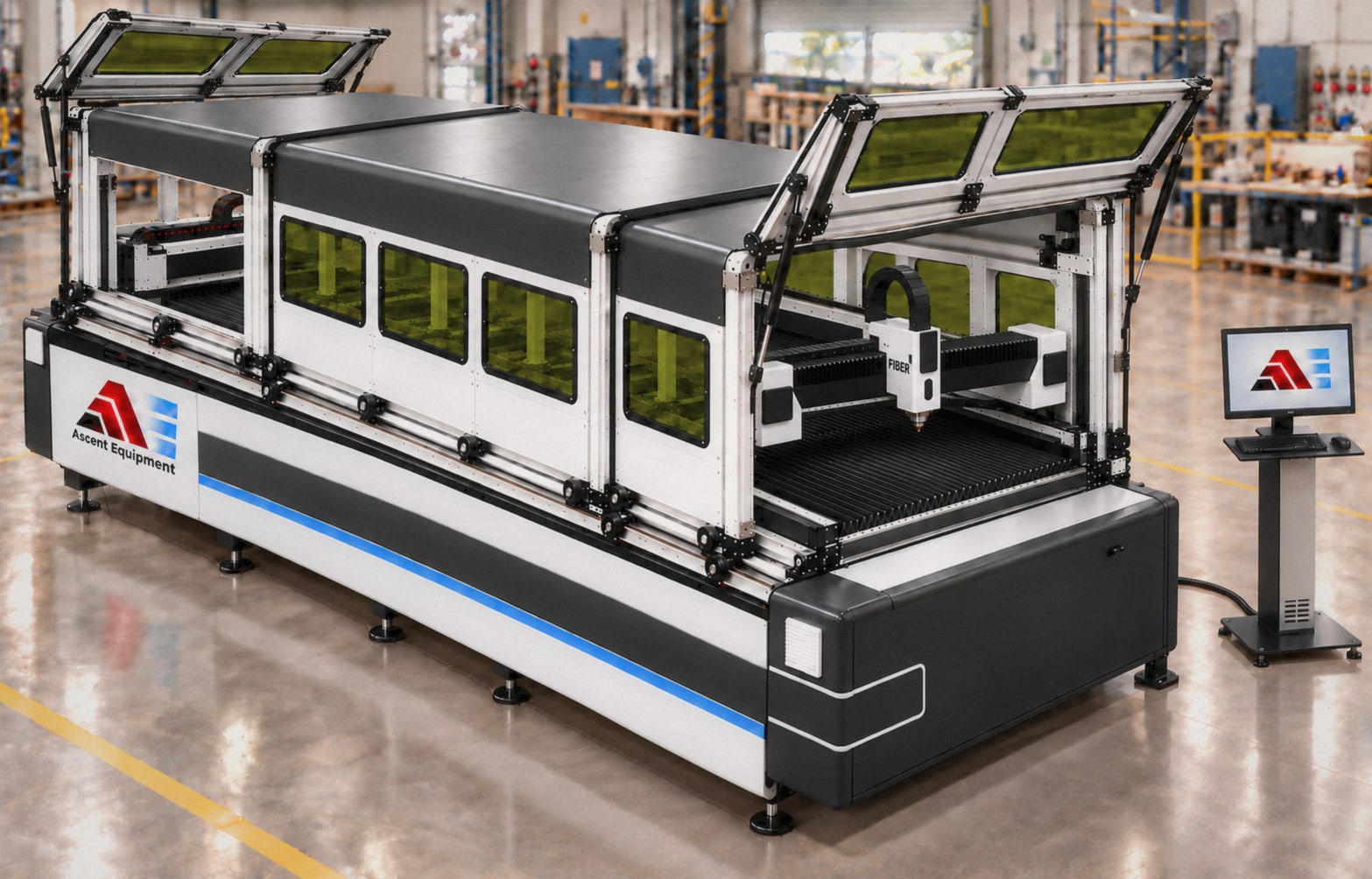
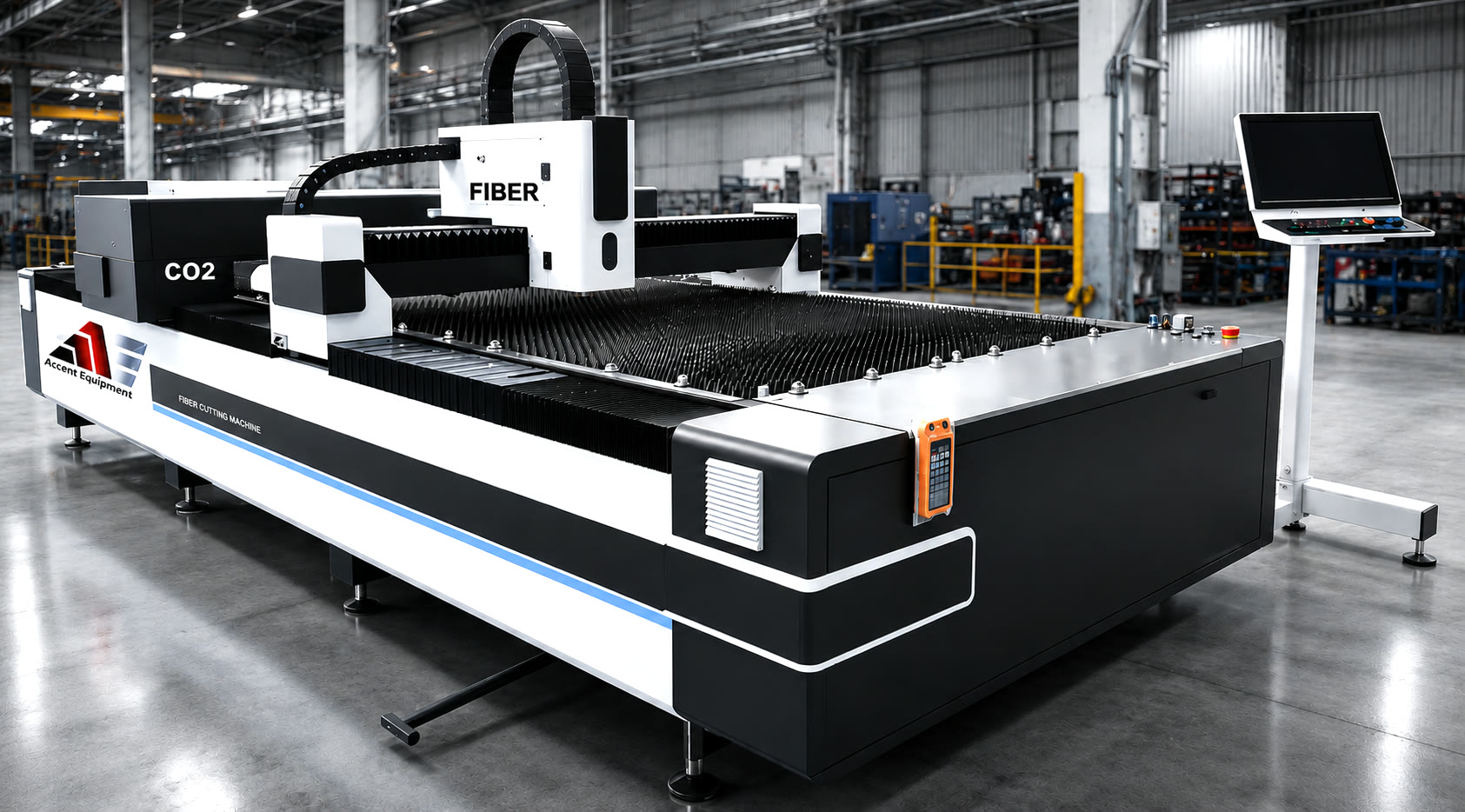
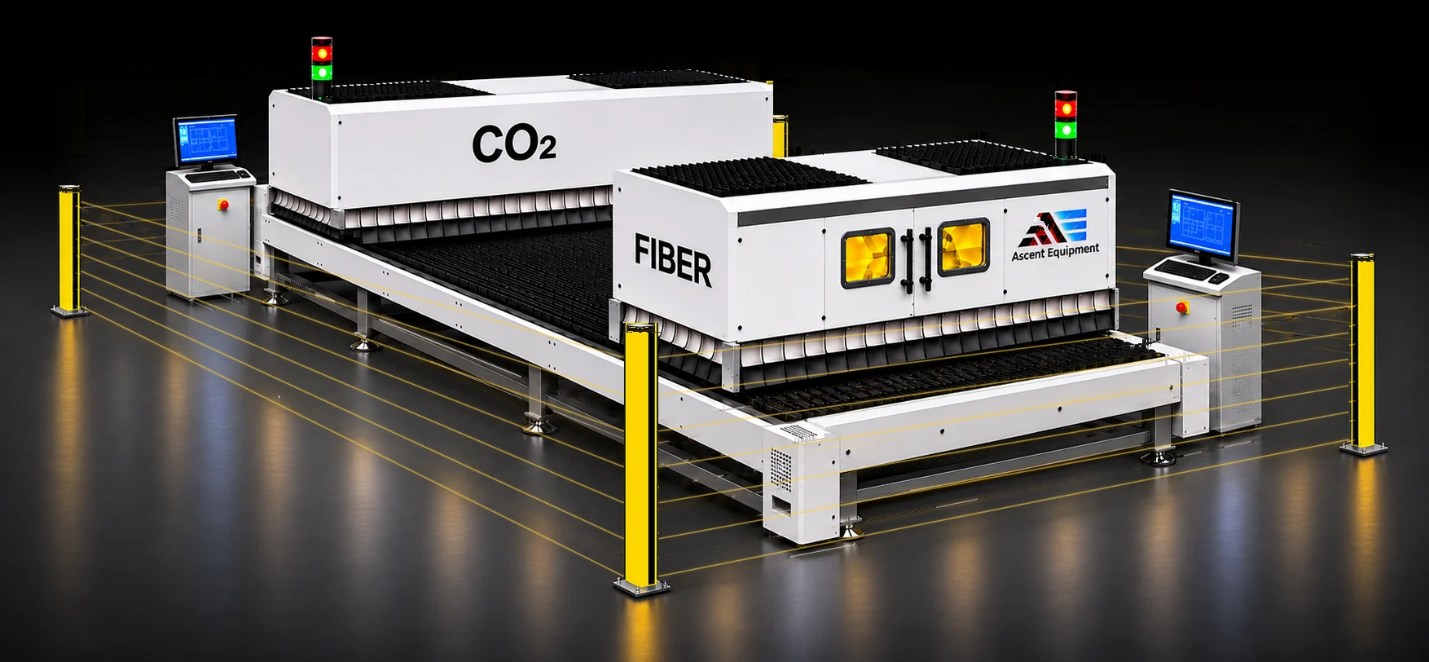
Take our most expensive equipment, a dual-gantry laser cutter, as an example.
Earlier articles covered the differences between CNC laser cutters and CNC routers and between CO₂ and fiber laser cutter technology. We've also gone over laser safety requirements and the types of covers available.
We start with two questions. What do you cut every week, and what are you sending out now?
A shop that cuts acrylic faces all day has a different investment to make than one that buys laser-cut aluminum backs from an outside supplier. A shop that does both may consider an Ascent dual-gantry laser cutter, with a CO₂ laser on one gantry for materials such as acrylic and a fiber laser on the other for metals. Machine prices are easy to compare across quotes. It's harder to work out what it will cost to put the machine into production and what it will save on work you already do.
This guide covers both, with the dual-gantry cutter as the example. The electrical numbers come from a recent installation plan.
Start with the cost of getting into production
Total acquisition cost is what you spend to buy, install, and commission the equipment and to train your team. Ask each supplier what the quote includes and what your shop will need to arrange separately.
| Cost category | What to confirm before you buy |
|---|---|
| Machine and options | Bed size, laser sources and power, controls, software, and included accessories |
| Freight and rigging | Delivery terms, unloading, forklift or rigging charges, and placement on the shop floor |
| Electrical work | Required voltage, phase, and capacity, plus any transformer, disconnect, wiring, or service upgrades |
| Fume and debris extraction | What the machine includes, what the shop supplies, and how the system is set up for the materials you cut |
| Assist air and gases | Compressor, dryer, filtration, or gas supply needed for your actual jobs |
| Installation and training | Who commissions the machine, what the training covers, and whether travel expenses are included |
| Startup supplies | First consumables, spare parts, safety eyewear, and material for test cuts and operator training |
Buying from Ascent already covers some of these lines. Every Ascent machine includes shipping, on-site installation, and operator training. Our laser cutters come with remote desktop software pre-installed, software updates are free, and remote technical support is included for the life of the machine, with technicians in Buffalo, Toronto, and Kentucky.
Every Ascent laser cutter ships with one pair of OD 8 safety goggles, so budget for extra pairs if more than one person works near the machine. Minimum OD 5; prefer OD 7 or 8.
What the site has to provide
The installation layout for the dual-gantry cutter shows how many trades are involved before the first cut:
- Floor space: the machine is 17.5 ft × 7.5 ft (5.3 m × 2.3 m). The layout uses an area of 27.5 ft × 20.5 ft (8.4 m × 6.2 m) so material can be loaded from three sides.
- Power: 380 V three-phase with a neutral for the fiber side and the fume collector fan, and 220 V for the CO₂ side, the two water chillers, and the air pump. The machine also has to be grounded.
- Compressed air: 73 psi (5 bar), supplied by the shop.
- Assist gas: nitrogen for aluminum and stainless steel, oxygen for carbon steel.
- Fume extraction: fume and debris collection come standard with the machine. The layout has one exhaust duct to the outdoors, shared by the CO₂ and fiber sides, and a fume and dust collector as an option.
Each of these has a cost, and most are quoted by someone other than the machine supplier. Electrical work is usually the largest.
Electrical work: a real example
Two shops can buy the same cutter and end up with different installed costs, and electrical work shows why. A shop with suitable power near the machine location may need only a short electrical run. Another may need a transformer, new distribution equipment, and a longer cable run.
Here is what it looked like for a dual-gantry cutter planned for a shop with a typical 208 V, three-phase, 200 A service. The building had neither 380 V nor 220 V, so the plan needed transformers, disconnect switches, a small breaker box for the 220 V loads, a starter for the fume collector fan, and the cable runs. We checked every line against listed prices from US electrical distributors and sized each part to the actual loads. The budget comes to about $12,500–$20,100 for the electrical equipment and about $17,800–$35,700 installed.
| Item | Estimated cost |
|---|---|
| Transformers | $7,578–$7,615 |
| Two fused disconnect switches | $1,786–$3,130 |
| Distribution box, breaker box, contactor, switch, and fan starter | $2,750–$7,250 |
| Fused switches to protect the transformers, if needed | $0–$1,500 |
| Cables, 50 ft each | $400–$612 |
| Electrical equipment | $12,514–$20,107 |
| Electrician's labor | $5,300–$15,600 |
| Total installed | $17,814–$35,707 |
Listed prices, November 2026, before freight, sales tax, permit fees, and any service upgrade.
Five things shape this budget:
- The 220 V loads are single-phase and add up to about 10–11 kW, so a standard 15 kVA single-phase transformer covers them. The 380 V side uses a standard 45 kVA transformer with the exact voltages, listed at about $5,100.
- Indoors, a NEMA 1 or NEMA 12 (dust-tight) switch does the job for about $900–$1,600.
- Each switch and breaker is sized to the load it feeds. The CO₂ laser, for example, draws only about 18–23 A.
- We budgeted $100–$130 an hour for a master electrician with a helper. That's an estimate, so ask at least three licensed contractors for a fixed price on the whole job.
- The electrician may want a fused switch ahead of each transformer to protect it. We allow up to $1,500 for that, so ask about it before you set the budget.
Check the service before you check the prices
The highest electrical cost is the one that isn't in the table: a service upgrade. With the cutter, both chillers, the air pump, and the fume collector fan running, the machines draw roughly 91–162 A on the 208 V service, depending on the size of the fan. Laser cutting runs for hours, so the electrical code counts it as a continuous load at 125 percent, which makes it 114–203 A. On a 200 A service with a large fan, that leaves little or nothing for the lights, office, and air conditioning.
Before you budget, ask your utility for 12 months of your building's peak demand and give it to your electrician along with the nameplates of every machine. If the service must be upgraded, that work involves the utility and needs its own quote.
Questions for your electrician
- What voltage, phase, and current does each machine need? Use the nameplates for the cutter, both chillers, the fume collector, and the air pump.
- Which machines need a neutral as well as the power wires?
- Is the existing service large enough once continuous loads are counted at 125 percent?
- What enclosure rating does the location really need?
- Are the transformers, switches, and breakers sized to the actual loads?
- Does the price include the permit and the inspection?
Ask your machine supplier one more question: are the chillers and every other component built for 60 Hz power? North American power is 60 Hz, and you don't want to find a 50 Hz component on installation day.
Look at the jobs that will pay for the machine
Say a sign shop routes acrylic faces in-house and outsources its aluminum backs. An Ascent dual-gantry cutter gives that shop a way to process both materials on one bed. The question is how much that is worth in day-to-day production.
For acrylic faces, run a test with your usual material, thickness, and letter geometry. Compare the time from loading the sheet to having faces ready for assembly, including any edge finishing your current process needs. For aluminum backs, start with your actual supplier invoices, freight and rush charges included. Then estimate what the same work would cost in-house: labor, material, assist gas, and consumables.
Also look at how often you need both processes at once. On a shared bed, a long acrylic run may be occupying the table when a rush metal job arrives. If the two materials routinely compete for machine time, compare the dual-gantry investment with the installed cost and capacity of two dedicated cutters. Remember that two cutters mean two sets of electrical work, extraction, and floor space. A week of real production orders will tell you more about that trade-off than a cutting-speed chart.
Put the savings and operating costs on the same page
Suppose, for illustration, that a shop's installed investment is $150,000. It expects to bring $72,000 a year of outsourced work in-house and to save $18,000 a year in production labor on work it already makes. It budgets $30,000 a year in added operating costs for the new work and equipment: operator time, materials, utilities, consumables, and maintenance.
| Annual impact | Illustrative amount |
|---|---|
| Outsourcing costs avoided | $72,000 |
| Production labor savings | $18,000 |
| Added in-house operating costs | ($30,000) |
| Estimated annual net savings | $60,000 |
| Simple payback on $150,000 installed | 2.5 years |
These figures only show the calculation. Use your own quotes and job records, and make sure the installed figure includes everything in the first table: freight, electrical work, extraction, air, and startup supplies. In the electrical example above, installed electrical work comes to about $17,800–$35,700, which is roughly four to seven months of the $60,000 annual savings in this illustration.
Count labor savings as cash savings when they reduce expenses such as overtime or temporary staffing. If the same employees stay on payroll and use the time to complete more orders, value that time by the extra work you can realistically sell. If you finance the purchase, build a monthly cash-flow estimate that includes the payments and allows for a gradual increase in production.
Don't be afraid to ask us for any detail you need. We're the experts on our machines, but you're the expert on your shop.
We can make samples so you can compare edge quality, handling time, secondary finishing, and what happens when you switch from acrylic to aluminum. That gives you a basis for deciding what the cutter is worth to your shop, from the day it arrives to the day it starts paying for itself.