
Canada has no single rulebook for a Class 4 industrial laser. You deal with three layers instead: Health Canada’s rules for the machine itself, workplace safety law for the people who run it, and, in Alberta, a separate registration.
Health Canada regulates the sale, lease, and import of laser products. Provincial and territorial authorities usually regulate the work, and federal labour rules apply only to federally regulated employment. Alberta is the one jurisdiction we found with a registration program for Class 3B and Class 4 lasers. In the other provinces and territories, the official sources we reviewed showed no general registration for industrial lasers, but they still carry real workplace duties, and several name laser standards outright. Product paperwork, workplace controls, and local approvals are separate obligations, and none of them stands in for the others.
This guide covers industrial welding, cleaning, and cutting with Class 4 lasers, including handheld fibre welders, pulsed cleaners, enclosed cutters, and demonstration, service, and mobile trailer work. It doesn’t evaluate a particular machine or certify an installation, and entertainment lasers are outside it. After the general rules, the guide takes laser cutters, laser welders, and laser cleaners in turn.
Last reviewed in October 2026. Rules change, so confirm anything that affects you with the authority before you act.
Who regulates what
Six groups have a say over a Class 4 laser. They rarely overlap, so it helps to know which one you’re dealing with.
| Group | What it covers | What it means for you |
|---|---|---|
| Health Canada (Consumer and Clinical Radiation Protection Bureau) | Administers the Radiation Emitting Devices Act and the laser product regulations. The product rules cover industrial equipment. | The machine itself: sale, lease, and import. Mostly the manufacturer’s and importer’s job, but it can become yours if you modify equipment. |
| Provincial and territorial OHS authorities | Employer duties, exposure control, training, PPE, ventilation, machinery, and hazardous energy. Some regulations name laser standards outright. | Where most workplace laser rules come from. Which authority applies depends on the employer. |
| ESDC Labour Program | Occupational safety for federally regulated employers under the Canada Labour Code and its regulations. | Applies in federally regulated sectors. Location alone doesn’t decide it. |
| Transport Canada | Protects aviation from hazardous laser emissions. | Outdoor work, and possession in some public areas including airports, need a separate look. |
| CCOHS and standards organizations | CCOHS publishes safety guidance. ANSI, IEC, and CSA publish standards. | A standard becomes legally significant when a regulation incorporates it. |
| Local authorities and electrical regulators | Building, fire, electrical installation, and ventilation discharge. | Laser paperwork doesn’t replace electrical equipment approval. |
How Canada differs from the US
Health Canada has no accession number and no pre-market approval process for laser products, and its new laser product rules took effect on October 9, 2025. There’s no federal counterpart to OSHA for general industry, so workplace laser law is mostly provincial. And Alberta runs the one registration program we identified for Class 3B and Class 4 lasers.
Health Canada’s product rules
The laser product rules under the Radiation Emitting Devices Regulations apply to products sold, leased, or imported into Canada on or after October 9, 2025. That covers industrial and commercial machines, second-hand sales, rentals, and modified products. A laser you bring into Canada for business use has to be assessed under the import requirements.
The rules classify products under IEC 60825-1, the 2014 edition, and the class that counts is the one for the complete machine, including its built-in protective features, across operation, maintenance, service, and failure. A classification report for the laser source alone doesn’t establish the class of the finished cleaner, welder, or cutter.
Changing a machine’s original performance or intended function can make you the manufacturer, responsible for reclassifying it and for the engineering features, labels, and user information. Review altered optics, scan heads, emission controls, power, housings, and operating modes before you import or supply a modified machine.
Labels and instructions have a language rule. Product identity and origin labels can be in English or French. The laser class and warning labels and the accompanying safety information have to be in both languages. Identity labels show the manufacturer’s name and address, the model, and the manufacture date, plus the importing distributor’s name and Canadian address where one applies.
| Ask your supplier for | What to look for |
|---|---|
| Exact product | Brand, model, serial or batch identity, intended use, and the head, optics, firmware, and accessories actually shipped. |
| Classification | Test method and conditions, measured accessible emissions, wavelength and pulse data, and the assigned class of the completed product. |
| Engineering controls | Protective housing, interlocks, and the other required features, verified under operating and failure conditions. |
| Canadian information | English and French safety labels and user information, plus product identification and origin markings. |
| Changes | A revision record showing whether any modification affects the classification, controls, instructions, or who is responsible. |
There’s no certification, registration, licensing, or pre-market approval process for laser products under the Radiation Emitting Devices Act or its regulations, and the Act sets no record-keeping rule. Health Canada still recommends keeping evidence of manufacturing, testing, and classification, because inspectors can ask for it. So don’t call a laser Health Canada approved because it has IEC paperwork, a customs release, a provincial registration, or a foreign reference number. Those records answer different questions. The accurate statement is that compliance evidence has been reviewed against identified Canadian requirements and is backed by actual documents.
Other records answer other questions too. An Alberta registration certificate authorizes covered equipment under its conditions, but it doesn’t prove national product compliance or cover every destination. Electrical approval is a separate matter, so confirm what the electrical authority in your province accepts.
Compliance in another country doesn’t carry over. Health Canada says laser products that meet US requirements (21 CFR 1040.10 and 1040.11) or EU requirements don’t automatically meet Canada’s, because classification terminology and the bilingual labelling rules differ. A model already sold in the US still needs its own Canadian review.
Two more federal rules can touch a handheld machine. Under the Canada Consumer Product Safety Act, Health Canada prohibits the import, manufacture, advertising, and sale of Class 3B and Class 4 handheld portable lasers. Its published criteria cover battery-operated, hand-carried lasers and leave out lasers that need an electrical outlet to operate or are designed to be mounted to a stationary object. Separately, Transport Canada prohibits the possession and operation of certain lasers in certain public areas, including airports. If your machine is handheld, confirm with Health Canada how these apply before you rely on your own reading of the criteria.
Workplace law: whose rules apply
Start by working out the employer’s jurisdiction. Most manufacturing shops follow the OHS law of their province or territory. A customer in a federally regulated sector may follow federal labour requirements instead, and location alone doesn’t decide that. If a supplier’s technician is working at your site, agree in advance who is responsible for what: the supplier, you, and the site operator each carry duties.
For federally regulated employment, section 10.26 of the Canada Occupational Health and Safety Regulations requires employers to implement ANSI Z136.1 for lasers. The text names the 1986 edition, including its appendices except Appendix D. Don’t read that old year as permission to use obsolete limits. Confirm the edition that applies, along with any sector-specific rules, before you approve a federal site.
Provinces and territories incorporate laser standards in different ways. Some name a fixed edition, others add “as amended from time to time,” and New Brunswick accepts standards that offer equivalent or better protection. Record the legal citation and the edition you used in your hazard assessment. A newer standard is good technical practice, but it doesn’t remove the need to meet the edition the law incorporates at your site.
CCOHS and provincial guidance help you build a program, but there’s no single Canada-wide industrial laser regulation. Ontario’s guidance says there is no regulation specifically for lasers, and the Occupational Health and Safety Act still requires employers to take every precaution reasonable in the circumstances. OSHA guidance can help with engineering review, but it doesn’t replace Canadian law.
Safety Code 6 covers radiofrequency exposure, so it isn’t the optical exposure standard for a 1064 or 1070 nm industrial laser. Ionizing-radiation dosimetry and X-ray registration rules shouldn’t be copied into a laser program without checking their scope.
Province by province
| Jurisdiction | What applies |
|---|---|
| British Columbia (WorkSafeBC) | OHS Regulation sections 7.19 and 7.23 bring in laser exposure limits and standards, with ANSI Z136.1-2000 as amended from time to time. Section 7.20 requires an exposure control plan when a non-ionizing action level is or may be exceeded. |
| Alberta (Alberta OHS) | Class 3B and Class 4 lasers are designated radiation equipment and need a registration certificate. Part 20 of the OHS Code also covers laser operation. Details below. |
| Saskatchewan (OHS Branch) | Check both the OHS regulations and the Radiation Health and Safety rules. A change effective August 8, 2024 ended laser light show registration. It doesn’t create a general industrial exemption, so don’t use older national summaries to impose the old rule or to skip a check. |
| Manitoba (Workplace Safety and Health) | Regulation 217/2006, section 16.28, requires a laser to be installed, used, and maintained in accordance with ANSI Z136.1-2014. That’s a specified edition, unlike the “as amended” wording elsewhere. |
| Ontario (MLITSD) | No regulation specifically for lasers. The Occupational Health and Safety Act and the industrial, construction, chemical, PPE, and energy-control provisions apply. Official guidance recommends a laser safety program and a competent person supervising Class 3B and Class 4 lasers. |
| Quebec (CNESST) | The RSST requires shielding of intense infrared sources (section 142) and eye and face protection to CAN/CSA Z94.3 where workers face intense radiation (section 343). Contaminant, ventilation, and respiratory program duties apply, and so do language obligations, so plan French materials and instruction workers understand. |
| New Brunswick (WorkSafeNB) | General Regulation 91-191, section 34, requires industrial laser use to follow ANSI Z136.1-2007, Z136.4-2005, Z136.5-2020, Z136.6-2005, and Z136.7-2008, or standards offering equivalent or better protection. |
| Nova Scotia (OHS Division) | General employer and safety regulations apply. The welding provisions require radiation screening, or keeping people out unless a lack of excessive exposure has been shown (section 112). An ordinary arc-welding curtain isn’t automatically a suitable near-infrared laser barrier. |
| Prince Edward Island (WCB OHS) | The OHS Act and General Regulations govern precautions, machinery, training, and PPE. Respirators follow CSA Z94.4-18 (section 45.18). |
| Newfoundland and Labrador (OHS Division) | OHS Regulations 2012 cover PPE, respiratory programs, machinery, hot work, and ventilation. Section 454 requires effective local exhaust at a fixed station for harmful contaminants from welding. No general laser device registration turned up. |
| Yukon (Workers Safety and Compensation Board) | Radiation Protection Regulations sections 21 to 25 set specific laser rules: a written code of practice, a responsible person, operation logs, restricted and screened work areas, warning lights, beam termination, and suitable eyewear. People who work with lasers need a medical exam first, including an ophthalmologist’s report, repeated every six months and after any accidental exposure. |
| Northwest Territories (WSCC) | OHS Regulations section 361 adopts ANSI Z136.1-2000, as amended from time to time, for laser installation, operation, labelling, and maintenance. Section 363 covers accidental exposure, including immediate notice to the Chief Safety Officer when a medical professional reports a known or suspected radiation injury. |
| Nunavut (WSCC) | OHS Regulations sections 361 and 363 cover laser operation and accidental exposure in the same way. Confirm the current consolidation for your site. |
Mining, construction, and specialized facilities may have more rules. Confirm the rules for your site and activity before demonstrations or mobile work.
Alberta: the one registration program we found
Alberta lists Class 3B and Class 4 lasers as designated radiation equipment. The OHS Act and Code require employers to register it, and the certificate comes from an authorized radiation health registration agency. Certain professional colleges, associations, and academic institutions can act as that agency, so you contact them to arrange the inspection. Part 20 of the OHS Code prohibits operating covered equipment without a registration certificate, apart from limited inspection and installation work. Don’t stretch those exceptions to routine customer demonstrations.
The definition leaves out these sources when they’re enclosed within a laser system of a lower classification, so confirm the class of the complete system. Certificate conditions matter, and so do changes to the emitted radiation or the facility’s protection. For mobile cleaning, demonstrations, and new locations, confirm what the certificate covers. The industrial facility provisions reference ANSI Z136.1-2014. The official searchable text carries a March 2023 currency notice, so check the latest consolidation and the agency’s conditions before you commission.
Start with a laser safety officer
Every laser program needs one person who answers for it. The laser safety officer (LSO) classifies the equipment, assesses the hazard, picks the controls, writes the procedures, signs off on training, and approves changes, and needs the authority to stop unsafe work. When a regulation incorporates ANSI’s laser program requirements, the LSO arrangements can become legally significant at that site.
The employer still owns the legal responsibility. Naming an LSO doesn’t pass those duties to an employee or make an unsafe installation acceptable. Put the appointment in writing: which machines, sites, mobile jobs, and service work it covers, who the LSO reports to, and who the trained alternate is. An LSO should also know their limits and call in a laser safety specialist, an industrial hygienist, or a controls engineer for anything beyond their competence. No LSO can waive a legal requirement or establish Health Canada product conformity.
No Canada-wide course-hour requirement, government LSO licence, or refresher interval turned up in our review, so follow the law that applies, the standard it incorporates, and any certificate conditions. Ontario’s guidance uses the term competent person. A professional certification shows knowledge but doesn’t prove someone can handle every pulse mode or industrial process. Good LSO training covers hazard analysis and program management, not only how to make a weld or run a cleaner. Operator training and LSO qualification are separate, and so are their records.
Controlling the beam
These practices draw on ANSI Z136.1 and OSHA’s laser guidance, which many Canadian programs use as technical references. Neither replaces Canadian law. The standard your jurisdiction incorporates governs, so use that edition and the laser maker’s design information.
Calculate the hazard instead of picking a distance
The maximum permissible exposure (MPE) is the limit used to judge eye and skin hazards. It’s set at one-tenth of the exposure that has a 50 per cent chance of causing injury, and it changes with wavelength and exposure time. The nominal hazard zone (NHZ) is where direct, reflected, or scattered radiation could exceed it, and the nominal ocular hazard distance is how far along a beam the eye hazard extends under defined conditions. None of them is a universal safe radius. A qualified assessment looks at wavelength, continuous or pulsed output, pulse duration and repetition rate, beam size and divergence, exposure time, optics, scanning, and foreseeable reflections. A 500 W or 1000 W average output alone can’t settle eyewear or barrier choices.
Contain the beam path and control the area
Choose a verified enclosure or contained beam path when you can. With an open handheld welder or cleaner, think through every plausible aiming direction, target, and reflected path. Curved rollers, polished metal, and edges can redirect the beam, and diffuse reflections from a Class 4 laser can be hazardous too. Use suitable beam stops, and keep radiation from leaving through windows, doors, roof openings, or ventilation paths.
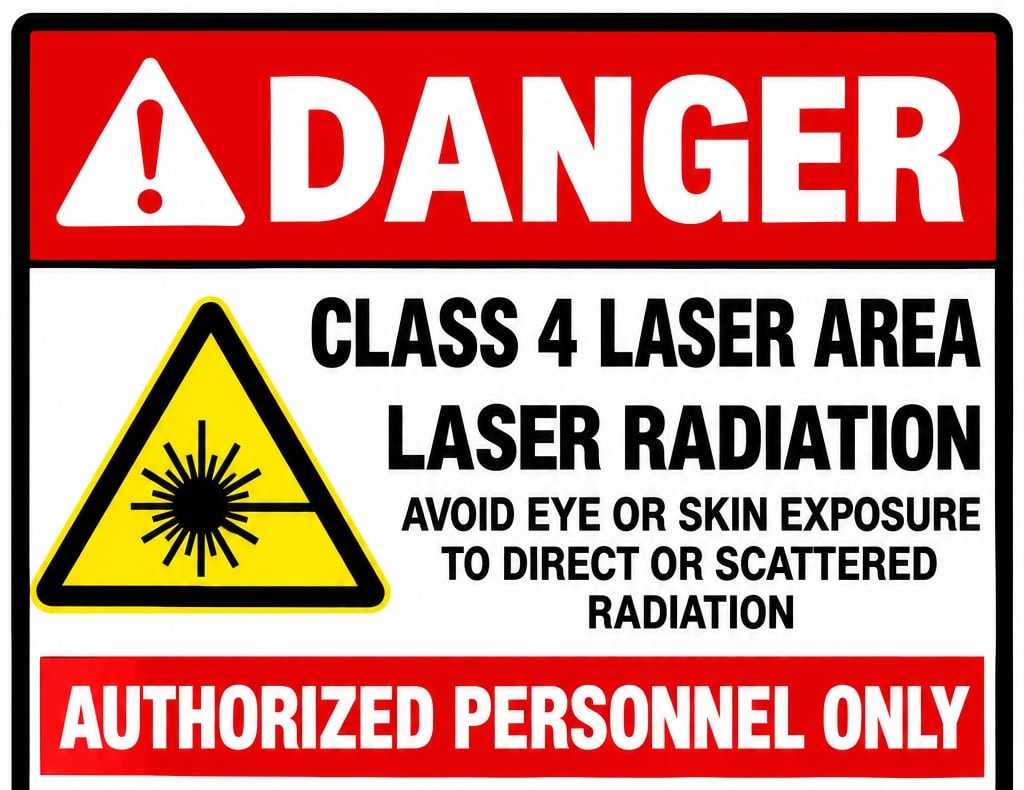
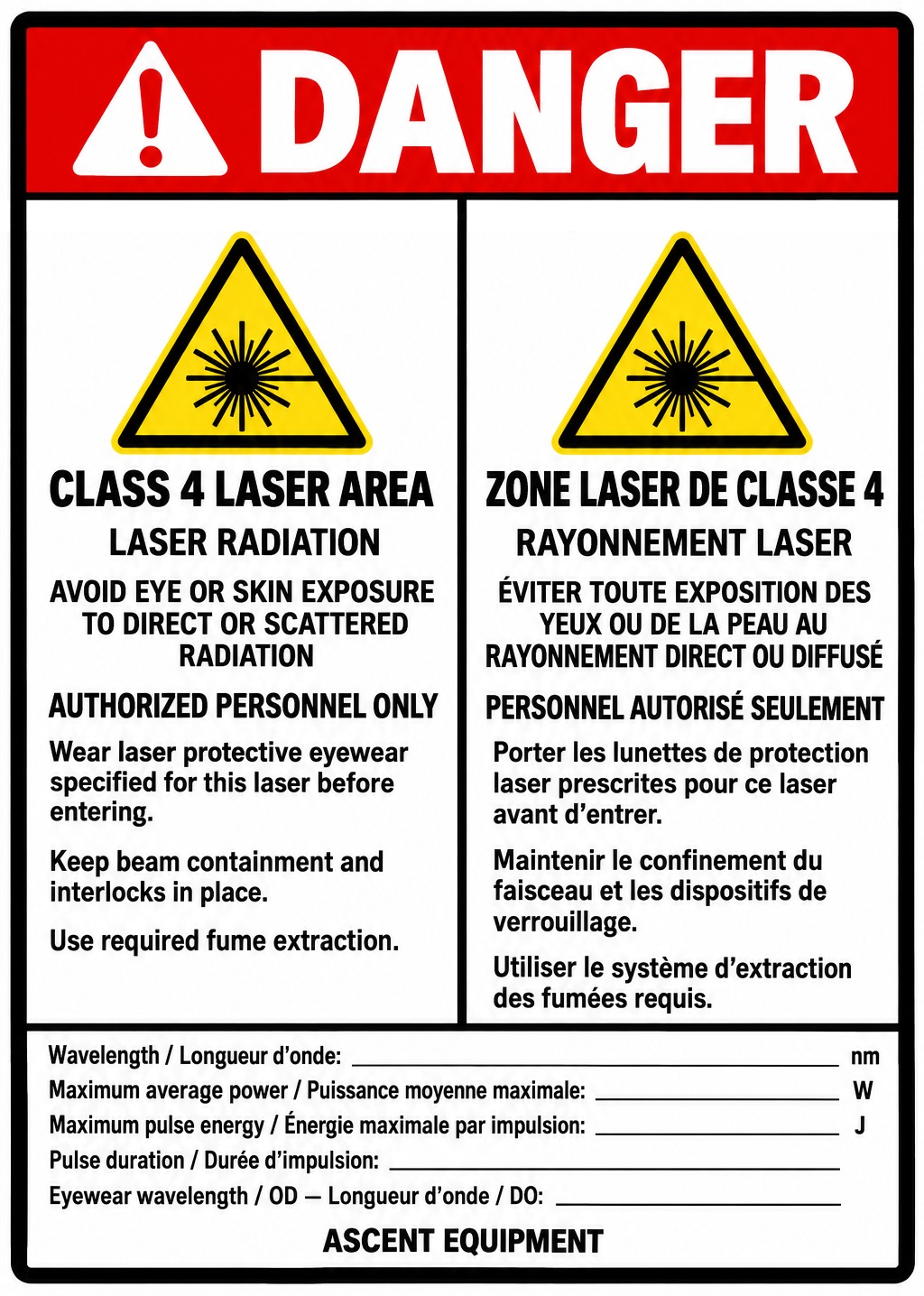
If hazardous emission can still be reached, the controlled area has to contain the whole assessed hazard zone, with entry limited to trained, authorized people, visitors and other trades included. A workpiece-contact sensor, a floor line, a cone, or a warning light doesn’t contain a beam. Post a warning at every way in that names the hazard and the protection required before anyone enters. The label below is in English and French and leaves blanks for the laser’s wavelength, power, pulse energy, and pulse duration, and for the eyewear wavelength and OD. Minimum OD 5; prefer OD 7 or 8.
How you apply these controls depends on the machine. The next three sections take laser cutters, laser welders, and laser cleaners in turn.
Laser cutters
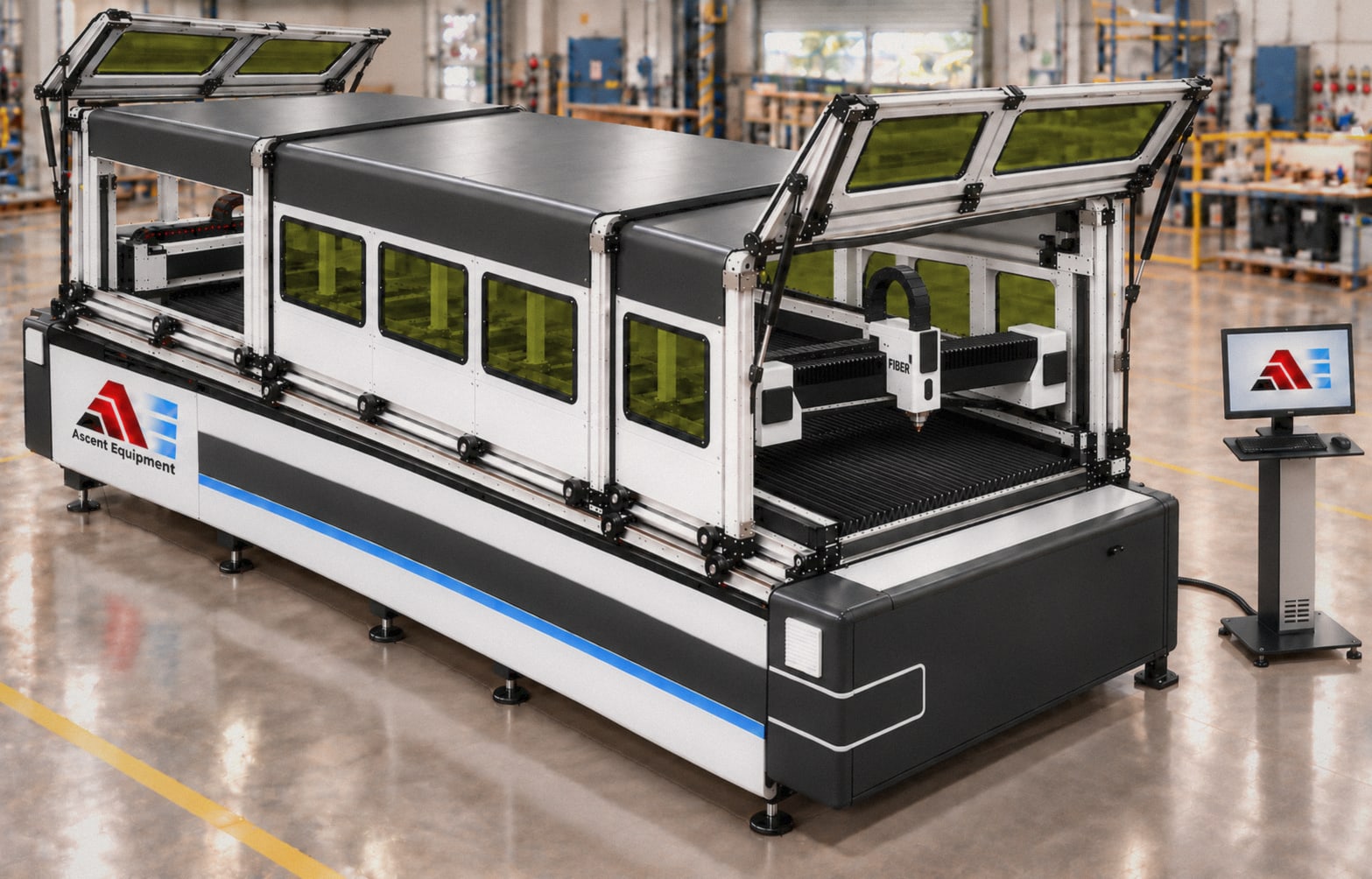
An enclosed cutter keeps its beam inside the machine, so the main safeguard is the cover around it.
The solution: a cover for the laser cutter
An enclosed cutter can be Class 1 in normal operation and still hold a Class 4 source. Health Canada gives no exemption to a Class 1 product with a higher-class laser inside it, and the inherently safe exemption fails if higher-class radiation can become accessible when interlocks are overridden, the product is opened, or a protective element fails. Ask for evidence of the protective housing, the access interlocks, and the accessible emission tests for the actual configuration.
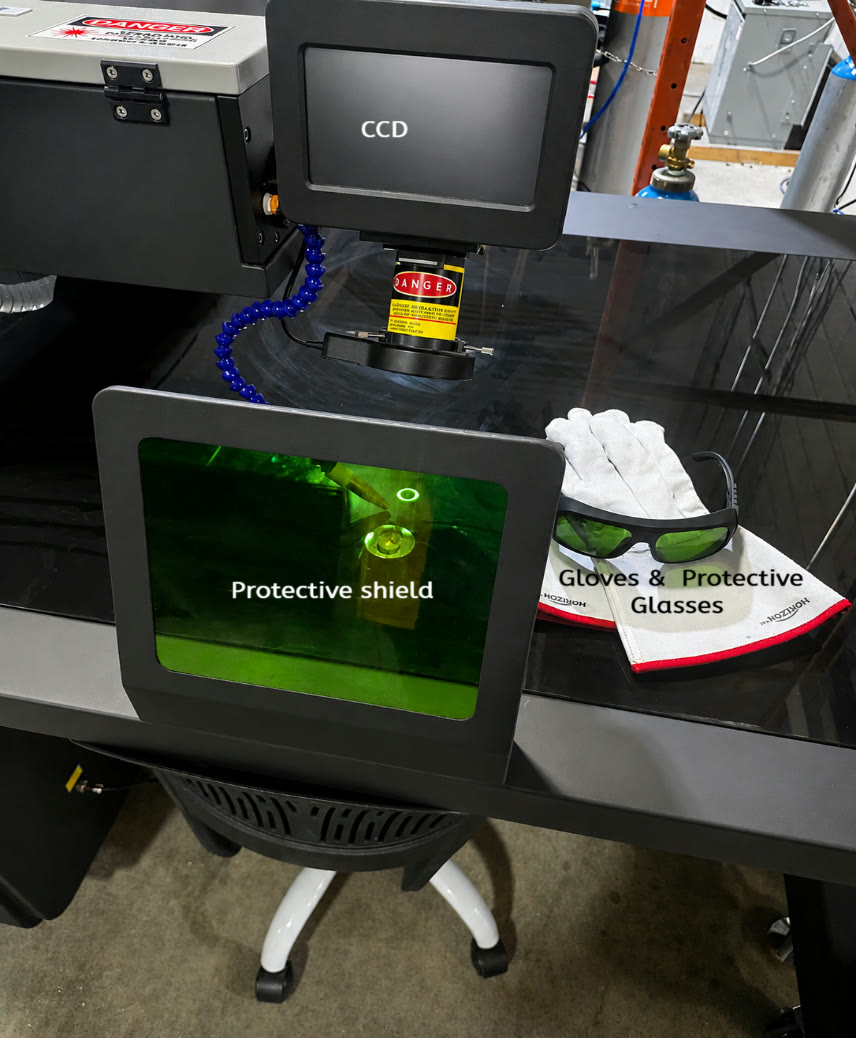
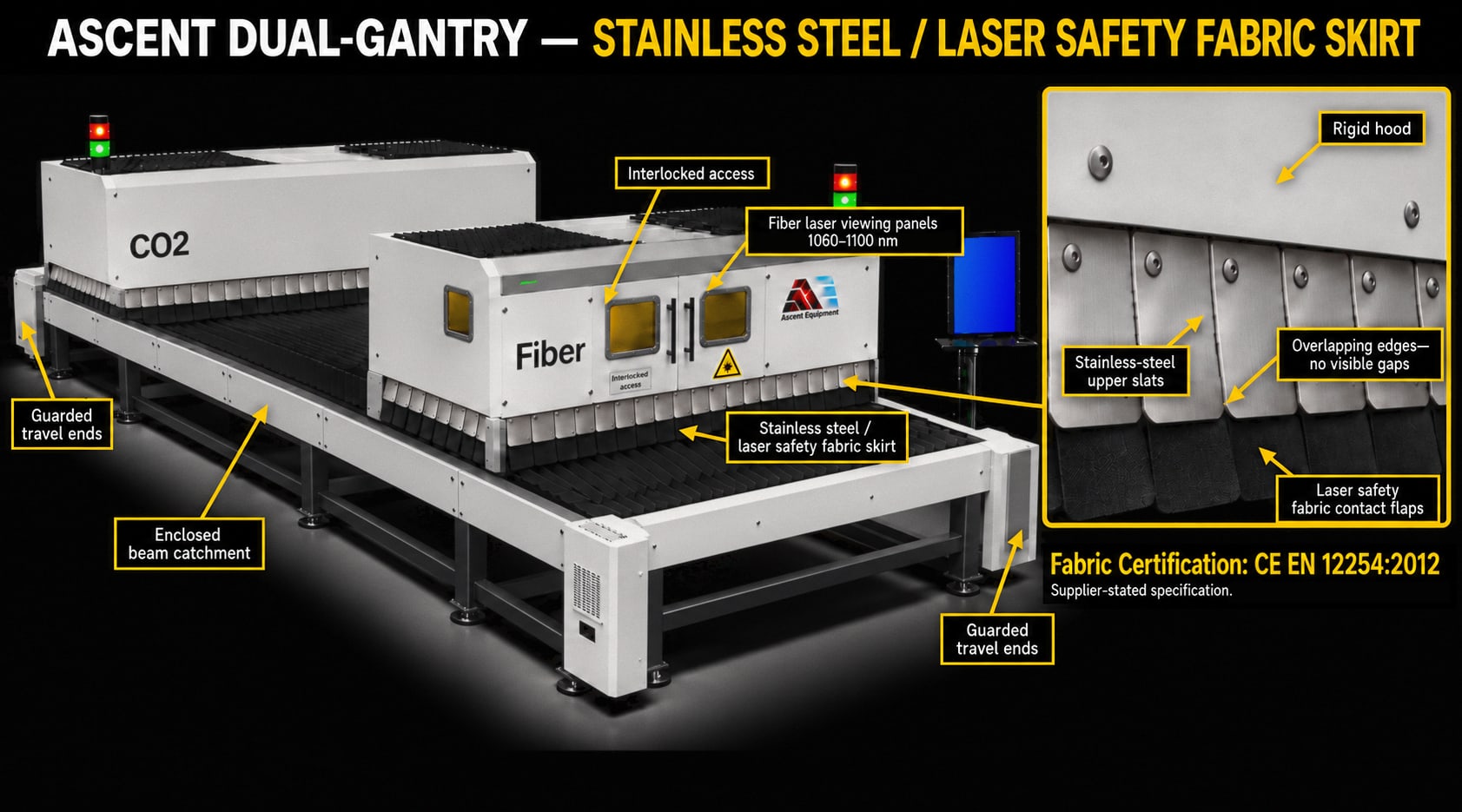
So the cover has to stay whole and stay interlocked. The annotated picture below calls out what to look for on a cutter: interlocked access, viewing panels, an enclosed beam catchment, guarded travel ends, and a stainless steel and laser safety fabric skirt along the lower edge. Check seams, door gaps, windows, penetrations, and fire resistance, and make sure the cover holds long enough for the system to shut the beam off.
The viewing panels need documented protection for your actual wavelength, irradiance, exposure time, and a foreseeable beam strike. A panel that only looks tinted proves nothing, and the callout on the picture says it plainly: rating to verify. Service is the weak point, because opening the cover can bring the Class 4 beam back within reach, so apply the entry-control and hazardous energy rules described under laser welders before anyone opens it.
Fire is the other risk to plan for. Keep a CO₂ extinguisher within reach of the cutter, as described under fire and other hazards.
Laser welders
An open-beam handheld welder or cleaner is a different case. The beam isn’t contained by design, so most of the protection comes from the room, the procedures, and the people. Target-contact sensing on the torch helps, but it doesn’t prove containment, and it doesn’t replace eye protection.
The solution: personal protective gear (PPE)
For laser welders, the solution is personal protective gear backed by the controls that keep people out of the beam’s reach. It has four parts: entry controls and emergency stops, barriers and viewing windows, protection for the people in the room, and fume extraction and respirators.
Fire protection belongs with the gear: a CO₂ extinguisher for the machine, and a Class D extinguisher if you weld reactive metals, as described under fire and other hazards.
Entry controls and emergency stops
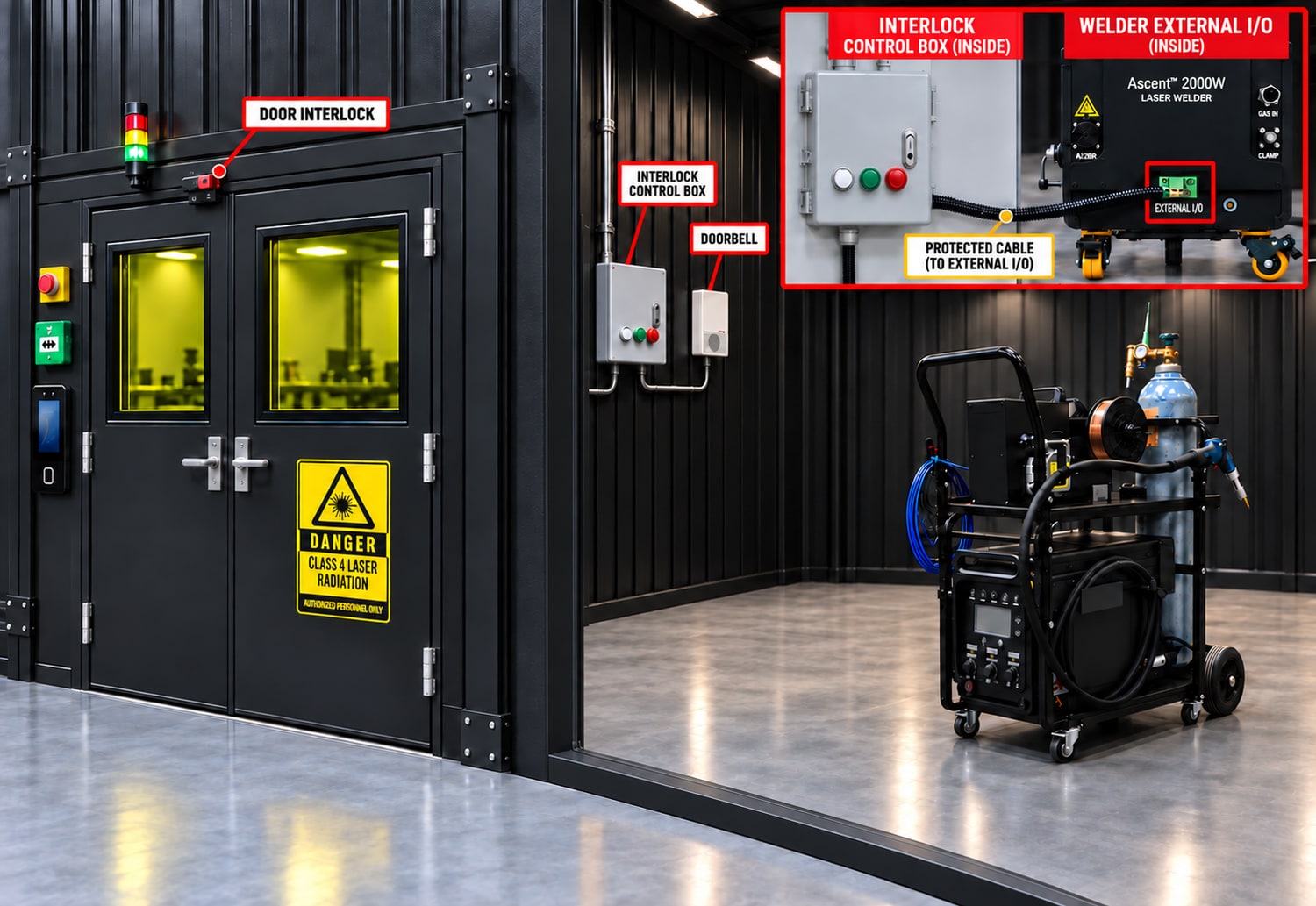
Common guidance describes nondefeatable interlocked entry, controlled defeatable entry, and procedural entry with suitable barriers and warnings. The right one depends on your design and the rules that apply. Whichever you pick, have a qualified controls specialist tie the entry controls into the manufacturer’s safety interface, keep a fast way out, put an emergency shutoff within reach, test door and panel interlocks, and control restarts. Opening a protected door should put the laser in its safe state before anyone can reach the hazard, and a reset shouldn’t start emission. A warning light must show the real state of the laser, not just that power is on. One unvalidated door magnet isn’t a safety system, nobody should bypass interlocks to keep production moving, and an emergency stop isn’t hazardous energy isolation.
Barriers and viewing windows
Get documented protection for your actual wavelength, irradiance, exposure time, and a foreseeable beam strike, and check seams, door gaps, windows, penetrations, and fire resistance. The barrier has to hold long enough for the system to shut the beam off. Flat black paint, ordinary welding curtains, and a generic metal thickness don’t make a tested barrier. A room without a ceiling needs its own look at upward emission, because wall height alone doesn’t show containment.
Protecting the people in the room
The LSO picks eyewear from the exposure analysis. Start with the laser’s wavelengths and its output: continuous power, or pulse energy, duration, and repetition rate. Work out the exposure limit and the longest exposure that’s realistic, then calculate the optical density (OD) that brings the beam down to a safe level. Minimum OD 5; prefer OD 7 or 8. Your LSO confirms the final rating for your machine and task, and the laser maker’s specification comes first if it calls for more. Then check these things on the glasses themselves:
| Check | What to look for |
|---|---|
| Optical density (OD) | OD is the base-10 logarithm of the light going in divided by the light that comes through, at one wavelength. Each step up lets through ten times less: OD 5 passes 1/100,000, OD 7 passes 1/10,000,000, and OD 8 passes 1/100,000,000, so it blocks 99.999999 per cent. No filter blocks everything, so the number tells you how much gets through. Minimum OD 5; prefer OD 7 or 8. |
| Wavelength range | Each rating is tied to a stated range in nanometres, for example OD 5+ across 830 to 980 nm and OD 7+ across 1000 to 1095 nm, and it doesn’t hold outside that range. Your laser’s wavelength has to sit inside it. Two lasers with the same name can run at different wavelengths, so check the actual figure. A fibre laser near 1070 nm needs glasses whose stated range includes 1070 nm. Go by the guaranteed rating, not a sample graph. Minimum OD 5; prefer OD 7 or 8, measured at your laser’s wavelength. |
| Lens material | Hardened, scratch-resistant polycarbonate, or absorptive glass with the laser-protective dye built in, so a surface scratch doesn’t compromise the protection. Reinforced or laminated glass lenses are built for a higher damage threshold. |
| Damage threshold | The laser power at which the lens and frame start to be damaged by a direct beam. Ask the maker for it and compare it with your laser’s power. Stop using glasses that are damaged, scratched, contaminated, or untraceable, or that have taken a high-energy hit. |
| Visible light transmission (VLT) | Depends on the dye, from low (23 per cent, for example) to clear lenses well above 60 per cent. It affects how bright the work looks and how comfortable the glasses are to use. |
| Fit and coverage | Side and top coverage and a snug fit. Some goggles go over prescription glasses and some large frames won’t fit under them, and some makers offer inner frames made to your prescription. |
| Markings and standards | The wavelength range, the protection rating, and the VLT should be printed on the glasses. ANSI Z136.1 is the standard for the safe use of lasers that many Canadian programs follow, and several provinces name it in law. CSA Z94.3 covers eye and face protectors, many jurisdictions require it, and Quebec’s section 343 names it for intense radiation, so check the edition and the laser-specific performance as well as impact and process protection. EN 207 and EN 208 were the European standards for laser eye-protection filters and equipment, now replaced by ISO 19818. |
Laser glasses aren’t welding eyewear. They don’t cover the light from the weld itself, so protect against that separately, and a welding shade or a dark lens doesn’t show laser protection at 1064 or 1070 nm. A CO₂ laser, which works near 10.6 micrometres, needs a separate assessment. Alignment glasses that pass some visible light, rated about OD 1 to 4, only suit low-power setup work. They fall short of the standard here, minimum OD 5; prefer OD 7 or 8, so they don’t belong at a production welder or cleaner. Keep the glasses on for the whole job, never look into the beam through them, and never aim a beam at them.
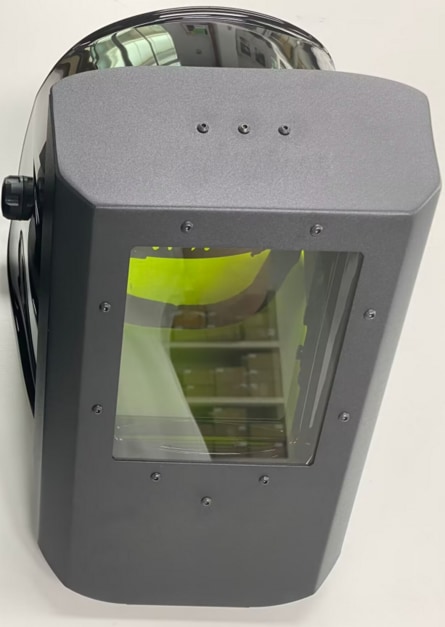
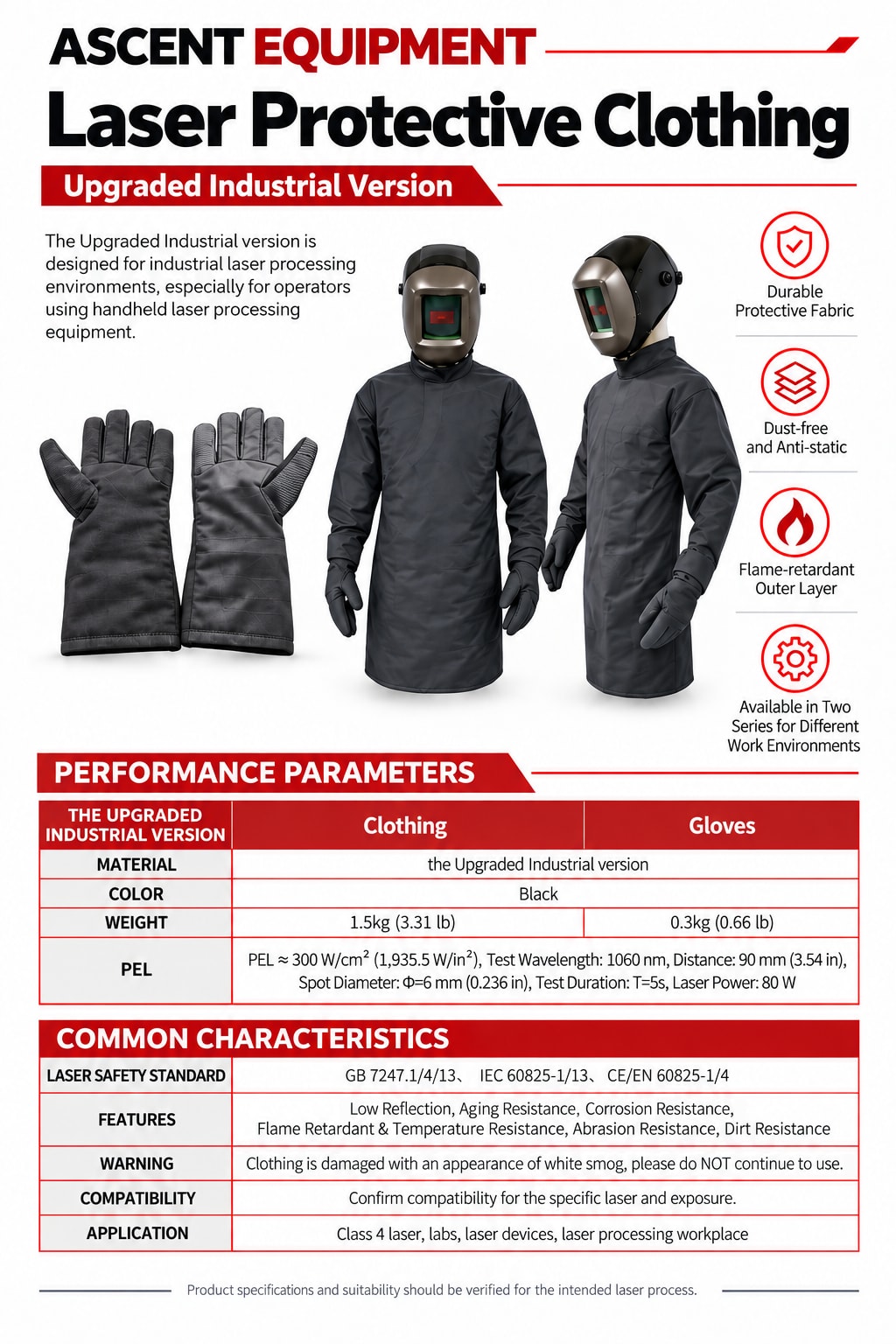
A laser face shield or helmet needs laser filtering for every viewing area and has to work with your eyewear.
Gloves, sleeves, and aprons protect against heat, sparks, sharp edges, and chemicals. Clothing never gives anyone permission to intercept a beam, and it counts as laser protection only if its wavelength and exposure ratings are documented. Keep hands out of the beam and use fixtures and beam stops.
Fume extraction and respirators
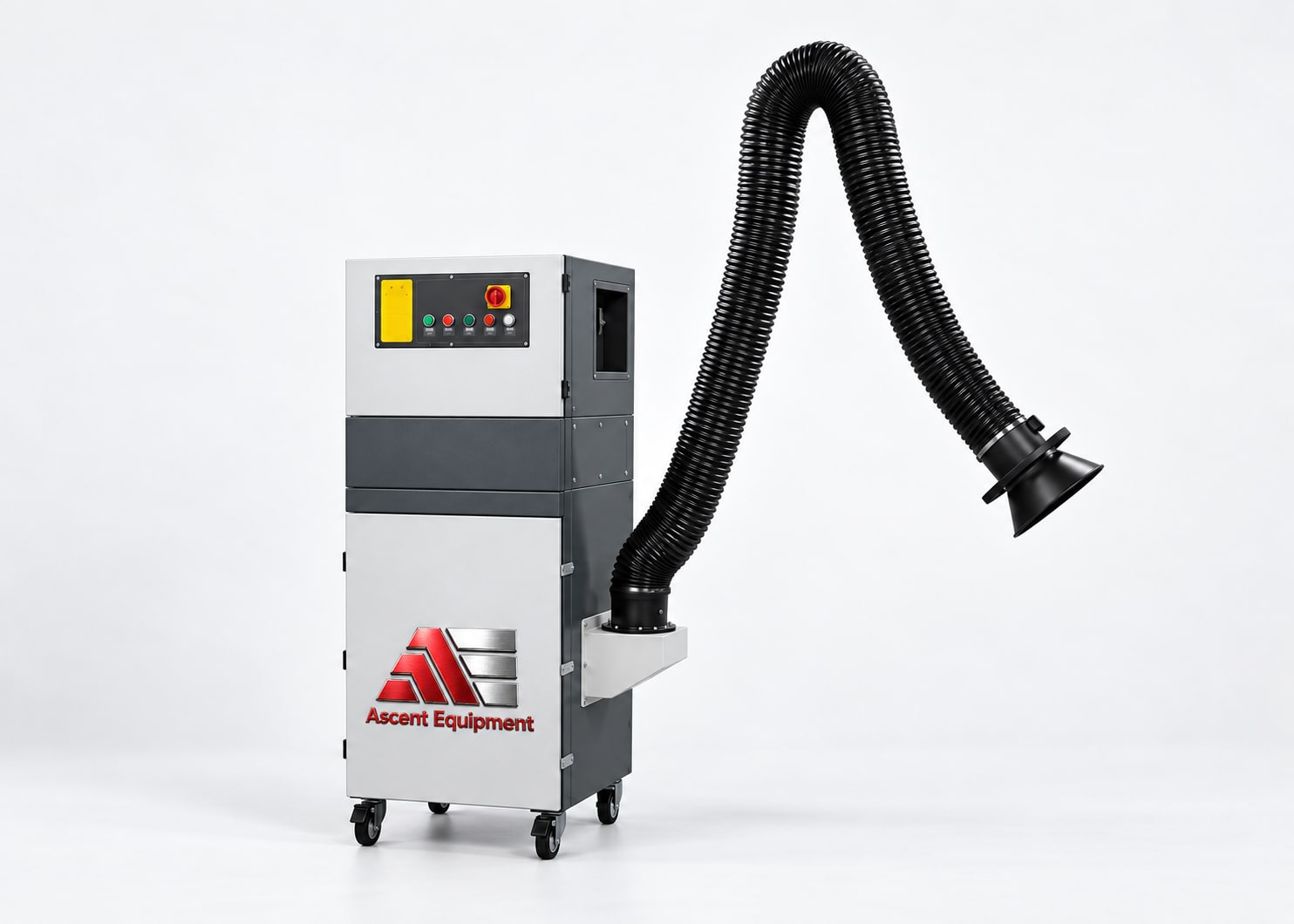
Cleaning, welding, and cutting can put hazardous particles and gases in the air, from the base metal and from coatings. Old paint or adhesive can release particles and decomposition gases even when it was water-based, so find out what’s on the part before you start: read the SDS, apply your jurisdiction’s exposure limits, and don’t assume laser cleaning eliminates hazardous dust. For coated steel rollers, get the material identity and exposure evidence before you choose filters. Capture fumes with local exhaust close to the beam, and test the capture under real working conditions. A HEPA stage stops particles, not gases or vapours.
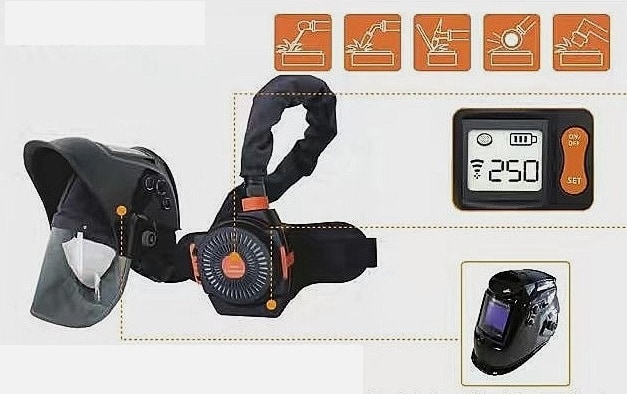
Follow your province’s respiratory rules and the CSA standard they incorporate, CSA Z94.4: hazard assessment, qualified administration, a health or fitness evaluation, training, fit testing for tight-fitting devices, cleaning, inspection, maintenance, and program review. A user seal check isn’t a fit test, facial hair can’t interfere with the seal, and fit-test intervals come from your jurisdiction’s rule and the incorporated standard, not from OSHA’s annual interval. Filter efficiency isn’t the protection the worn respirator gives. A welding PAPR helmet isn’t automatically laser rated, and an air-purifying respirator is the wrong tool for oxygen-deficient or immediately dangerous conditions. A filtered helmet protects only its wearer within its limits and does nothing for the people nearby.
Laser cleaners
A laser cleaner combines an open, often handheld, beam with a material nobody has tested: whatever is on the part. The controls described for laser welders, meaning entry controls, barriers, eyewear, fume extraction, and respirators, apply to open-beam cleaners too. The points below are the ones that are different.
Know what’s on the part
Laser cleaning removes whatever is on the surface, so the coating matters as much as the beam. Old paint or adhesive can release particles and decomposition gases even when it was water-based, and lead paint, chromium-containing alloys, and other contaminants can trigger substance-specific rules in your jurisdiction. Read the SDS and the process information before you start, and for coated steel rollers, get the material identity and exposure evidence before you choose filters. If the part is a reactive metal such as magnesium or titanium, you also need a Class D extinguisher within reach, as described under fire and other hazards.
Capture the fumes and protect the lungs
Don’t tell a customer that laser cleaning eliminates hazardous dust unless you have exposure data to back it up. Capture fumes with local exhaust close to the point where the beam hits the work, test the capture under representative working conditions, apply your jurisdiction’s exposure limits, and remember that a HEPA stage stops particles, not gases or vapours. Pick respiratory protection from the measured or expected exposure, and follow the respirator rules described under laser welders.
Pulsed output and eyewear
Many cleaners are pulsed and use a scan head, so average power doesn’t describe what a pulse can do. Record the pulse energy and duration, the repetition rate, the peak and average power, the beam size, and how the scan head behaves, and design for scan failure and incorrect aiming. A 500 W or 1000 W average output alone can’t settle eyewear or barrier choices. Minimum OD 5; prefer OD 7 or 8, and the LSO confirms the final rating from the actual pulse conditions, using pulse performance and damage-limit data from the glasses’ maker.
Mobile cleaning
Many cleaners work from a trailer at customer sites. A trailer isn’t automatically a safe enclosure, so read the section on taking a laser to another site or province before you roll. For mobile cleaning, demonstrations, and new locations in Alberta, confirm what the registration certificate covers. Before each job, confirm the target and its coating, the beam orientation, public access, nearby work, penetrations, and exits, and check outdoor work against Transport Canada’s rules. An LSO can limit an appointment, for example by approving routine contained cleaning only and requiring specialist review for new pulse conditions or outdoor beam paths.
Fire and other hazards
Look at combustible targets, sparks, collected dust, flammable chemicals, and shielding gases, and make sure the extraction equipment suits the material. Then add electric shock, stored capacitor energy, compressed gas and oxygen displacement, and moving equipment, and apply the fire, electrical, chemical, and machine requirements alongside your laser controls.
Fire extinguishers
A carbon dioxide (CO₂) extinguisher is the main choice for the electronics and optics on CO₂ and fibre laser cutters, welders, and cleaners. If you weld or clean combustible reactive metals, you also need a Class D extinguisher.
| Extinguisher | Best for | Why | Size and placement |
|---|---|---|---|
| Carbon dioxide (CO₂) | Direct use on the laser machine. | It displaces oxygen and cools the fire without leaving residue, so sensitive electronics, mirrors, and lenses aren’t exposed to corrosive chemicals. | At least 5 kg (11 lb) within 10 m (33 ft) of an industrial laser cutter is commonly recommended. Units of 2 to 5 kg (4.4 to 11 lb) work for desktop or hobbyist setups. |
| Class D (dry powder) | Laser welders and cleaners working with reactive metals. | Laser welding and cleaning of metals like aluminum, titanium, or magnesium can produce combustible metal dust and chips. CO₂, standard ABC, and water extinguishers can react dangerously with burning metals, so a Class D dry powder extinguisher has to be immediately available for a metal fire. | NFPA 10, which Canadian fire codes reference, puts the Class D agent within 22.9 m (75 ft) of travel distance from the combustible metal working area. |
CO₂ displaces oxygen, so in a small closed space such as a booth or a trailer, leave and ventilate after you discharge one. The National Fire Code of Canada and its provincial versions send you to NFPA 10 for selecting and installing portable extinguishers, and NFPA 10 calls for Class D extinguishers wherever combustible metal powders, flakes, shavings, or chips are generated. Treat the CO₂ size and distance as a common recommendation, and check them with your local fire authority. Inspect the extinguishers on a schedule, and show everyone who works near the machine where they are and how to use them.
Procedures, training, and incidents
Write procedures for the specific machine and task: start-up, shutdown, permitted settings, target preparation, entry control, extraction, eyewear, fault response, and emergencies. Spell out who may align, repair, or open the beam path, and use reduced power for alignment where practical.
Operators need laser hazard knowledge and proven, machine-specific skill. Service staff, other employees, and visitors need training on the hazards and controls that affect them. Keep attendance and competency records. Meet any stricter local requirement, including Yukon’s specific training and examination provisions.
Check interlocks, emergency stops, barriers, windows, signs, eyewear, and extraction on a documented schedule, and reassess after any change to the machine, power, optics, target, layout, or enclosure. Apply hazardous energy procedures and temporary optical controls to servicing and alignment, and verify the safety functions before you release the machine. An annual program review is good practice, not a Canada-wide legal interval.
If someone may have been exposed, stop the emission, make the scene safe, and get prompt medical evaluation for a suspected eye injury. Preserve the settings, the target, and the control information. Notify the employer and the regulator under your jurisdiction’s injury and radiation reporting rules, including the territorial provisions where they apply, and verify the corrective measures before you restart. In Yukon, visual disturbances, after-images, and burns have to be reported to the person in charge.
Taking a laser to another site or province
A trailer isn’t automatically a safe enclosure. Check openings, windows, floor and ceiling penetrations, reflected beam paths, extraction, and the emergency exit, and plan for keeping people out of the area around the trailer if emission can escape. A machine used outside the trailer needs its own controlled area, assessed separately.
Crossing a provincial line can change the law. Before a new destination, work out the governing employer jurisdiction and work sector, the site and dates, and whether an Alberta certificate is required. Provide the authority with the wavelength, the class of the complete system, continuous or pulse data, the task, the owner and operator, fixed or mobile use, the dates, and the enclosure layout. Ask which law, standard edition, registrations, notifications, examinations, and records apply, and keep the answer in the job file. A finding of no general registration requirement doesn’t remove workplace duties.
Outdoors, prevent hazardous beam escape toward aircraft or public areas. A business exception to a possession rule isn’t authorization to endanger aircraft, so check the actual outdoor operation with Transport Canada where it’s relevant, and don’t assume a trailer-mounted system is exempt from every laser or vehicle requirement.
Before each mobile job, confirm the target and its coating, beam orientation, public access, nearby work, weather and changing access, and emergency arrangements. Set up containment before the laser emits, and reassess when you move or change the target.
Where to start
- Write down what you have: model, serial number, wavelengths, power or pulse data, and whether you’ll use it fixed or mobile.
- Get the supplier’s compliance evidence: the Canadian classification of the complete machine, English and French labels and information, and the test report.
- Work out which jurisdiction’s law governs your workplace and which standard edition it incorporates.
- Ask the provincial or territorial authority whether registration, notices, or a safety program apply. In Alberta, arrange registration through an authorized agency. Put the question in writing if the scope is unclear.
- Appoint and document a laser safety officer.
- Run the hazard assessment and approve protective gear to the local rules.
- Build the controls and test them: enclosure or controlled area, barriers and windows, interlocks, emergency stops, and extraction.
- Put extinguishers in place: CO₂ within reach of the machine, and Class D if you work with reactive metals.
- Write procedures, train everyone the laser affects, and set an inspection schedule.
Keep the records together in one binder, physical or digital: the machine’s identity and classification evidence, bilingual labels and manuals, electrical approval evidence, provincial certificates, the LSO’s appointment, the hazard assessment, containment specifications, interlock and extraction checks, procedures, training records, and the inspection schedule.
All 10 provinces and 3 territories at a glance
This table summarizes a review of official federal, provincial, and territorial legislation and regulator guidance in October 2026. “Yes” means we found a registration program that covers industrial lasers. “Not found” means we didn’t find a general registration scheme for industrial Class 4 lasers, which is a research finding, not an exemption, and it isn’t a substitute for a written answer on an unusual installation. Every jurisdiction carries workplace duties either way.
| Jurisdiction | Workplace safety authority | Laser registration | Note |
|---|---|---|---|
| British Columbia | WorkSafeBC | Not found | OHS Regulation 7.19, 7.20, and 7.23. |
| Alberta | Alberta OHS | Yes | Class 3B and Class 4 registration under Part 20 of the OHS Code. |
| Saskatchewan | OHS Branch | Not found | Check OHS and radiation rules. Laser light show registration ended August 8, 2024. |
| Manitoba | Workplace Safety and Health | Not found | Regulation 217/2006, section 16.28 (ANSI Z136.1-2014). |
| Ontario | MLITSD | Not found | No laser-specific regulation. The OHSA applies. |
| Quebec | CNESST | Not found | RSST sections 142 and 343. French materials. |
| New Brunswick | WorkSafeNB | Not found | General Regulation 91-191, section 34 (ANSI standards). |
| Nova Scotia | OHS Division | Not found | General regulations. Radiation screening for welding. |
| Prince Edward Island | WCB OHS | Not found | General Regulations. Respirators to CSA Z94.4-18. |
| Newfoundland and Labrador | OHS Division | Not found | OHS Regulations 2012. Local exhaust for welding. |
| Yukon | Workers Safety and Compensation Board | Not found | Radiation Protection Regulations: code of practice and medical exams. |
| Northwest Territories | WSCC | Not found | OHS Regulations, sections 361 and 363. |
| Nunavut | WSCC | Not found | OHS Regulations, sections 361 and 363. |
Questions about the rules that apply to your own setup? Contact us. Installation and training are included with every Ascent machine, and we’re glad to talk it through before you buy.
This guide is general information, not legal advice. It reflects the rules as we reviewed them in October 2026. Authorities change forms, deadlines, and requirements, and a finding that no registration applies is not permission to skip a workplace duty.