
Loading a full sheet by hand slows down a CNC router or a laser cutter. It ties up two people, and it puts expensive acrylic and aluminum at risk of scratches and dings. A lifting aid or an automatic loader can take most of that work off your crew and keep the machine cutting.
The answer isn't always a robot arm. A vacuum lifter, a powered arm, or a simple overhead gantry often handles big flat sheets for much less money. The right choice depends on sheet thickness, how many sheets you load a day, the layout around the machine, and whether you also want the finished parts taken off.
This guide covers both machine types. A CNC router holds the sheet on a vacuum table, and a laser cutter is usually enclosed, so each one changes what a loader has to do. The cost figures are budget numbers for planning, not quotes. Ascent can integrate a loading system with its equipment, so the loader and the machine can be planned together.
Start with sheet weight
A 5 × 10 foot sheet covers 50 square feet, and its weight changes a lot with the material and the thickness.
| Material | Thickness | Approximate sheet weight |
|---|---|---|
| Acrylic | 1/8 inch | 39 lb / 18 kg |
| Acrylic | 1/4 inch | 77 lb / 35 kg |
| Acrylic | 1/2 inch | 154 lb / 70 kg |
| Aluminum | 0.040 inch | 28 lb / 13 kg |
| Aluminum | 0.063 inch | 44 lb / 20 kg |
| Aluminum | 0.080 inch | 56 lb / 25 kg |
| Aluminum | 1/8 inch | 88 lb / 40 kg |
| Aluminum | 1/4 inch | 176 lb / 80 kg |
Calculated from typical densities for solid acrylic (about 1.19 g/cm³) and aluminum (about 2.70 g/cm³). Real sheets vary a little. If your machine takes 6 × 12 foot sheets, as the dual-gantry cutter can, every weight above goes up by 44%.
For a robot arm, the payload has to cover the sheet plus the whole vacuum gripper, with its frame, hoses, and fittings. A 1/4-inch acrylic sheet weighs about 35 kg. If the gripper weighs another 25 kg, the robot is handling 60 kg, and it still has to stay inside the maker's limits for center of gravity, wrist moment, and inertia.
Reach matters too. The arm has to get to the sheet stack and set each sheet down in the right place without hitting the machine's gantry, its enclosure, or anything else nearby.
What your machine adds to the problem
CNC routers
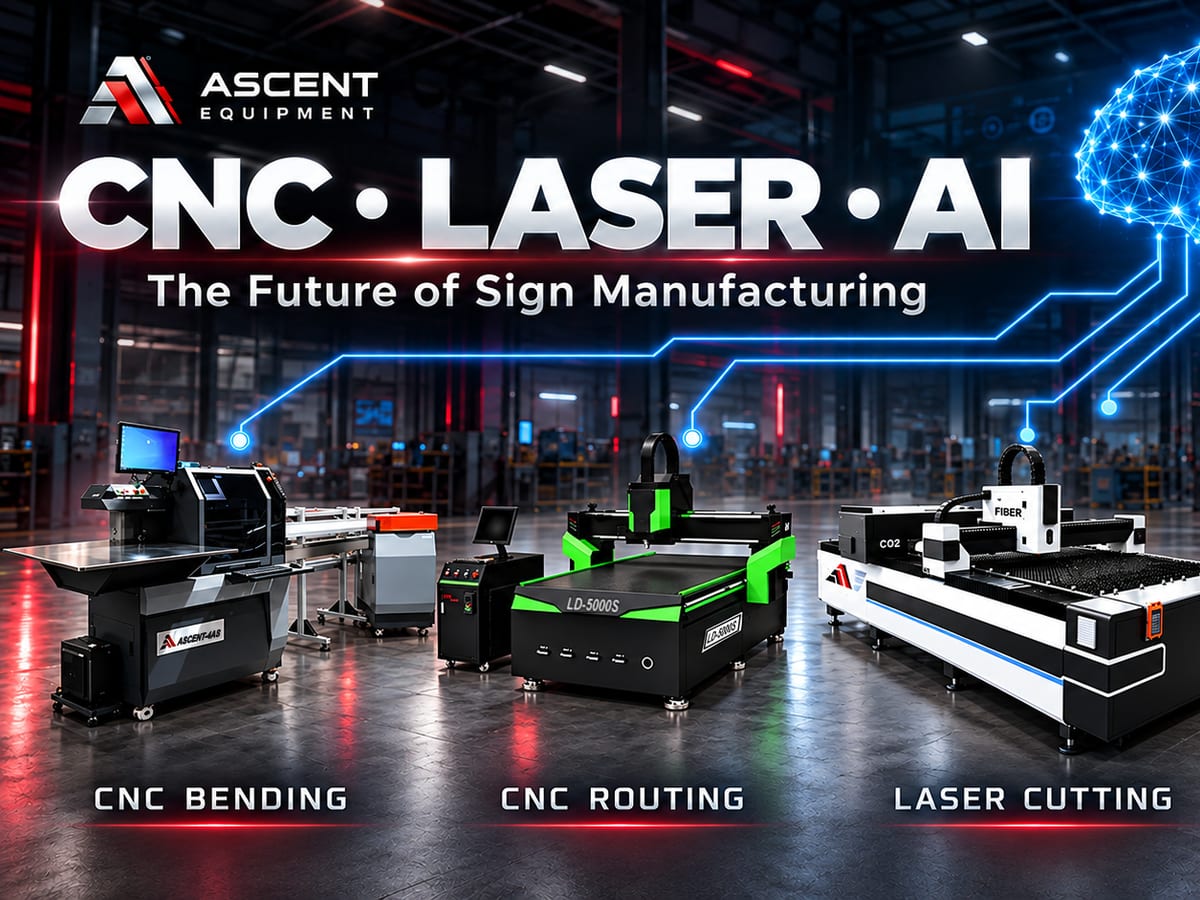
A router holds the sheet down with vacuum, and the sheet has to be in the right place before the vacuum is switched on. Ascent's LD-5000S, for example, has a vacuum table with T-slots and pop-up locating pins, two along one side and three along the other. A loader needs to set each sheet down square against those pins, flat on the table, with its film intact. A sheet that lands crooked can lose its seal and shift under the cutter.
Routers also make chips and dust. Plan where the loader's suction cups, sensors, and cables sit so they stay clean, and keep the path to the table clear of the dust collector's hoses.
Laser cutters
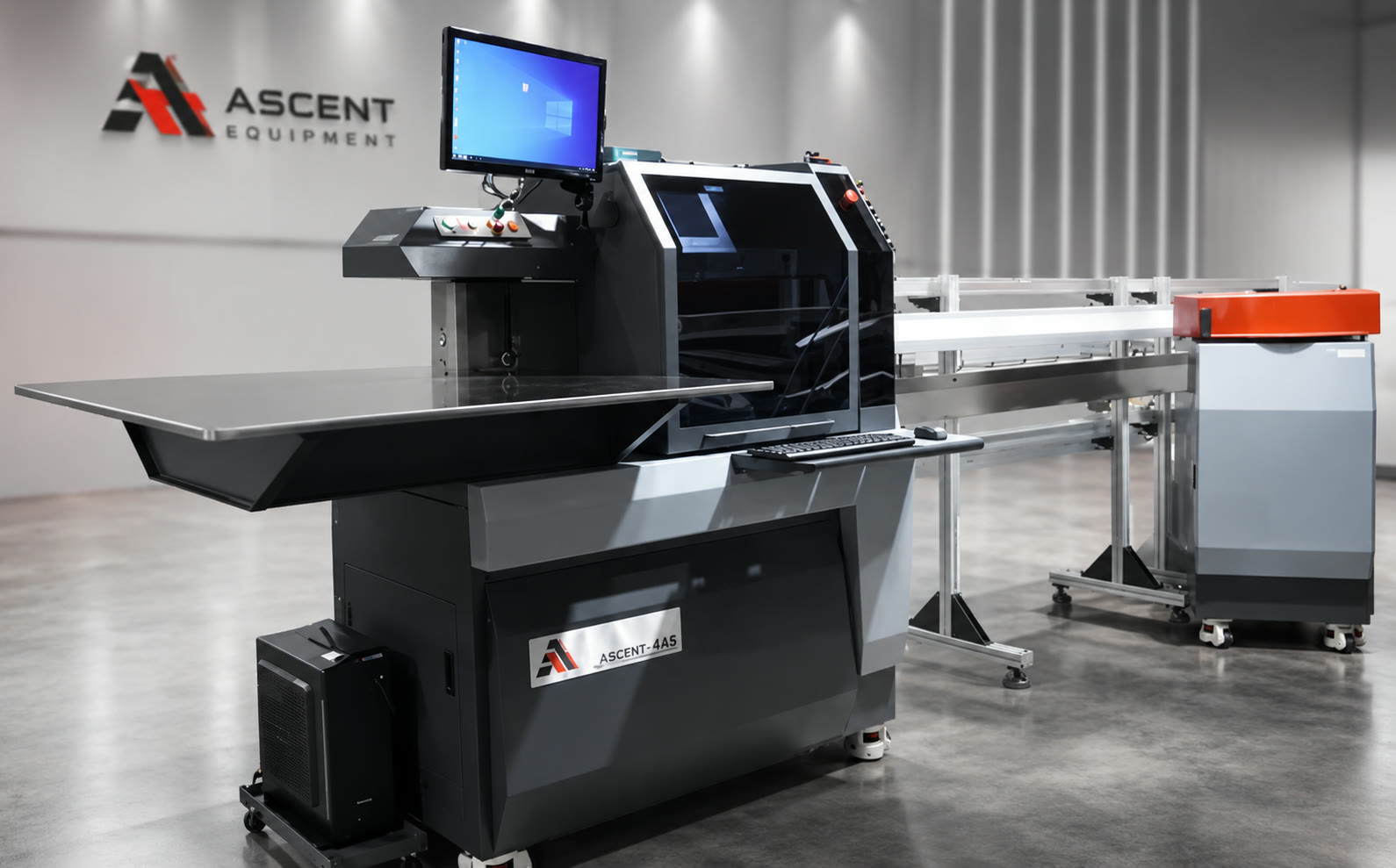
A laser cutter is usually enclosed, so a loader has to work with the covers, doors, and interlocks and not around them. Our fiber laser cutter has an enclosed shuttle table that lets an operator load the next sheet while the machine is cutting. That outside position is the natural handoff point for a loader, but confirm the interface with the machine supplier before you design around it.
On the dual-gantry cutter, the safety covers and interlocks have to stay in the picture as well. Our laser safety guide explains what an installation needs, and any loader you add has to fit inside it. After cutting, parts can tip or fall, so think about how finished parts leave the table before you buy anything.
Seven ways to load, and what they cost
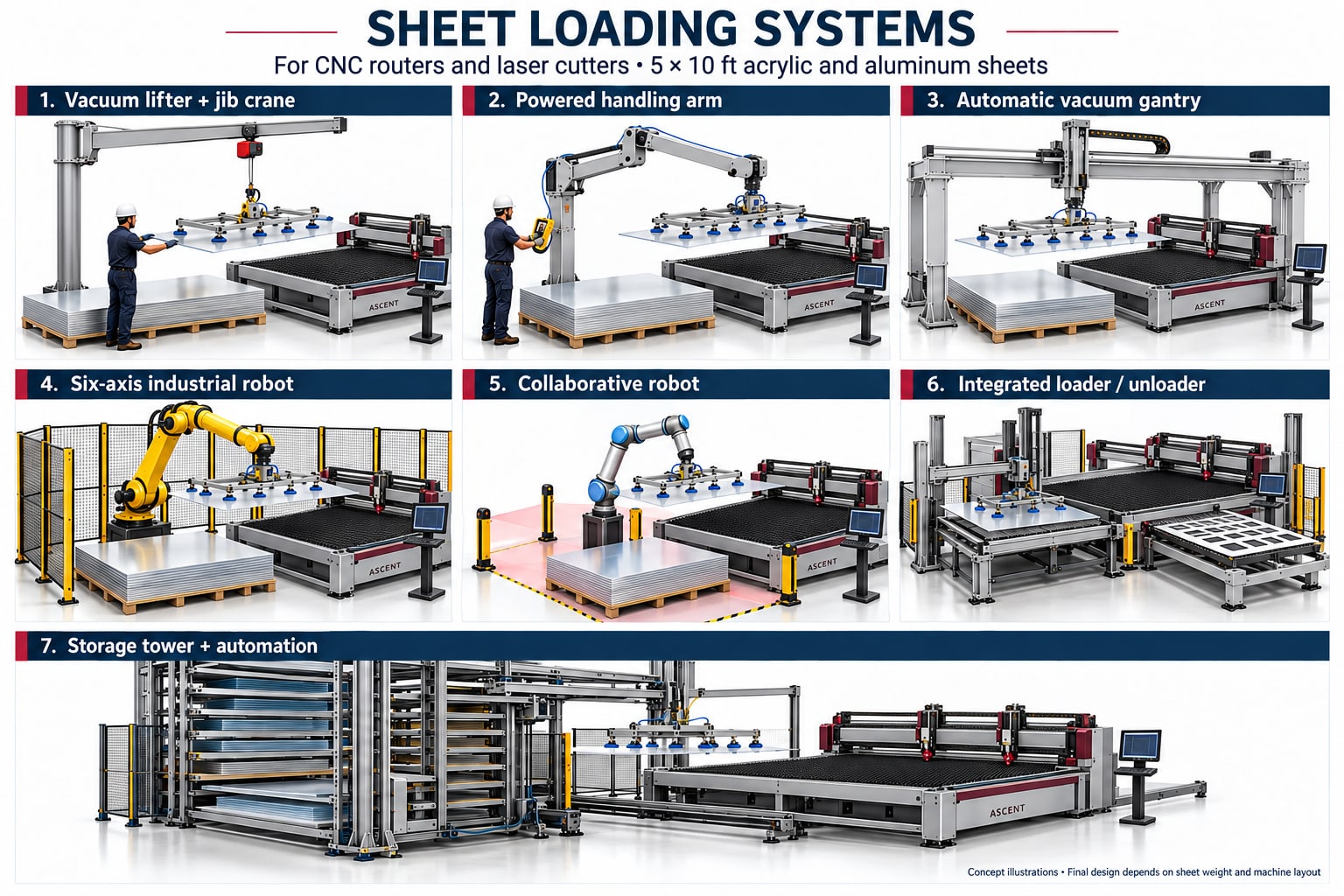
The figures below are preliminary planning estimates in US dollars, not quotes from any supplier. They assume a new system with the right sheet tooling and ordinary installation and commissioning. They leave out the router or laser cutter, taxes, import duties, major building work, and complex sorting of finished parts. A real quote can land outside these ranges.
| System type | Best application | Installed budget (USD) |
|---|---|---|
| Vacuum lifter with jib crane | Lower-volume shops; operator-guided handling | $12,000 to $35,000 |
| Powered articulated handling arm | Frequent loading with operator guidance | $20,000 to $50,000 |
| Automatic vacuum gantry | Repetitive full-sheet loading | $60,000 to $150,000 |
| Six-axis industrial robot cell | Flexible handling or multiple stations | $120,000 to $250,000 |
| Collaborative robot cell | Selected lightweight sheets and suitable layouts | $75,000 to $150,000 |
| Integrated loading and unloading | High-volume production on a compatible machine | $90,000 to $250,000+ |
| Storage tower with automation | Multiple materials and extended runs | $200,000 to $500,000+ |
For a sense of scale, integrators publish rough costs of $75,000 to $150,000 for straightforward cobot cells and $150,000 to $350,000 for mid-complexity industrial robot cells. Those are general robot cells, not full-sheet handling, so a loader for 5 × 10 foot sheets needs its own quote.
1. Vacuum lifter with a jib crane
A vacuum lifter grips the sheet with several suction cups, and a jib crane or an overhead rail carries the weight. The operator guides the sheet from the stack onto the cutting table. For a shop with mixed jobs through the day, this is often the sensible first purchase. It takes the strain out of lifting, and your people can still handle different materials and layouts.
A package like this needs a spreader frame built for the size and flexibility of your sheets.
Best when the goal is easier handling and less lifting, with an operator still doing the loading.
2. Powered articulated handling arm
A powered manipulator carries the sheet on a rigid arm instead of a hanging lifter. The operator steers it, and air or electric power does the lifting.
That gives you good control when a sheet has to be placed carefully, or moved from a vertical rack to a flat table. Check the arm's working envelope against the whole loading path.
Best when loading is frequent, the operator's control is worth having, and full automation isn't needed.
3. Automatic vacuum gantry
A gantry moves a vacuum frame along straight axes: across the stack, up, and onto the machine table. A full sheet mostly needs a simple flat transfer, so this can be a cheaper and simpler answer than a six-axis arm.
A good system senses the stack height, separates the sheets, monitors the vacuum, and uses alignment stops. Some gantry loaders for routers already combine automatic loading, sheet separation, and pop-up alignment pins, with plastics and aluminum plate on their material lists. Confirm that any loader works with your particular machine.
Best when a shop loads full 5 × 10 foot sheets into one machine over and over and wants it automatic.
4. Six-axis industrial robot
An industrial robot moves more freely. It can turn a sheet over, pass it between stations, or serve two machines if the layout allows. A mid-size robot, for example, might have a 70 kg payload and a reach of about 2 meters. Numbers like those show why you must look at both lifting capacity and the loading path. Thick acrylic, heavy aluminum, or a big gripper frame may call for a larger robot.
If one robot serves a router and a laser cutter, it also needs scheduling, because both machines can ask for a sheet at the same time. A linear rail stretches the reach, at extra cost.
Best when the job needs sheet rotation, several stations, or handling tasks beyond simple loading later on.
5. Collaborative robot
A collaborative robot can work for lighter sheets, but it needs careful screening. The largest collaborative arms carry a nominal 30 kg and reach about 1.3 meters. A 1/4-inch acrylic sheet already goes past that rating before you add the gripper.
The whole application decides the safeguarding. Big moving sheets bring sharp edges, pinch points, and collision risks, and the word "collaborative" alone doesn't prove that people can work next to the cell safely. A risk assessment of the finished cell does.
Best when sheets are fairly light and an integrator has checked the payload, reach, gripping, and safety of the real application.
6. Integrated loader and unloader
This system is built around one machine. It brings the next sheet in from one side and takes the cut sheet out on the other, often on a second table. It is the choice for high-volume production, because the machine rarely waits for a person.
The budget runs from $90,000 to $250,000 and up, and it works best on a machine designed to take it. Ask the machine's maker what is supported before you ask for quotes.
7. Storage tower with automation
A storage tower holds many sheets, often in several materials, and a handler delivers the one the next job needs. It suits shops with a lot of material variety or long runs, including unattended work. The cost starts around $200,000 and can pass $500,000, and it takes floor space and power, so the volume has to justify it.
Loading and unloading are separate problems
Picking up a whole sheet is the easy part. After cutting, that sheet may be dozens of loose parts inside a flimsy skeleton, and a loader doesn't automatically get them out.
A router may need a sweep-off system or an unloading conveyor. A metal laser may use forks to unload onto a pallet, followed by sorting by hand or by machine. Some laser equipment makers sell loading and unloading automation built around their own machines.
Test acrylic with its real protective film. The gripper has to hold a flexible sheet without letting it sag, marking the surface, or lifting the film off the material. With aluminum, you need reliable separation of stacked sheets and a way to detect a double pick. Magnetic separation doesn't work on either material.
Planning the loader and the machine together
Ascent can integrate the loading system with its equipment. That matters because the loader and the machine have to agree on several things: where the sheet is set down, how it is held, when the covers or doors open, and how finished parts leave the table. Settling those points before either is bought is easier than fixing them afterward.
Bring your sheet sizes, thicknesses, protective films, and daily volume, and we can talk through which of the options above fits your machine and your shop.
Choosing the right investment
For a sign shop with varied work and moderate sheet volume, an operator-controlled vacuum lifter is often a sensible start. For repetitive full-sheet loading into one machine, an automatic vacuum gantry deserves the first quote. A six-axis industrial robot makes more sense when flexibility, or serving several stations, is worth the extra complexity.
Before you buy, ask for a demonstration with your own 5 × 10 foot sheets, your thicknesses, your protective films, and your machine layout. A quote should state:
- the loading time per sheet,
- the positioning accuracy,
- how it detects a double sheet,
- how it protects against a loss of vacuum,
- the machine interfaces,
- the safeguarding, and
- whether unloading is included.
Work out the return from handling time you have measured. For example, saving four minutes per sheet at 40 sheets a day frees up about 667 labor hours a year over 250 working days. At an assumed loaded labor cost of $35 an hour, that is about $23,000 a year in labor capacity. Extra output is only worth money when demand and the rest of your production can use it, so check the cutting, assembly, and finishing steps behind the machine before you count on it. Our post on how CNC routers increase production output looks at that wider picture.
Planning a new router or laser cutter and thinking about loading? Ascent can integrate the loading system with its equipment. Contact us with your sheet sizes and daily volume. Installation and operator training are included with every Ascent machine, and we're glad to help you plan.
Learn more
- Ascent CNC routers
- Ascent CNC metal fiber laser cutter, 5 × 10 ft
- Ascent dual-gantry CO₂ and fiber laser cutter
- Deciding between a CNC router and a CNC laser cutter
- Ascent laser safety guide
- Automation in the sign industry
The cost figures are budget estimates for planning, not quotes. Product details were checked against the Ascent Equipment site on October 12, 2026. Specifications and configurations can change, so confirm them with us before you order.